Personal Loan vs Credit Card Debt: Which Is Worse for Your Money?
Jaspal Singh
Author
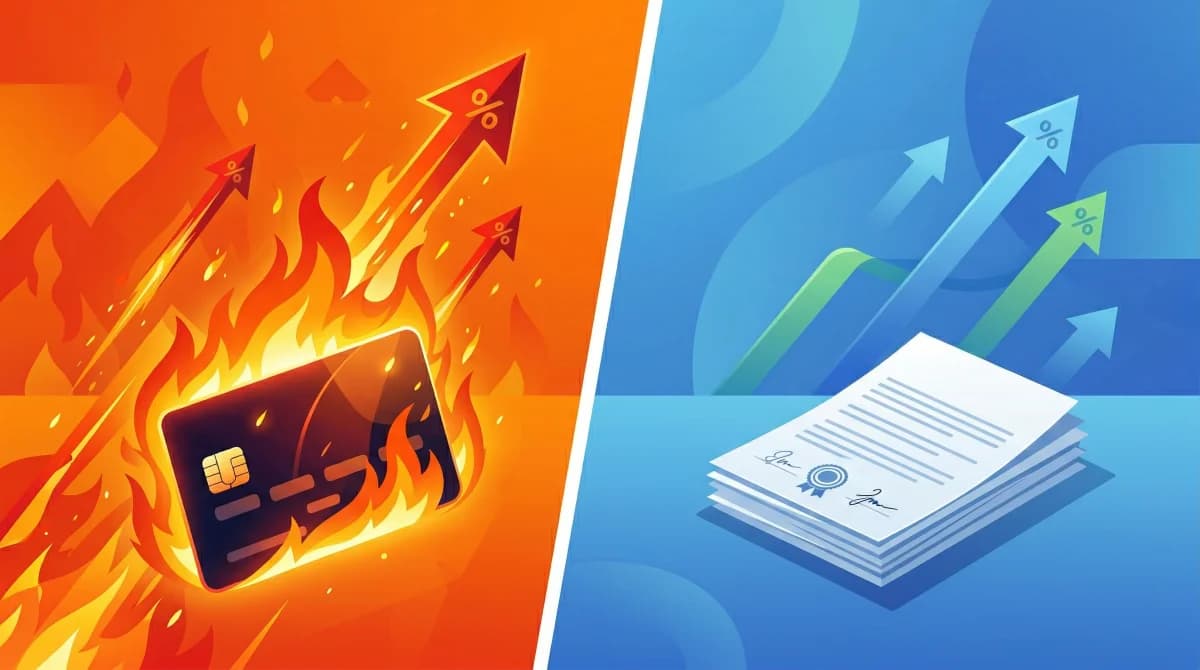
The Interest Rate Gap Is Shocking
Let's start with the most important number — what each type of debt actually costs you:
| Factor | Credit Card Debt | Personal Loan |
|---|---|---|
| Interest Rate | 36-42% per year | 10-18% per year |
| Monthly Cost on ₹1 Lakh | ₹3,000-₹3,500 | ₹833-₹1,500 |
| Repayment Structure | Minimum due (2-5%) | Fixed EMI |
| Tenure | Revolving (endless) | Fixed (1-5 years) |
| End Date | No end date if paying minimum | Clear end date |
| Discipline Required | Very high (self-imposed) | Low (bank enforces) |
If you owe ₹1 lakh on a credit card and only pay the minimum due every month, it will take you over 7 years to pay it off, and you'll pay approximately ₹2.5 lakh in total interest — more than double the original amount.
The same ₹1 lakh as a personal loan at 14% for 3 years costs about ₹23,000 in total interest. That's a ₹2.27 lakh difference.
Why Credit Card Debt Is Almost Always Worse
1. The "Minimum Due" Trap
Credit cards require you to pay only 2-5% of your outstanding balance as "minimum due." This sounds helpful — but it's the most profitable trick in banking. At 36% interest, most of your minimum payment goes toward interest, and the principal barely shrinks.
Example: ₹1 lakh balance, 36% interest, paying 5% minimum (₹5,000 initially):
- Month 1 payment: ₹5,000 (of which ₹3,000 is interest, only ₹2,000 reduces the balance)
- Month 2 balance: ₹98,000 + ₹2,940 interest = still ₹97,940
- After 12 months: You've paid ₹49,000 but still owe ₹72,000+
2. Revolving Credit Is Endless
A personal loan has a fixed end date. You know exactly when you'll be debt-free. Credit card debt has no end date — as long as you keep paying the minimum, the balance keeps revolving. Many people carry credit card debt for 5-10 years without realizing how much they've paid in interest.
3. Compound Interest Works Against You
Credit card interest compounds monthly — meaning you pay interest on interest. At 36% annual, the effective rate after compounding is about 42.6%. Personal loans, in contrast, calculate interest on a reducing balance, which is significantly cheaper.
When a Personal Loan Makes More Sense
To Pay Off Credit Card Debt
If you have ₹50,000+ in credit card debt, taking a personal loan at 12-15% to clear it makes mathematical sense. You'll save 20-25% in annual interest, and you'll have a fixed EMI that forces you to pay it off.
This is essentially what debt consolidation is — and it works, as long as you don't re-accumulate credit card debt.
For Planned Large Expenses
Need ₹3-5 lakh for a wedding, renovation, or medical procedure? A personal loan at 12-14% is far cheaper than putting it on a credit card and paying 36-42% over many months.
When Credit Cards Are Actually Fine
Short-Term Float (Paying Full Bill Each Month)
If you use a credit card and pay the full bill every month before the due date, you pay zero interest. You get 20-45 days of free credit, plus rewards points. This is the only correct way to use a credit card.
No-Cost EMI on Specific Products
Some credit cards offer genuine no-cost EMI on specific purchases (electronics, appliances). If the EMI tenure is 3-6 months and there are no hidden charges, this can work.
The Real Comparison: ₹2 Lakh Debt Over 3 Years
| Metric | Credit Card (Min Due) | Personal Loan (14%) |
|---|---|---|
| Monthly Payment (initial) | ₹10,000 (min 5%) | ₹6,833 (fixed EMI) |
| Time to Pay Off | 7+ years | 3 years (fixed) |
| Total Interest Paid | ₹4.8+ lakh | ₹46,000 |
| Total Paid (principal + interest) | ₹6.8+ lakh | ₹2.46 lakh |
Difference: ₹4.34 lakh. That's not a rounding error. That's a life-changing amount of money wasted on interest.
Action Plan: What to Do Right Now
- Check your credit card statement: Look for the "Total Interest Charged" line. If it's more than ₹1,000/month, you're in expensive debt.
- If balance > ₹50,000: Seriously consider a personal loan to pay it off
- If balance < ₹50,000: Use the avalanche method — throw every extra rupee at the credit card first
- Set up auto-pay for full bill: Going forward, never carry a credit card balance. Pay in full, every month
- Check your CIBIL score: High credit utilization (using > 30% of your credit limit) hurts your score
Use our EMI Calculator to see what a personal loan EMI would look like compared to your current credit card payments.
Disclaimer: This article is for educational purposes only. Interest rates are indicative and vary by card issuer, lender, and credit profile. Taking a personal loan to pay off credit card debt only works if you stop accumulating new credit card debt. Please consult a qualified financial advisor.
Written by
Jaspal Singh
Founder & Editor
Personal finance writer helping Indians make smarter money decisions through clear, jargon-free guides on taxes, investments, and budgeting.
Continue Reading
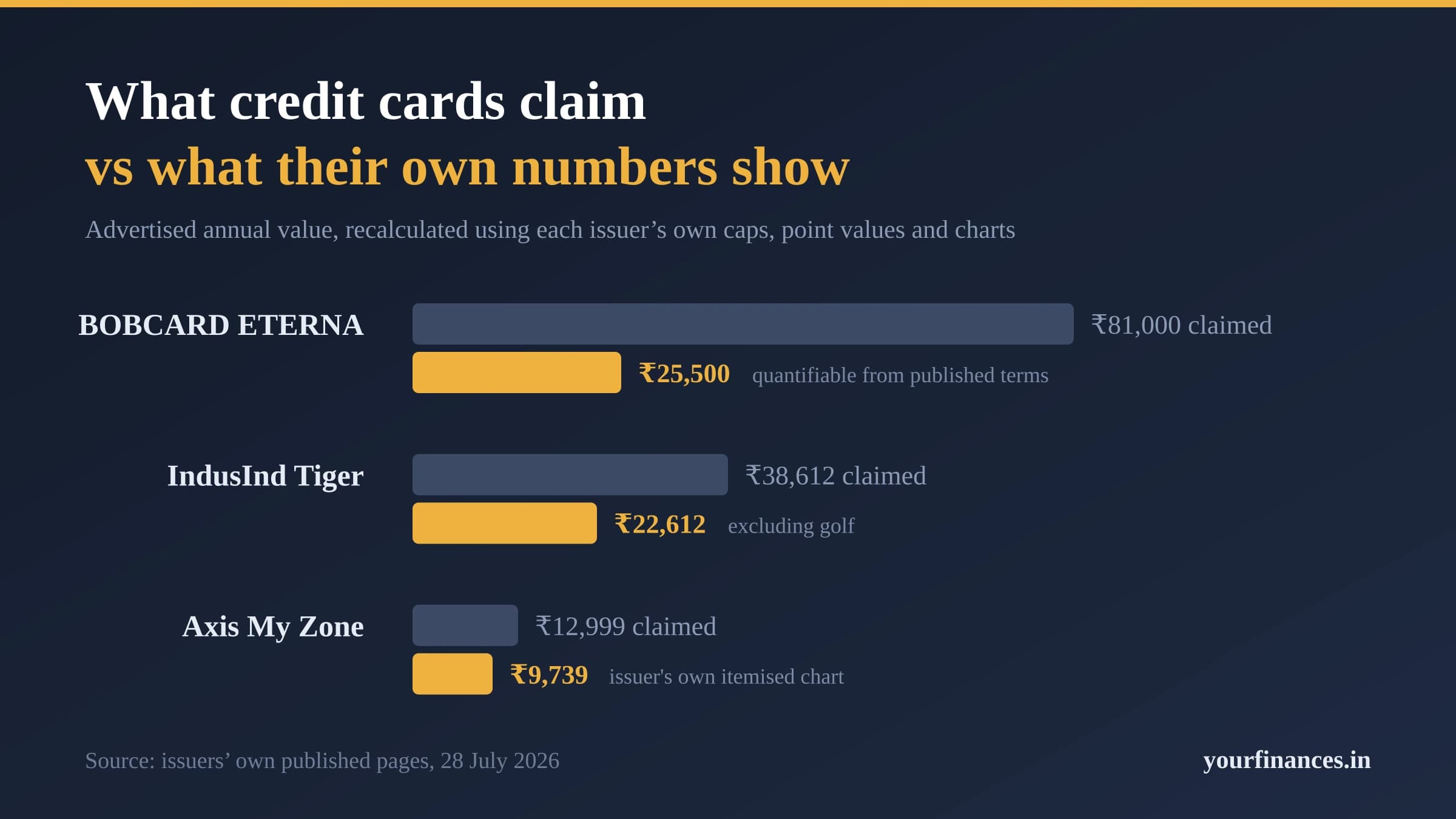
What Indian Credit Cards Claim vs What Their Own Numbers Show
An original study of eight Indian credit cards from seven issuers, using only figures each bank publishes itself. The illustrations consistently sit just inside caps the headlines never mention.
The BNPL Trap: How "Buy Now Pay Later" Is Creating India's Hidden Debt Crisis
60% of BNPL users spend more than they can afford. Late fees can hit 30-40% interest. Here's how Buy Now Pay Later apps are trapping young Indians in invisible debt.
Your EMIs Are About to Get Expensive — Here's Why and What to Do
Oil at $113, inflation rising, RBI rate cuts on hold. If you have a floating-rate home or car loan, your EMI could increase soon. Here's how to prepare.