Understanding Credit Scores in India: How to Check, Improve, and Use Your CIBIL Score
Jaspal Singh
Author
Why Your Credit Score Is Your Financial Reputation
Think of your credit score as your financial report card. Just like your school marks determined which college you got into, your CIBIL score determines whether banks will lend you money — and at what interest rate.
A good score can save you lakhs in interest over your lifetime. A bad score can shut doors to loans, credit cards, and even rental agreements. Yet most Indians have never checked theirs.
What Is a CIBIL Score?
Your CIBIL score is a 3-digit number between 300 and 900, generated by TransUnion CIBIL — India's oldest and most widely used credit bureau. It is based on your credit history — how you have borrowed and repaid money in the past.
| Score Range | Rating | What It Means |
|---|---|---|
| 750 - 900 | Excellent | Best loan rates, instant credit card approvals |
| 700 - 749 | Good | Most loans approved, reasonable rates |
| 650 - 699 | Fair | Loans possible but at higher rates |
| 550 - 649 | Poor | Limited options, very high rates |
| 300 - 549 | Very Poor | Most applications will be rejected |
The magic number is 750. Above this, you get the best interest rates on home loans, car loans, and premium credit cards.
How to Check Your CIBIL Score for Free
You can check your score for free once a year on the official CIBIL website:
- Visit cibil.com and click "Get Your Free CIBIL Score"
- Enter your name, date of birth, PAN card number, and contact details
- Verify via OTP
- Your score and full credit report will be displayed instantly
You can also check via:
- Paisabazaar — free unlimited checks (does not affect your score)
- UMANG app — government app, one free check per year
- Your bank's app — SBI, HDFC, ICICI all show CIBIL scores in their banking apps
Important: Checking your own score (a "soft inquiry") does NOT affect your score. Only loan/credit card applications by lenders ("hard inquiries") can impact it.
What Affects Your CIBIL Score?
Four main factors determine your score:
1. Payment History (35% weightage)
This is the single biggest factor. Even one missed EMI or late credit card payment can drop your score by 50-100 points. Always pay at least the minimum due on your credit card, and never miss an EMI.
2. Credit Utilization (30% weightage)
This is how much of your available credit you are using. If your credit card limit is ₹1 lakh and your balance is ₹80,000, your utilization is 80% — which is terrible for your score.
Rule of thumb: Keep credit utilization below 30%. If your limit is ₹1 lakh, never let your outstanding balance exceed ₹30,000.
3. Credit Age (15% weightage)
How long you have had credit accounts. Longer history = higher score. This is why you should never close your oldest credit card, even if you do not use it much.
4. Credit Mix and Inquiries (20% weightage)
Having a mix of credit types (credit card + car loan + home loan) is better than having only credit cards. And too many loan applications in a short period (hard inquiries) can lower your score.
How to Improve Your Credit Score Fast
Quick wins (1-3 months)
- Pay all bills on time — set up auto-pay for credit cards and EMIs
- Reduce credit card balances — pay down outstanding amounts below 30% of limit
- Do not apply for multiple loans at the same time — each application is a hard inquiry
Medium-term (3-6 months)
- Get added as an authorised user on a family member's old, well-maintained credit card
- Request a credit limit increase — this automatically lowers your utilization ratio
- Dispute errors in your CIBIL report — incorrect late payments or loans you never took
Long-term (6-12 months)
- Take a small secured loan (like a loan against FD) and repay on time — this builds history
- Diversify credit types — if you only have credit cards, a small personal loan repaid on time helps
- Keep old accounts open — length of credit history matters
2026 Update: Banks Now Report Every 15 Days
Starting 2026, banks update credit bureau data every 15 days (previously monthly). From July 2026, this becomes weekly. This means:
- Your score updates faster after positive changes
- But mistakes (missed payments) also show up faster
- It is more important than ever to maintain consistent payment discipline
When Does Your Credit Score Matter?
- Home loan: 750+ gets you the best rates (7.45% vs 9%+ for lower scores). On a ₹50 lakh loan, this difference is ₹10-15 lakh over 20 years. See our Home Loan Guide.
- Credit cards: Premium cards with best rewards require 750+
- Car/personal loans: Higher score = lower rates and faster approval
- Rental agreements: Some landlords in metros now check tenant credit scores
- Job applications: Some financial services companies check scores during hiring
Related Reading
- Home Loans in India: Complete Guide — how your score affects your home loan rate
- Credit Cards: How to Use Them Responsibly — build your score with smart card usage
- EMI Calculator — plan your loan EMIs
Disclaimer: Credit score information is based on publicly available CIBIL guidelines as of March 2026. Your actual score depends on your individual credit history. This article is for educational purposes only.
Written by
Jaspal Singh
Founder & Editor
Personal finance writer helping Indians make smarter money decisions through clear, jargon-free guides on taxes, investments, and budgeting.
Continue Reading
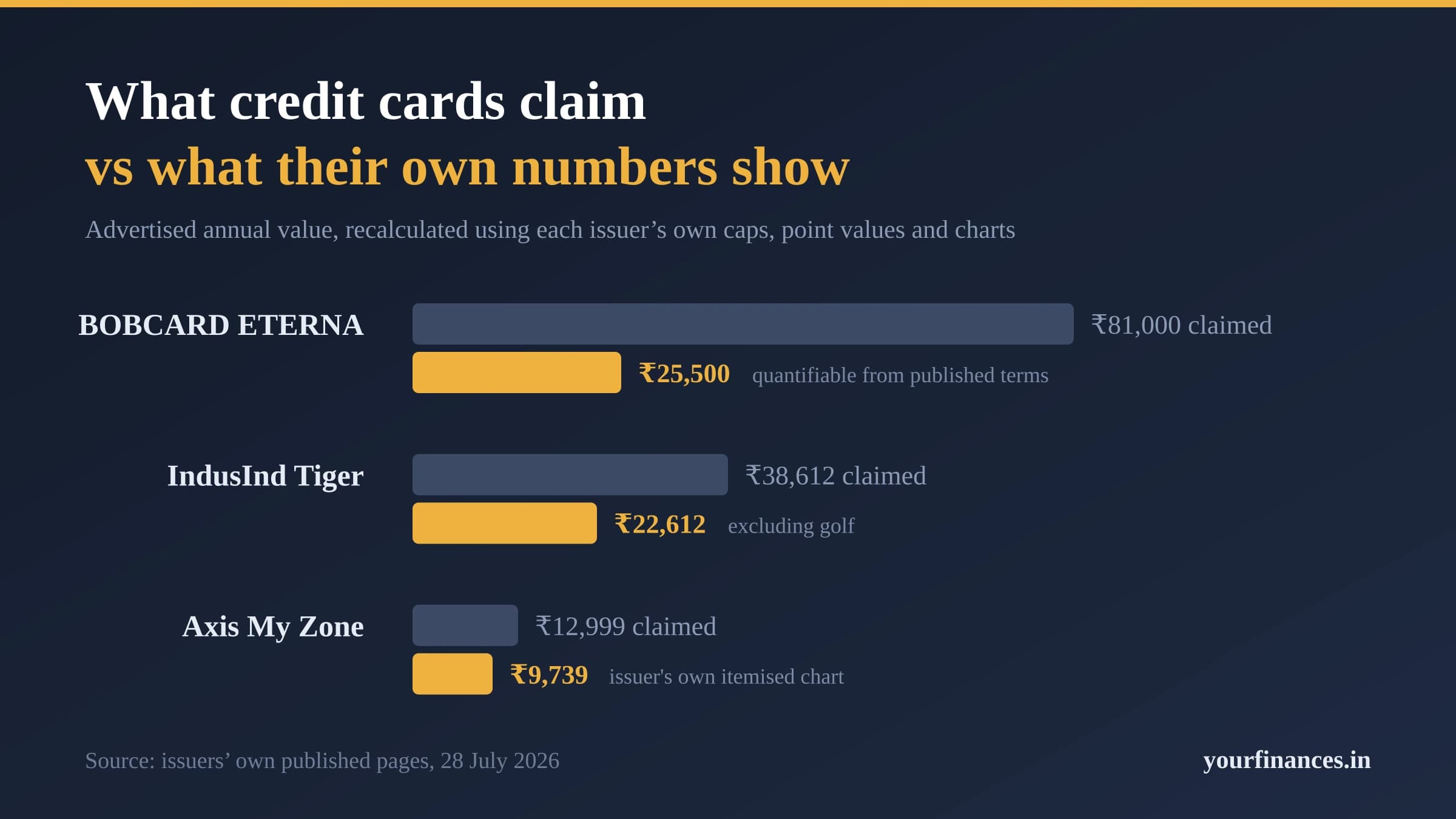
What Indian Credit Cards Claim vs What Their Own Numbers Show
An original study of eight Indian credit cards from seven issuers, using only figures each bank publishes itself. The illustrations consistently sit just inside caps the headlines never mention.
Personal Loan vs Credit Card Debt: Which Is Worse for Your Money?
Credit cards charge 36-42% interest. Personal loans charge 10-18%. The math is clear — but the real story is more nuanced. Here's the complete comparison.
The BNPL Trap: How "Buy Now Pay Later" Is Creating India's Hidden Debt Crisis
60% of BNPL users spend more than they can afford. Late fees can hit 30-40% interest. Here's how Buy Now Pay Later apps are trapping young Indians in invisible debt.