Stock Market Crash Explained: What to Do When Sensex Falls Sharply
Jaspal Singh
Author
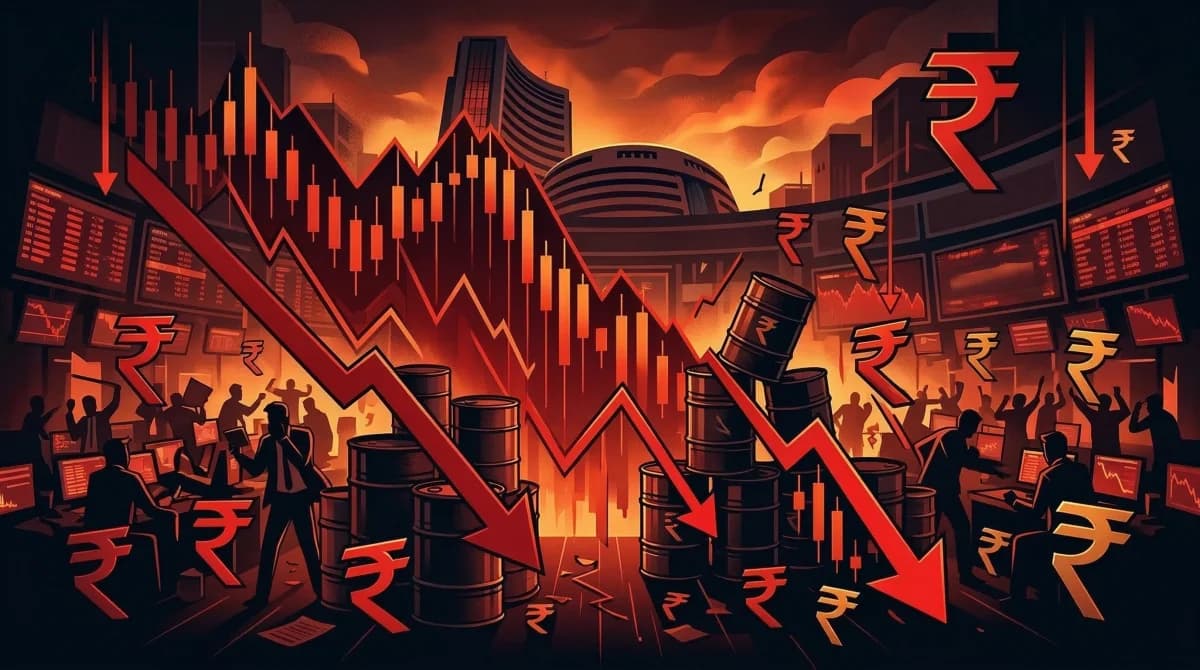
Sharp Sensex falls happen once every few years — and panic-selling at the bottom is the most expensive mistake retail investors make. The good news: crashes follow a recognizable pattern. The same four forces — geopolitical shocks, oil prices, FII selling, and rupee pressure — show up almost every time. If you understand the pattern, you can avoid panic and even buy aggressively when others are selling.
This article explains what causes a sharp stock market crash, which sectors get hit hardest, and exactly what to do with your portfolio. We use the March 2026 "Black Monday" crash — when the Sensex lost 4,300+ points and ₹14 lakh crore of investor wealth in days — as a real case study.
Update (March 24, 2026): After Monday's bloodbath (Sensex -1,837 pts, ₹14 lakh crore wiped), markets staged a massive relief rally on Tuesday — Sensex surged 1,500+ points at the open after Trump announced a 5-day pause on Iran strikes. Oil crashed 11% to $100. But with Iran denying any talks and the pause expiring March 28, this could be a dead-cat bounce. Full ceasefire rally analysis here. Stay cautious — VIX is still at 27+, and FIIs are still selling.
Last updated: 4 May 2026
What Just Happened to the Stock Market?
If you opened your investment app this month and felt your stomach drop — you're not alone. The Indian stock market is having its worst month since the COVID crash of March 2020.
Between March 5 and March 13, 2026, the Sensex plunged 4,355 points (down 5.5%) and the Nifty50 crashed 1,299 points (down 5.3%). On Friday alone, the Sensex fell 1,460 points and the Nifty dropped 488 points to close at 23,151.
In simple terms? Investors lost about ₹9.5 lakh crore in market value — just on Friday. That's roughly the GDP of a small country, wiped out in a single trading session.
Case Study: The 2026 Black Monday — ₹14 Lakh Crore Wiped Out
Just when investors thought the March 5-13 crash was bad, Monday (March 23) delivered an even bigger blow:
- Sensex: Down 1,951 points (2.62%) to 72,581
- Nifty 50: Down 592 points (2.56%) to 22,522
- Wealth destroyed: ₹14.19 lakh crore — BSE market cap fell from ₹429 lakh crore to ₹414.81 lakh crore
- Mid-caps and small-caps: Fell over 3% each — worse than large-caps
- India VIX: Surged 19% — indicating extreme fear in the market
- HDFC Bank: Dropped 4%, extending a two-session fall after chairman Atanu Chakraborty's abrupt resignation over ethical concerns
What Triggered Today's Crash?
Three things hit simultaneously:
- Trump's Iran ultimatum: The US President issued a direct ultimatum over the Strait of Hormuz, dramatically escalating the conflict. Asian markets crashed first — Japan's Nikkei and South Korea's KOSPI both fell 5%+.
- FPI exodus: Foreign investors have now sold ₹90,000 crore in March alone, making this the heaviest monthly foreign outflow since October 2024. Read our full FPI analysis here.
- Rupee at record low: The rupee crashed to ₹93.89 per dollar, making India even less attractive for foreign investors. Full rupee impact analysis.
The Perfect Storm: Why Markets Keep Falling
There's no single villain here. It was a perfect storm of bad news hitting all at once.
1. The Iran-US War and Oil Crisis
The biggest trigger was the ongoing US-Iran conflict, which has effectively shut down the Strait of Hormuz — a narrow waterway through which 20% of the world's oil passes.
With this critical supply route blocked, crude oil has surged to $113 per barrel (and touched $119.5 intraday on March 13) — up nearly 20% since the conflict began on February 27. This oil shock is already hitting consumers directly through fuel surcharges on flights.
Why does this matter for India? Because India imports over 85% of its crude oil. When oil prices go up, everything from petrol to cooking gas to manufacturing costs goes up. This squeezes company profits and makes investors nervous.
2. Foreign Investors Are Pulling Out
Foreign Institutional Investors (FIIs) have been selling Indian stocks aggressively. In March alone, they've pulled out billions of dollars from Indian equities, with net daily selling crossing ₹3,000-5,000 crore on multiple sessions.
Why? A stronger US dollar, rising US Treasury yields, and geopolitical uncertainty are making foreign investors move their money to "safer" assets like US bonds and gold, which even the RBI is stockpiling at record levels.
3. Inflation Is Creeping Up
India's retail inflation rose to 3.21% in February 2026, up from 2.74% in January. Food prices jumped significantly, with the Consumer Food Price Index climbing to 3.47%.
Rising inflation means the RBI might pause or slow down its rate-cutting cycle, which is bad news for both the stock market and the economy.
4. Rupee Under Pressure
With oil prices surging and foreign money leaving, the Indian rupee has been under significant pressure. A weaker rupee makes imports more expensive, further feeding inflation.
Which Sectors Were Hit the Hardest?
Not all sectors suffered equally. Here's how the damage was spread:
- Auto stocks: Down 10.6% for the week — the worst performer. Higher oil means higher fuel costs, fewer car buyers, and expensive raw materials.
- Bank stocks: Bank Nifty crashed 7%. Rising NPAs and economic uncertainty spooked investors.
- Metal stocks: Supply chain disruptions from the Middle East conflict hit hard.
- Energy stocks: Mixed bag — oil marketing companies suffered, but upstream oil producers gained.
What Should You Do Now?
Here's the most important part. If you're an investor, don't panic. Here's what financial experts recommend:
Continue Your SIPs
If you have a Systematic Investment Plan (SIP), keep it running. Market crashes are actually good for SIP investors because you buy more units at lower prices. This is called rupee cost averaging — and it works beautifully over the long term.
Use our SIP Calculator to see how your investments grow even during volatile markets.
Don't Sell in Panic
History shows that markets always recover from crashes. After the 2008 Lehman Brothers crisis, Indian markets took about 2 years to recover — but investors who stayed invested saw massive gains in the following decade.
Review Your Portfolio
If your portfolio is heavily tilted toward one sector (like auto or banking), this might be a good time to diversify. Consider adding some fixed-income instruments like Fixed Deposits (check the best FD rates available right now) or PPF for stability.
Consider Buying Quality Stocks
Warren Buffett famously said, "Be greedy when others are fearful." If you have spare cash and a long-term horizon (5+ years), this dip could be a buying opportunity — but only in fundamentally strong companies.
When Will the Market Recover?
Nobody can predict this with certainty. But here's what to watch:
- Oil prices: If the Iran situation de-escalates and oil comes below $100/barrel, markets could bounce back quickly. But with Brent at $113 and the Strait of Hormuz in play, this looks unlikely in the near term.
- FII flows: If foreign investors start buying again, that's a strong bullish signal.
- RBI policy: The next RBI monetary policy meeting in April will be crucial. A rate cut could boost market sentiment.
- Domestic consumption: India's domestic economy remains strong. If consumer spending holds up, corporate earnings will follow.
The Bottom Line
Market crashes are scary, but they're also a normal part of investing. The Sensex has crashed many times before — during the 2008 financial crisis, the 2020 COVID crash, and the 2022 Russia-Ukraine conflict. Each time, it came back stronger.
The key is to stay invested, stay diversified, and stay calm. If you don't need your money in the next 3-5 years, this crash is just a bump in the road.
Use our Lumpsum Calculator to see how a one-time investment today could grow over the next decade.
Frequently Asked Questions
What causes a sharp stock market crash?
Most sharp crashes have a combination of triggers: (1) a geopolitical shock (war, pandemic, banking crisis), (2) a sudden spike in oil prices that hurts emerging markets, (3) heavy FII selling triggered by a stronger US dollar or higher US rates, and (4) rupee depreciation that hurts foreign-flow appetite. When 3 or 4 forces hit together, you get a Black Monday-style move.
Should I sell my mutual funds during a market crash?
No. Selling during a crash converts paper losses into real losses. Historically, every Indian market crash has been followed by a strong recovery within 12-24 months — the 2008 financial crisis, 2013 taper tantrum, 2020 COVID crash, 2026 Iran-conflict crash. Investors who held through the falls (and kept their SIPs going) consistently outperformed those who tried to time the bottom.
What stocks should I buy during a market crash?
Focus on quality: consumer staples, large private banks, IT services, pharma. Avoid PSU banks, real estate, and small-caps until the dust settles. The best buys are companies with strong balance sheets, moats, and historical track records of recovery — names like HDFC Bank, ITC, TCS, Asian Paints, or Hindustan Unilever. Use staggered SIPs in mutual funds rather than lump-sum stock buying.
How long does it take for the market to recover from a crash?
Indian markets typically recover from sharp falls within 6-18 months. The 2008 crash recovered in 18 months; the 2020 COVID crash recovered in just 8 months. Recovery speed depends on whether the underlying trigger fades. Geopolitical crashes (war, oil shocks) tend to recover faster than valuation-driven crashes.
Should I stop my SIP during a market crash?
Absolutely not — this is when SIPs do their best work. When markets fall, your SIP buys more units at lower prices, dramatically lowering your average cost. Investors who continued SIPs through 2008-2009 and 2020 saw the highest long-term returns. Stopping a SIP during a crash is mathematically the worst possible decision.
Disclaimer: This article is for educational purposes only and does not constitute financial advice. Please consult a qualified financial advisor before making investment decisions.
Written by
Jaspal Singh
Founder & Editor
Personal finance writer helping Indians make smarter money decisions through clear, jargon-free guides on taxes, investments, and budgeting.
Continue Reading

Gold, Silver Import Duty Raised to 15%: What It Means for Prices, Rupee, and India's Trade Balance
India has raised import duty on gold and silver to 15% from 6%. Here is what the move means for bullion demand, trade deficit, forex reserves, and everyday buyers.
Your Take-Home Salary Just Got Cut — Here’s Why
From April 2026, your basic pay must be at least 50% of your CTC. That means lower take-home pay but significantly higher EPF and gratuity. Here’s what changed and what it means for your wallet.

Silver Loans Are Now Legal in India — Here’s How to Get One
From April 1, the RBI allows banks and NBFCs to give loans against your silver jewelry and coins. Up to 85% LTV, 10kg silver limit, and strict borrower protections. Here’s everything you need to know.