Loan Against Property: When It Makes Sense and When It Doesn't
Jaspal Singh
Author
What Is a Loan Against Property?
A Loan Against Property (LAP) is exactly what it sounds like — you pledge your residential or commercial property as collateral, and the bank gives you a loan against it. You continue to live in or use the property, but the bank has a legal charge on it until you repay.
The big advantage? Because the bank has security (your property), they offer much lower interest rates than an unsecured personal loan:
| Loan Type | Typical Interest Rate | Max Tenure |
|---|---|---|
| Personal Loan | 10-24% | 5 years |
| Loan Against Property | 8.45-12% | 15-20 years |
| Home Loan | 8.25-9.5% | 30 years |
| Gold Loan | 9-17% | 1-3 years |
How Much Can You Get?
Banks typically lend 50-75% of your property's market value (called the Loan-to-Value or LTV ratio). So if your property is worth ₹1 crore, you can get ₹50-75 lakh.
The actual amount depends on:
- Property type: Residential gets higher LTV than commercial
- Property location: Metro properties are valued higher
- Your income: EMI must fit within 50% of your monthly income
- CIBIL score: 700+ for approval, 750+ for best rates
When a Loan Against Property Makes Sense
1. Business Expansion
If you're a business owner who needs ₹20-50 lakh for expansion, inventory, or working capital, a LAP at 9% is far cheaper than a business loan at 14-18% or a personal loan at 12-20%. The longer tenure also means lower EMIs that won't strain your business cash flow.
2. Funding Higher Education Abroad
Foreign university fees can run ₹30-80 lakh. A LAP typically offers better rates and higher amounts than education loans, especially for postgraduate programs where education loan limits may not cover the full cost.
3. Medical Emergency
A serious medical situation requiring ₹10-30 lakh? A LAP is one of the cheapest ways to raise large amounts quickly. Most banks can process a LAP in 7-10 working days.
4. Debt Consolidation
If you have ₹15-20 lakh spread across credit cards (36%) and personal loans (14-18%), consolidating into a single LAP at 9% can cut your interest cost by more than half.
When a Loan Against Property Is Risky
1. For Lifestyle Spending
Taking a LAP for a vacation, wedding, or luxury purchase is dangerous. You're putting your home at risk for a depreciating or one-time expense. If you can't repay, the bank can seize your property.
2. If Your Income Is Unstable
LAP tenures are long (10-15 years). If your income is project-based, seasonal, or uncertain, a long-term secured loan is risky. Missing EMIs on a LAP has far more serious consequences than missing a credit card payment.
3. If You're Already Over-Leveraged
If your existing EMIs already consume 40%+ of your income, adding a LAP EMI could push you into financial distress. The rule: total EMIs should never exceed 50% of take-home pay.
LAP Interest Rates
Indicative rates last reviewed in July 2026. Lending rates are floating and revise often — always confirm the current rate directly with the lender before applying.
| Lender | Rate (Salaried) | Rate (Self-Employed) |
|---|---|---|
| Bajaj Housing Finance | 8.45% | 9.00% |
| SBI | 9.00% | 9.50% |
| HDFC Bank | 9.25% | 9.75% |
| Tata Capital | 9.00% | 9.50% |
| ICICI Bank | 9.25% | 10.00% |
LAP vs Personal Loan: Which Should You Choose?
| Factor | LAP | Personal Loan |
|---|---|---|
| Interest Rate | 8.45-12% | 10-24% |
| Loan Amount | Up to ₹5-10 crore | Up to ₹40 lakh |
| Tenure | Up to 15-20 years | Up to 5 years |
| Collateral | Yes (property) | No |
| Risk if default | Property seizure | Credit score damage, legal action |
| Processing time | 7-15 days | 1-3 days |
| Best for | Large amounts, long tenure | Small amounts, quick disbursement |
Use our EMI Calculator to compare monthly payments for both options side by side.
LAP Loan Amount, LTV and Real Costs
The advertised rate is only half the story. What decides how much money you actually get is the Loan-to-Value (LTV) ratio — the share of your property's assessed value the lender will fund. Unlike home loans, the RBI does not prescribe a standard LTV cap for LAP, so each lender sets its own, and most land between 50% and 70%.
| Lender | LTV Offered | Loan Amount | Max Tenure | Processing Fee |
|---|---|---|---|---|
| SBI (official) | 65% up to ₹1 crore; 60% for ₹1–7.5 crore | ₹10 lakh – ₹7.5 crore | 15 years | 1%, capped at ₹50,000 + GST |
| ICICI Bank | Typically 60–70% | Up to ₹8 crore | 15 years (official) | Around 1% + GST |
| HDFC | Typically 50–65% | Up to ₹10 crore | 15 years | Around 1% + GST |
| Bajaj Finserv (NBFC) | Up to 70% (advertised) | Up to ₹10 crore+ | Up to 20 years | Up to 2% + GST |
| LIC Housing Finance | Typically 50–65% | ₹2 lakh – ₹15 crore | 15 years | Around 1% + GST |
SBI and ICICI figures are from the lenders' own product pages (linked at the end). Other entries are typical advertised ranges — confirm the exact LTV, fee and tenure in your sanction letter.
Two costs people forget: the legal and technical valuation fee (₹3,000–₹10,000, often non-refundable even if the loan is rejected) and stamp duty on the mortgage deed, which varies by state. On a ₹50 lakh LAP, budget ₹60,000–₹1.2 lakh in upfront costs before a single rupee reaches your account.
LAP vs Gold Loan vs Top-Up Home Loan vs Personal Loan
| Option | Typical Rate | How Much You Get | Tenure | What You Risk |
|---|---|---|---|---|
| Loan Against Property | 9–12% | 50–70% of property value | 10–20 years | Your house or shop |
| Top-up on existing home loan | Close to home loan rate | Limited by existing LTV headroom | Balance of home loan tenure | The same mortgaged house |
| Gold loan | 9–17% | Up to 75% of gold value (RBI cap) | 1–3 years | Your jewellery |
| Personal loan | 10–24% | Up to ₹40 lakh | 1–5 years | Credit score, legal recovery |
The rule of thumb: if you already have a running home loan and need under ₹25 lakh, a top-up on that home loan is almost always cheaper and faster — the property is already mortgaged, the valuation is on file, and there is no second set of legal charges. For under ₹10 lakh over two or three years, a gold loan against jewellery you are not using beats mortgaging a ₹1 crore asset; our gold investment guide explains how lenders value it. And for small, short-tenure needs, a plain personal loan can cost less overall once LAP's processing, valuation and stamp duty are added.
Eligibility: Salaried vs Self-Employed, and Which Properties Qualify
LAP underwriting judges two things independently — the property and your cash flow. A ₹2 crore property does not help if your income cannot service the EMI.
- Age: broadly 21–65 at maturity. SBI requires the loan to be closed before the eldest borrower turns 70.
- Income floor: SBI sets a minimum net monthly income of ₹25,000 (₹3 lakh a year); private lenders often start higher in metros.
- Salaried: three months' salary slips, six months' bank statements, Form 16, two years of employment continuity. Approval is faster.
- Self-employed: two to three years of ITRs with computation, audited financials, GST returns and business continuity proof. Expect roughly 0.25–0.75% higher pricing than a salaried borrower with the same score.
- FOIR: all EMIs including the new one generally cannot exceed 50–60% of net monthly income.
- Credit score: 700+ to qualify, 750+ for the headline rate.
ICICI Bank states it funds residential, commercial or industrial property with a clear and marketable title. Residential fetches the highest LTV, commercial less, industrial or bare land the least. Properties usually rejected outright: agricultural land, disputed or ancestral titles with unlisted heirs, unapproved construction or plan violations, buildings over 30–35 years old with poor residual life, gram panchayat or unauthorised-colony properties, and anything already mortgaged without an NOC.
The Real Risk: What Happens If You Default
This is the part LAP marketing skips, and it deserves plain language. Signing a LAP creates a legally enforceable mortgage. If the account slips into default and is classified a Non-Performing Asset — generally after 90 days of missed payments — the lender can enforce that security under the SARFAESI Act, 2002, without going to court first.
- Section 13(2) notice: a formal demand giving you 60 days to clear the entire outstanding amount — not just the missed EMIs.
- Section 13(3A): you may file a representation, and the lender must respond with reasons if it rejects it.
- Section 13(4): if dues remain, the lender can take possession and auction the property.
- Appeal: you may apply to the Debt Recovery Tribunal within 45 days of that action, under Section 17.
Auction recoveries are frequently below fair market value, and any shortfall after the sale is still legally yours to pay. Before signing, stress-test the EMI in our EMI calculator at 2% above your quoted rate — floating rates move — and check it still sits inside the "needs" bucket of your 50-30-20 budget. If it only fits when everything goes right, it does not fit.
Tax Treatment: When LAP Interest Is Deductible
There is no blanket tax benefit on a Loan Against Property, and the principal never qualifies under Section 80C. Whether interest is deductible depends entirely on documented end-use:
- Used for business: generally allowable as business expenditure — Section 36(1)(iii) for interest on capital borrowed for business, or Section 37(1) — if you can prove the funds went into the business.
- Used to buy or construct another house: claimable under Section 24(b) — up to ₹2 lakh a year for a self-occupied property under the old regime, or against rental income if let out.
- Used for repair, renewal or reconstruction of house property: the Section 24(b) deduction is capped at ₹30,000 a year.
- Used for a wedding, holiday or car: no deduction at all.
- New regime (Section 115BAC): the Section 24(b) interest deduction is not available for self-occupied property, and house-property losses cannot be set off against salary — so many borrowers on the default regime get no personal-use benefit whatsoever.
Keep a clean paper trail — sanction letter, disbursement credit, and outward payments showing where the money went. Interest is routinely disallowed where end-use cannot be traced. Confirm your position with a chartered accountant before filing.
Documents and Timeline
Keep ready: KYC (PAN, Aadhaar, address proof); income proof (salary slips and Form 16, or ITRs and financials); six months of bank statements; and the full property file — title deed, ownership chain, approved building plan, latest property tax receipts, occupancy certificate and encumbrance certificate.
A realistic timeline is 10 to 21 working days: 1–2 days for login, 3–5 for legal and technical valuation, 3–5 for credit appraisal and sanction, and 3–7 for mortgage creation and disbursement. Anyone promising a large LAP in 48 hours is quoting a top-up, or has not started the legal check.
New RBI Rule: No Prepayment Penalty on Floating-Rate Loans
Under the RBI (Pre-payment Charges on Loans) Directions, 2025, applicable to loans sanctioned or renewed on or after 1 January 2026, banks and large NBFCs cannot levy pre-payment charges on floating-rate loans taken by individuals for non-business purposes. The protection also extends to business-purpose loans to individuals and micro and small enterprises from commercial banks — irrespective of the source of the prepayment funds and with no minimum lock-in. Smaller lenders retain an exemption above a ₹50 lakh sanctioned amount.
In practice, a floating-rate LAP taken in 2026 can be closed early — from a bonus, a business windfall or a balance transfer — without a 2–4% penalty. Fixed-rate LAPs are not covered, so if you expect to prepay, floating is now worth real money. Read the pre-payment clause before signing.
Frequently Asked Questions
Can I sell my property while a loan against property is running?
Not without the lender's consent. The original title documents stay with the lender and a mortgage charge is registered against the property. You can sell only by repaying the outstanding loan and obtaining a No Objection Certificate and release of charge — usually done by routing part of the sale proceeds directly to the lender at registration.
Is a loan against property cheaper than a top-up on my home loan?
Usually not. A top-up rides on an existing mortgage, so it avoids fresh valuation, legal vetting and mortgage stamp duty, and is often priced close to your home loan rate. A fresh LAP makes sense mainly when you need more than the top-up headroom allows, or want to pledge a different property.
Can I get a loan against a jointly owned property?
Yes, but every co-owner must join as a co-applicant or guarantor and sign the mortgage documents. Lenders will not create a charge on a fraction of a property, so a co-owner who refuses to sign effectively blocks the loan.
Do I need to tell the bank what I will use the money for?
Yes. LAP is an end-use-declared loan. Lenders explicitly bar speculative purposes such as trading in shares, and may ask for utilisation proof — especially if you later claim the interest as a business deduction. Misdeclaring end-use can trigger recall of the entire loan.
What happens to the loan if the borrower dies?
The liability passes to co-applicants and legal heirs along with the property, and the mortgage survives. If dues are not serviced, the lender can still enforce the security. That is why term cover at least equal to the outstanding loan is sensible protection for your family.
Sources
- SBI — Loans Against Property (LTV, tenure, processing fee, eligibility)
- ICICI Bank — Loan Against Property FAQs
- Reserve Bank of India — Pre-payment Charges on Loans Directions, 2025
- India Code — SARFAESI Act, 2002 (Section 13)
Disclaimer: This article is for educational purposes only. A Loan Against Property involves pledging your property as security — the lender can seize the property if you default. Please assess your repayment capacity carefully and consult a financial advisor.
Written by
Jaspal Singh
Founder & Editor
Personal finance writer helping Indians make smarter money decisions through clear, jargon-free guides on taxes, investments, and budgeting.
Continue Reading
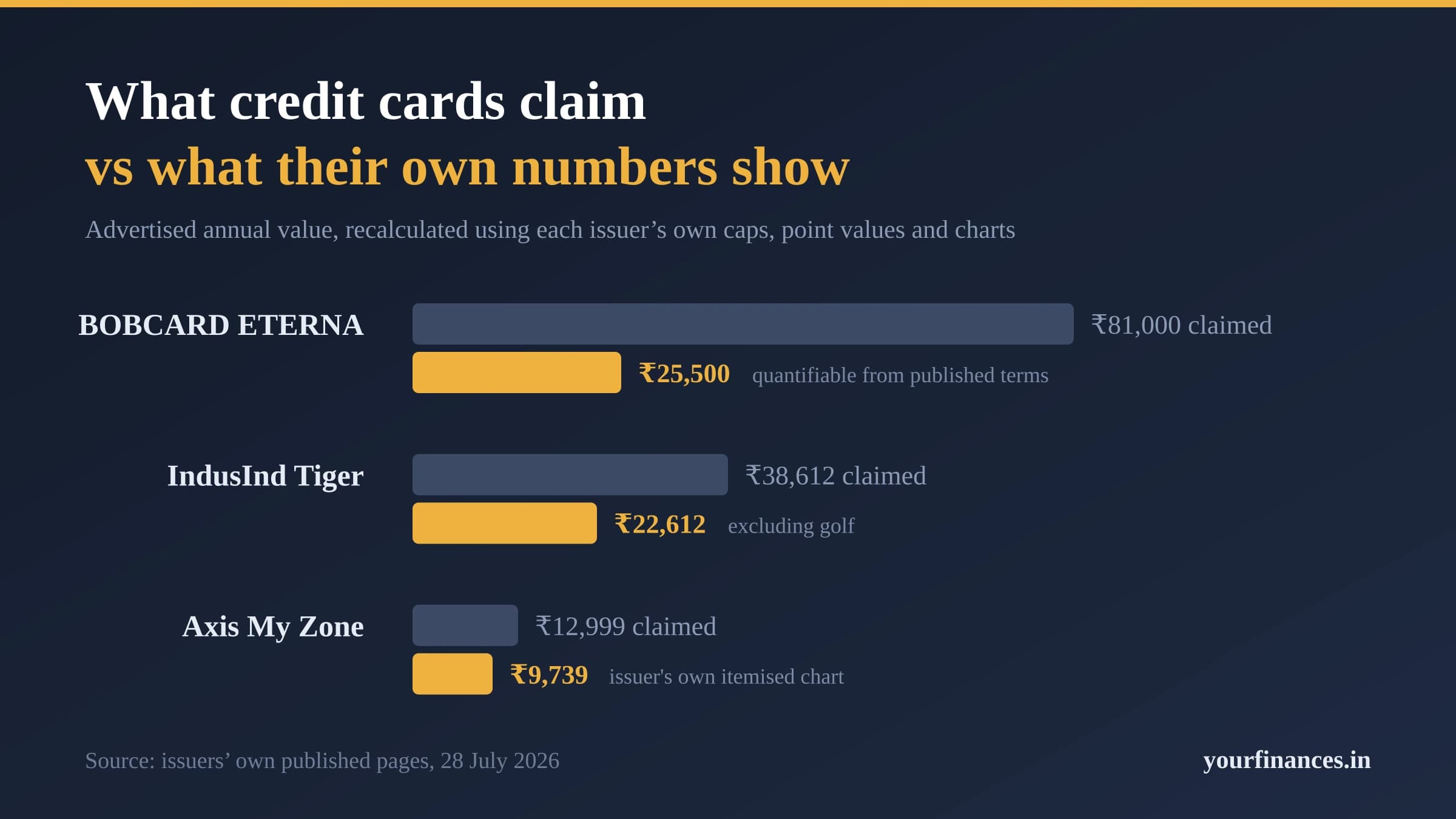
What Indian Credit Cards Claim vs What Their Own Numbers Show
An original study of eight Indian credit cards from seven issuers, using only figures each bank publishes itself. The illustrations consistently sit just inside caps the headlines never mention.

Personal Loan vs Credit Card Debt: Which Is Worse for Your Money?
Credit cards charge 36-42% interest. Personal loans charge 10-18%. The math is clear — but the real story is more nuanced. Here's the complete comparison.

The BNPL Trap: How "Buy Now Pay Later" Is Creating India's Hidden Debt Crisis
60% of BNPL users spend more than they can afford. Late fees can hit 30-40% interest. Here's how Buy Now Pay Later apps are trapping young Indians in invisible debt.