Education Loans in India: Interest Rates, Eligibility, Collateral, and Repayment Guide
Jaspal Singh
Author

Why Education Loans Make Financial Sense
Higher education in India or abroad is expensive. An engineering degree at a private college costs ₹8-15 lakh. An MBA from a top B-school costs ₹20-30 lakh. Studying abroad? ₹30 lakh to ₹1 crore or more.
Many families deplete their savings, break FDs, or sell gold to fund education. But there is a smarter way: education loans. Here is why they make financial sense:
- You repay after earning: Repayment starts only 6-12 months after your course ends
- Interest rates are low: typically around 8.5-11% — far below personal loans (14-24%)
- Tax benefit: Full interest deduction under Section 80E — no upper limit
- Your parents' savings stay invested: Instead of breaking a 7% FD to pay fees, borrow at 7% and let the FD continue earning
Collateral-Free Education Loans
You do NOT always need property or gold as collateral:
- Up to ₹7.5 lakh: Most banks offer collateral-free education loans for courses in India and abroad
- Up to ₹50 lakh: SBI offers collateral-free loans to students from IITs/IIMs and top QS 200-ranked universities
- Up to ₹1.25 crore: NBFCs like HDFC Credila and Avanse offer collateral-free loans for students at top-ranked global universities, based on the course's placement record and expected salary
Important: Collateral-free loans typically have higher interest rates (1-2% more) than secured loans. If you can provide collateral, you will save significantly on interest.
How to Apply: Step by Step
- Get admission first: You need an admission letter (conditional or unconditional) from your college before applying
- Identify a co-applicant: Usually a parent or guardian who co-signs the loan. Their income and credit history matter for approval.
- Compare at least 3 lenders: PSU banks for lowest rates, NBFCs for higher amounts and faster processing
- Submit documents: Admission letter, fee structure, academic transcripts, co-applicant income proof, ID/address proof
- Loan sanction: 7-15 working days for banks, 3-7 days for NBFCs
- Disbursement: Directly to the college, usually semester by semester
Repayment: When and How
Education loans come with a moratorium period — you do not pay EMIs while studying. Here is how it works:
- During the course: No EMI payment required. However, interest accrues.
- Grace period: 6-12 months after course completion or 6 months after getting a job (whichever is earlier)
- Repayment tenure: 5-15 years depending on the loan amount
Pro tip: If you can afford it, pay the interest during the moratorium (called "partial disbursement interest"). This prevents interest from compounding on interest, and can save you ₹2-5 lakh over the loan tenure.
Tax Benefits Under Section 80E
This is one of the best tax deductions available in India:
- You can deduct the entire interest paid on your education loan — there is NO upper limit
- Available for 8 years from the year you start repaying, or until the interest is fully repaid (whichever is earlier)
- Only the person who repays can claim the deduction (student or parent)
- Old regime only. Section 80E is not available under the new tax regime — and the new regime is now the default, so you must actively opt for the old regime to claim it
For someone in the 30% tax bracket repaying ₹2 lakh in interest per year, this saves ₹62,400 in taxes annually. Use our Tax Calculator to check your savings.
Education Loan vs Parents' Savings: What Is Better?
Many families wonder whether to break their FDs and investments or take a loan. Here is the math:
- If your FD earns 7.5% and the education loan costs 8.5%, the gap is only 1% — and the 80E tax deduction more than covers it
- If your parents have equity investments earning 12%+, it makes zero sense to sell them to avoid a 7-8% loan
- The moratorium period means no cash flow pressure while the student is studying
Bottom line: In most cases, taking an education loan and letting family investments continue compounding is the financially smarter choice.
Government Schemes for Education Loans
- PM Vidyalaxmi Portal (pmvidyalaxmi.co.in): One digital application that reaches scheduled banks, RRBs and co-operative banks — this replaces the older Vidya Lakshmi route
- Central Sector Interest Subsidy Scheme: Government pays the interest during moratorium for economically weaker students (family income below ₹4.5 lakh)
- PM-Vidyalaxmi (2024): Collateral-free, guarantor-free loans for merit admissions to 860 listed institutions, plus a 3% interest subvention during the moratorium for family income up to ₹8 lakh — see the detailed section below. (Note: the older Padho Pardesh subsidy for minority students studying abroad was discontinued from 2022-23.)
How Lenders Actually Price an Education Loan
The "starting from" rate a bank advertises is rarely the rate you get. Bank retail loans are linked to an external benchmark — usually the RBI repo rate — so your rate is benchmark + a fixed spread. The spread is locked for the life of the loan; only the benchmark moves. With the repo rate at 5.25% in mid-2026, a spread of 3.5% means an effective rate near 8.75%, and every future repo cut reaches your EMI automatically.
Two things move the spread most: whether the loan is secured and which institution you got into. Here is how the major lenders structure it, per their own published pages:
| Lender / Scheme | How the rate is set | Maximum loan | Collateral-free limit |
|---|---|---|---|
| SBI Student Loan Scheme (India) | Repo-linked (EBLR + spread); concessions for select institutions | Up to ₹1 crore | ₹7.5 lakh |
| SBI Global Ed-Vantage (abroad) | Repo-linked; simple interest during course + moratorium | ₹7.5 lakh to ₹3 crore | Up to ₹50 lakh for listed institutions |
| Bank of Baroda — Baroda Gyan (India) | From BRLLR + 1.10%; 0.50% concession for female students, extra 0.50% for medical courses | As per course cost | ₹7.5 lakh |
| Bank of Baroda — Baroda Scholar (abroad) | From BRLLR + 0.55% for premier institutes | As per course cost | Varies by institute list |
| ICICI Bank | Secured from 9.00%; unsecured from 10.25%. Select institutes: 8.50% secured / 9.25% unsecured | Up to ₹3 crore | Profile-based |
| Axis Bank | Repo-linked, from repo + 3.50% | Up to ₹1.5 crore unsecured | Up to ₹1.5 crore |
The real lesson is the secured-versus-unsecured gap — 1.25 percentage points at ICICI Bank, with something comparable everywhere else. On a ₹40 lakh loan over 12 years that is worth several lakh rupees, so pledging a flat or an FD you were not going to touch is usually the highest-return decision in the whole process. NBFCs such as Credila and Avanse price higher still, but will lend against expected salary where a bank will not.
Rates move with every RBI policy. Treat the table as structure, not a quote — confirm the live figure on the lender's page, then run it through our EMI calculator.
Collateral: The ₹4 Lakh and ₹7.5 Lakh Breakpoints
Three slabs govern almost every education loan in India. They come from the RBI's directions and the IBA Model Education Loan Scheme, not from any individual bank:
- Up to ₹4 lakh: banks must not ask for collateral. The RBI's own education loan FAQ states that banks must not obtain collateral security on education loans up to ₹4 lakh. Margin money is nil.
- ₹4 lakh to ₹7.5 lakh: no tangible security, but a third-party guarantee may be sought. Margin is typically 5% for study in India and 15% for study abroad.
- Above ₹7.5 lakh: tangible collateral — property, FD, LIC policy or securities — plus a parent or guardian as co-borrower. SBI accepts collateral offered by a third party other than the parents, which is useful when the family home is already mortgaged.
A parent or guardian co-signs at every slab, so their credit history and income are assessed alongside the student's admission. Loans up to ₹7.5 lakh also carry a government-backed credit guarantee covering 75% of any default — which is why banks are far more relaxed below that line.
PM-Vidyalaxmi: Collateral-Free Loans and a 3% Interest Subvention
The single biggest change to student borrowing in India is one most guides still miss. PM-Vidyalaxmi, approved by the Union Cabinet on 6 November 2024, applies to education loans taken after that date. Per the Department of Higher Education scheme guidelines:
- Collateral-free and guarantor-free loans for students admitted on merit to any of the 860 Quality Higher Education Institutions — the top 100 NIRF-ranked HEIs, state HEIs ranked in the top 200, and all remaining central government institutions, covering roughly 22 lakh students a year.
- No family income ceiling for the collateral-free loan and no cap on the amount — it is set by course fee, hostel and living costs, even a reasonable laptop.
- 3% interest subvention during the moratorium on loans up to ₹10 lakh where annual family income is up to ₹8 lakh — capped at 1 lakh beneficiaries a year, allocated state-wise with preference to government-institution students and technical courses.
- 75% credit guarantee on sanctions up to ₹7.5 lakh, regardless of family income.
- Repayment up to 15 years excluding the moratorium (course period plus one year).
Two disqualifiers matter: students admitted through management quota are not eligible, and benefits cover study in India only. Applications go through the PM Vidyalaxmi portal (pmvidyalaxmi.co.in) — one digital form that replaces the older Vidya Lakshmi route and reaches every scheduled bank, RRB and co-operative bank.
PM-Vidyalaxmi sits alongside the older PM-USP Central Sector Interest Subsidy Scheme (CSIS). Which one you get depends on income and course type:
| Annual family income | Technical / professional course | Other degree or diploma course |
|---|---|---|
| Up to ₹4.5 lakh | 100% interest subvention (PM-USP CSIS), loans up to ₹10 lakh | 3% subvention (PM-Vidyalaxmi) |
| ₹4.5 lakh to ₹8 lakh | 3% subvention (PM-Vidyalaxmi) | 3% subvention (PM-Vidyalaxmi) |
One correction worth noting: Padho Pardesh, the interest subsidy for minority students studying abroad, was discontinued from 2022-23. Only beneficiaries sanctioned on or before 31 March 2022 continue to receive it.
Moratorium Maths: How "No EMI" Quietly Costs You
During the course and grace period you pay no EMI — but interest accrues, and at most banks the accrued interest is added to the principal when repayment begins. A ₹30 lakh loan at 9.5% over a four-year course accrues roughly ₹11 lakh of interest before the first EMI falls due, and you then pay interest on that interest for a decade.
Servicing only the simple interest during the moratorium — often a few thousand rupees a month — stops the capitalisation and typically earns an extra 0.50% to 1% rate concession. It is the cheapest optimisation in the entire loan. Model both paths in the EMI calculator.
Section 80E: The Old-Regime Catch That Trips Up Most Borrowers
Section 80E lets you deduct the entire interest paid on an education loan with no upper limit, for up to 8 assessment years from the year repayment starts or until the interest is fully repaid, whichever comes first. Only an individual can claim it, for their own higher education or that of a spouse, children or a legal ward, and only the person actually repaying may claim.
Here is the part that costs people real money: Section 80E is not available under the new tax regime. The Income Tax Department's own deductions reference permits only Section 24(b) and Section 80CCH under Section 115BAC — every other Chapter VI-A deduction, 80E included, is old-regime only. Since the new regime is now the default, a borrower who does nothing loses the benefit by omission.
So the question is not "how much does 80E save" but "does 80E plus my other old-regime deductions beat the new regime's lower slabs". For a 30% bracket taxpayer paying ₹2 lakh of interest a year, 80E alone is worth roughly ₹62,000 — often enough to tip the answer, not always. Work it through with our old vs new tax regime comparison, and if you stay with the old regime, stack it against the other deductions and exemptions and the options beyond Section 80C.
One more trap: the loan must come from a bank or a financial institution notified by the Central Government. Major education NBFCs qualify — Credila was notified for Section 80E back in 2010 — but a loan from a co-operative society, an employer or a relative does not, and neither does a personal loan used to pay fees, however you label it.
Studying Abroad vs in India: What Actually Changes
Beyond size, four things change when the campus is overseas:
- Margin money triples. Roughly 5% for study in India against 15% for study abroad on loans above ₹4 lakh — on a ₹50 lakh sanction that is ₹7.5 lakh you fund yourself.
- Government subsidies stop at the border. PM-Vidyalaxmi and PM-USP CSIS apply to Indian institutions only; foreign campuses of Indian institutions and Indian campuses of foreign institutions are explicitly excluded.
- TCS is now nil on loan-funded fees. From 1 April 2025 the Budget removed tax collected at source on overseas education remittances funded by a loan from a notified financial institution, and raised the general LRS threshold from ₹7 lakh to ₹10 lakh. Self-funded fees above that threshold still attract TCS, creditable against your tax liability.
- You carry currency risk. Fees are billed in dollars or pounds while the loan and your repayment capacity are in rupees; a 5% rupee slide over a two-year course quietly enlarges the loan.
Education Loan FAQs
Can a bank refuse an education loan because I live outside its service area?
No. The RBI bars banks from rejecting an education loan application solely because the applicant's residence falls outside the branch's service area. If it happens, escalate in writing, then to the RBI Integrated Ombudsman if there is no satisfactory reply within one month.
Do I need a co-applicant even for a small education loan?
Yes. A parent or guardian signs as joint borrower at every slab, including the collateral-free band below ₹4 lakh. Their income and credit score are assessed, which is why a co-applicant with a damaged score can sink a strong application.
Can I claim Section 80E on a loan taken by my parents?
Only the person who actually repays may claim it, and only if named as a borrower. If your parent borrows and repays, the parent claims it; if you take over repayment after starting work, you can claim it once the loan is in your name.
What happens if I cannot find a job after the moratorium ends?
Speak to the bank before you miss an EMI. Most lenders will extend the moratorium by six months to a year or restructure the tenure. A missed EMI hits your credit report and your co-applicant's; a negotiated extension does not.
Is prepaying an education loan a good idea?
Usually yes — floating-rate education loans carry no prepayment penalty for individual borrowers. The exception is if you claim Section 80E under the old regime and the post-tax cost of the loan is below what your investments earn; then let it run inside the 8-year window.
Related Reading
- EMI Calculator — calculate your education loan EMI
- Tax Calculator — see how Section 80E saves tax on education loan interest
- Credit Score Guide — how your co-applicant's score affects loan approval
- Home Loan Guide — if you are planning to buy a house after education
Disclaimer: Interest rates and loan terms are based on publicly available information as of March 2026 and may change. Eligibility depends on individual and co-applicant profiles. Please compare offers from multiple lenders. This article is for educational purposes only.
Written by
Jaspal Singh
Founder & Editor
Personal finance writer helping Indians make smarter money decisions through clear, jargon-free guides on taxes, investments, and budgeting.
Continue Reading
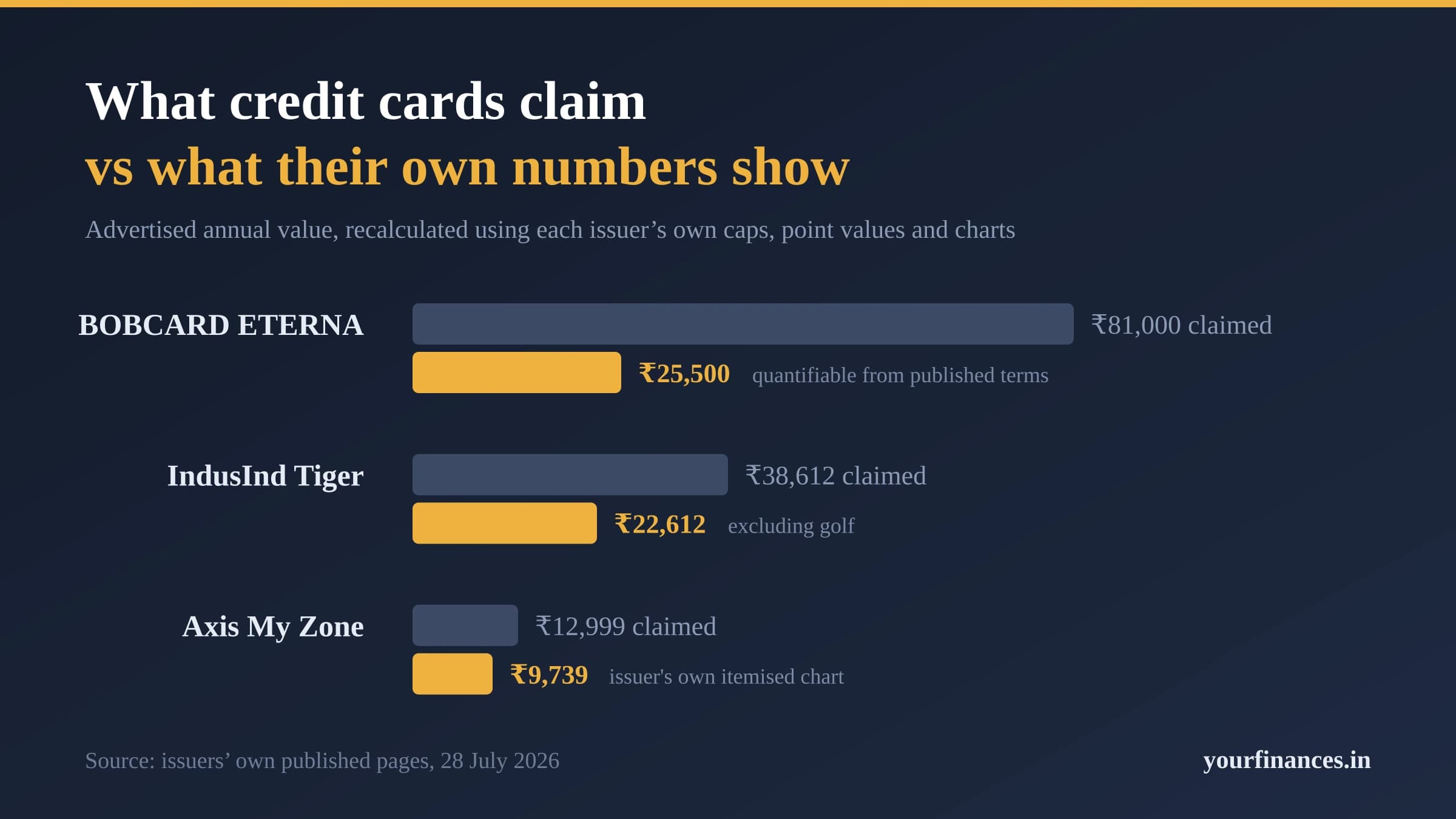
What Indian Credit Cards Claim vs What Their Own Numbers Show
An original study of eight Indian credit cards from seven issuers, using only figures each bank publishes itself. The illustrations consistently sit just inside caps the headlines never mention.
Personal Loan vs Credit Card Debt: Which Is Worse for Your Money?
Credit cards charge 36-42% interest. Personal loans charge 10-18%. The math is clear — but the real story is more nuanced. Here's the complete comparison.

The BNPL Trap: How "Buy Now Pay Later" Is Creating India's Hidden Debt Crisis
60% of BNPL users spend more than they can afford. Late fees can hit 30-40% interest. Here's how Buy Now Pay Later apps are trapping young Indians in invisible debt.