Home Loans in India: A Complete Guide to Interest Rates, Eligibility, and EMI
Jaspal Singh
Author
Is 2026 a Good Time to Take a Home Loan?
Buying a home is the biggest financial decision most Indians will ever make. And with home loan rates linked to the RBI repo rate and repricing as policy moves, the question is not whether to buy, but how to get the best deal.
This guide covers everything you need to know: current rates, how to check eligibility, EMI calculations, tax benefits, and common mistakes to avoid.
Current Home Loan Interest Rates (March 2026)
Advertised "starting" rates change with every RBI policy move and depend on your credit profile. The section below explains how the rate is actually built (repo + spread) and compares lenders structurally — always confirm the live rate on the lender's own page.
Rates as of March 2026. Actual rate depends on your credit score, loan amount, and profile. A CIBIL score of 750+ typically qualifies you for the lowest advertised rates.
Pro tip: PSU banks (SBI, BoB, PNB) consistently offer lower rates than private banks. The trade-off is slightly slower processing.
How Much Home Loan Can You Get?
Banks lend a share of the property value called the Loan-to-Value (LTV) ratio, and the RBI caps it by loan size: up to 90% for loans up to ₹30 lakh, 80% for ₹30–75 lakh, and 75% above ₹75 lakh. The remainder is your down payment, and stamp duty and registration are usually excluded from the value the bank funds.
Your loan eligibility depends on:
- Monthly income: Banks allow EMIs up to 40-50% of your net monthly income
- Existing loans: Car loan, personal loan EMIs reduce your eligible amount
- Credit score: 750+ gets you the best rates and highest eligibility. Read our credit score guide to understand your score.
- Age: Maximum tenure is typically until you turn 60-65
- Property value: The bank independently values the property
EMI Calculation: How Much Will You Pay Monthly?
Here is what your EMI looks like for a ₹50 lakh home loan at different rates and tenures:
| Tenure | 7.5% Rate | 8.5% Rate | 9.5% Rate |
|---|---|---|---|
| 15 years | ₹46,350 | ₹49,250 | ₹52,200 |
| 20 years | ₹40,280 | ₹43,390 | ₹46,610 |
| 25 years | ₹36,950 | ₹40,260 | ₹43,700 |
| 30 years | ₹34,960 | ₹38,450 | ₹42,050 |
Use our EMI Calculator to calculate your exact monthly payment based on your loan amount, rate, and tenure.
Key insight: A 1% difference in interest rate on a ₹50 lakh loan over 20 years means you pay ₹6-7 lakh more in total interest. That is why negotiating your rate matters enormously.
Tax Benefits on Home Loans
Important: the new tax regime is now the default, and it does not allow the two main home-loan deductions on a self-occupied property. You must actively choose the old regime to claim them — factor that into any "tax saving" calculation.
Under the old regime, home loans offer substantial tax savings:
- Section 80C (old regime only): up to ₹1.5 lakh a year on principal repayment
- Section 24(b) (old regime only for a self-occupied home): up to ₹2 lakh a year on interest paid
- Let-out property: interest remains deductible against rental income in both regimes — but the resulting house-property loss cannot be set off against salary
- Section 80EEA — historic only: it applied to loans sanctioned between 1 April 2019 and 31 March 2022, so new borrowers cannot claim it
- Joint loan: If both spouses are co-borrowers, each can claim deductions separately — effectively doubling the benefit
Use our Tax Calculator to see how home loan deductions reduce your tax liability.
Step-by-Step: How to Apply for a Home Loan
- Check your credit score — get your free CIBIL report at cibil.com. Aim for 750+.
- Calculate your budget — your EMI should not exceed 40% of your take-home salary. Use our EMI Calculator.
- Compare rates from 3-4 banks — do not just go with your salary account bank. Compare PSU and private banks.
- Get pre-approved — a pre-approval letter strengthens your bargaining power with sellers.
- Choose your property — ensure it is RERA-registered and the builder has all clearances.
- Submit documents: ID proof, address proof, income proof (salary slips/ITR), bank statements (6 months), property documents.
- Bank verification — the bank will verify your documents, visit the property, and do a legal check.
- Loan sanction and disbursement — once approved, the bank disburses directly to the seller/builder.
Common Mistakes to Avoid
- Not comparing rates: Even 0.25% difference saves lakhs over 20 years. Always get quotes from at least 3 banks.
- Choosing the longest tenure blindly: A 30-year loan has lower EMI but you pay almost double in total interest vs a 15-year loan.
- Ignoring processing fees: Some banks charge 0.5-1% processing fee. Factor this into your total cost.
- Skipping the fine print: Check for prepayment charges (RBI barred them on floating-rate loans to individuals for non-business purposes, but only for loans sanctioned or renewed on or after 1 January 2026 — older loans are not covered), reset clauses, and foreclosure terms.
- Maxing out your eligibility: Just because you qualify for ₹1 crore does not mean you should borrow ₹1 crore. Keep your EMI under 35% of income for financial comfort.
Fixed vs Floating Rate: Which to Choose?
In 2026, floating rate is almost always better for home loans. Here is why:
- Floating rates are 1-2% lower than fixed rates
- No prepayment penalty on floating-rate individual loans sanctioned or renewed on or after 1 January 2026 (RBI directions; fixed-rate loans are not covered)
- If RBI cuts rates (possible later in 2026), your EMI automatically reduces
- Fixed rates are "fixed" only for the first 2-3 years in most banks, then convert to floating anyway
Should You Prepay Your Home Loan or Invest?
This is one of the most common questions. The simple rule:
- If your home loan rate is above 8.5%, prioritise prepayment — it is a guaranteed 8.5%+ "return" on every rupee you prepay.
- If your rate is below 8%, consider investing the surplus in equity SIPs instead — which historically deliver 12%+ over the long term. Use our SIP Calculator to compare.
- Always maintain your emergency fund first — 6 months of EMIs in liquid savings before prepaying.
How Your Home Loan Rate Is Actually Set
Since 1 October 2019, the RBI has required banks to link every new floating-rate retail loan — housing, auto, personal — to an external benchmark, and almost all of them chose the policy repo rate. The rule is set out in the RBI circular on External Benchmark Based Lending. So your rate is simply:
Your home loan rate = Repo rate + Bank's spread
As of July 2026 the RBI's policy repo rate is 5.25%, unchanged at the June 2026 MPC. That number is identical for every borrower in the country. The spread is the only part that is yours to negotiate.
The spread has two components, and the RBI treats them very differently:
- Business/operating spread — the bank's margin. Under the RBI circular, this can be changed only once in three years for an existing borrower.
- Credit risk premium — your personal risk loading, driven by credit score, income stability and loan-to-value. This "may undergo change only when the borrower's credit assessment undergoes a substantial change, as agreed upon in the loan contract".
Two more rules matter: banks cannot lend below the benchmark, and the rate must be reset at least once every three months — which is why a repo cut reaches your EMI within a quarter rather than instantly.
The practical takeaway: when you ask for "a better rate", you are asking the bank to cut its spread. Make the relationship manager state the repo rate and the spread separately. Two lenders quoting 7.90% and 8.40% are working off the same repo rate and simply pricing your risk differently — so the higher quote can usually be matched.
What to Compare Across Lenders (Beyond the Headline Rate)
Advertised "starting from" rates are quoted for the strongest possible borrower profile. Compare the structure instead:
| What to check | Public sector banks | Private banks | Housing finance companies (HFCs) |
|---|---|---|---|
| Rate benchmark | Repo-linked EBLR | Repo-linked EBLR | Own PLR/benchmark — not repo-linked by RBI mandate |
| Rate transparency | High — repo + published spread | High — repo + published spread | Lower — internal benchmark, harder to audit |
| Maximum tenure | Typically up to 30 years | Typically up to 30 years | Typically up to 30 years |
| Processing fee (typical) | 0.25%–0.50% of loan, often capped or waived in campaigns | 0.25%–1.00% of loan | 0.50%–1.00% of loan |
| Best suited to | Salaried borrowers with clean documents | Fast approvals, higher-ticket loans | Self-employed and non-standard income profiles |
Fee ranges are typical market practice as of July 2026 and are negotiable — get the figure in writing in the sanction letter. HFCs are RBI-regulated but are not covered by the mandatory external-benchmark rule that applies to banks, so an HFC rate cut is discretionary rather than automatic.
How much can you actually borrow? The RBI's LTV ceilings
The Loan-to-Value cap is not a bank policy — it is a prudential ceiling under the RBI's Master Circular on Housing Finance:
| Loan amount | Maximum LTV | Minimum down payment you must fund |
|---|---|---|
| Up to ₹30 lakh | 90% | 10% |
| Above ₹30 lakh and up to ₹75 lakh | 80% | 20% |
| Above ₹75 lakh | 75% | 25% |
One detail catches first-time buyers out: the RBI instructs banks not to include stamp duty, registration and documentation charges in the property value used for LTV, because those costs are not realisable. On a ₹80 lakh flat in a state charging 6% stamp duty, that is roughly ₹5 lakh from your own funds on top of the 25% margin. Our guide to buying a house in India covers the full cost stack.
The Tax Trap Most Home Loan Guides Get Wrong
The new tax regime under Section 115BAC is now the default. Under it, per the Income Tax Department's own New vs Old Regime FAQs:
- Section 24(b) interest deduction on a self-occupied house is NOT allowed. The ₹2 lakh cap you have read about everywhere exists only in the old regime.
- Section 80C principal repayment (₹1.5 lakh) is NOT allowed — all Chapter VI-A deductions of that kind fall away in the new regime.
- Loss under "Income from house property" cannot be set off against salary in the new regime, and cannot be carried forward.
What survives in the new regime: interest on a let-out property remains deductible against that property's rental income — you simply cannot use the resulting loss to shelter your salary.
Note also that Section 80EEA is closed to new borrowers. That extra ₹1.5 lakh deduction applied only to loans sanctioned between 1 April 2019 and 31 March 2022. A loan sanctioned in 2026 does not qualify, whatever the property's stamp duty value.
So the honest calculation is: total up your old-regime deductions (home loan interest + 80C + 80D + HRA) and compare tax payable under both regimes before assuming the loan "saves tax". For borrowers with modest interest outgo, the new regime's lower slab rates often still win. Run both scenarios via our old vs new tax regime comparison and the full list of tax deductions and exemptions.
Eligibility: FOIR, Score Bands and Co-Applicants
Lenders assess three things: your FOIR (Fixed Obligation to Income Ratio — all EMIs including the proposed one, divided by net monthly income), your credit score, and the property's legal standing.
- FOIR: lenders typically cap total EMIs at 50%–60% of net income for higher earners, and 40%–50% for incomes under ₹50,000 a month. Every existing car, personal or card EMI directly cuts your sanction.
- Score bands (typical): 800+ gets the finest spread; 750–799 standard pricing; 700–749 a loading of roughly 0.10%–0.50%; below 650 often means rejection or an HFC at a materially higher rate.
- Co-applicants: adding an earning spouse pools both incomes for FOIR. Many lenders also offer a small concession (commonly around 0.05%) when a woman is the primary applicant or co-owner, and several states charge lower stamp duty for women buyers.
- Keep headroom: FOIR allowing 55% does not mean you should live at 55%. Sizing the EMI against a 50-30-20 budget leaves room for property tax, maintenance and repairs.
Prepayment: What One Extra EMI a Year Actually Does
The RBI's Pre-payment Charges on Loans Directions, 2025 removed the main obstacle. For loans sanctioned or renewed on or after 1 January 2026, lenders cannot levy pre-payment or foreclosure charges on floating-rate loans to individuals for non-business purposes — an ordinary home loan qualifies. There is no minimum lock-in, and the source of funds is irrelevant.
Now the arithmetic. Take a ₹50 lakh loan at 8.5% for 20 years:
| Strategy | Loan closes in | Total interest paid | Interest saved |
|---|---|---|---|
| EMI only (₹43,391/month) | 20 years | ₹54.14 lakh | — |
| EMI + one extra EMI every 12 months | 16 years 9 months | ₹43.85 lakh | ≈ ₹10.3 lakh |
One extra payment a year — roughly ₹3,600 a month set aside, or part of your annual bonus — cuts 39 months and about ₹10.3 lakh off the loan, because every rupee of prepayment goes 100% to principal and kills all the future interest it would have generated. Prepaying in the first seven or eight years, when the interest share of each EMI is highest, delivers most of the benefit. Model your own numbers with the EMI calculator. If you are also servicing a loan against property or costlier debt, clear that first.
Is the PMAY Subsidy Still Available?
Yes — under PMAY-Urban 2.0, whose Interest Subsidy Scheme runs for five years from 1 September 2024. Per the official ISS page on pmaymis.gov.in, the terms are:
- Eligible households: EWS (annual income up to ₹3 lakh), LIG (up to ₹6 lakh), MIG (up to ₹9 lakh), with no pucca house owned anywhere in India
- Subsidy: 4% on the first ₹8 lakh of the loan, up to ₹1.80 lakh total, with a maximum NPV of ₹1.50 lakh at an 8.5% discount rate
- Caps: loan up to ₹25 lakh, house value up to ₹35 lakh, carpet area up to 120 sqm
- Tenure: subsidy released in 5 equal yearly instalments; loan tenure must exceed five years, subsidy computed over up to 12 years
- Loan date: sanctioned and disbursed on or after 1 September 2024
Apply through your lender at the time of sanction — most banks and HFCs carry the PMAY form. Confirm current status on the official portal, as scheme components are periodically revised.
Frequently Asked Questions
Can I claim home loan tax benefits under the new tax regime?
Not for a self-occupied house. Under Section 115BAC, neither the Section 24(b) interest deduction of up to ₹2 lakh nor the 80C principal deduction of ₹1.5 lakh is available, and house property loss cannot be set off against salary. Let-out property interest stays deductible against that property's rental income. To claim the self-occupied deduction you must opt for the old regime in your ITR.
How is my home loan interest rate calculated?
For a bank floating-rate loan it is the RBI repo rate (5.25% in July 2026) plus the bank's spread. The repo rate is identical for everyone; the spread carries the bank's margin plus your credit risk premium. Banks must reset the rate at least once every three months.
Do I still pay a penalty to prepay my home loan?
No — for floating-rate home loans to individuals sanctioned or renewed on or after 1 January 2026. The RBI's Pre-payment Charges on Loans Directions, 2025 bar pre-payment and foreclosure charges on such loans, with no lock-in. Fixed-rate loans are treated differently, so check your sanction letter.
What is the maximum loan I can get against my property's value?
RBI norms cap LTV at 90% up to ₹30 lakh, 80% for ₹30–75 lakh, and 75% above ₹75 lakh. Stamp duty and registration cannot be counted in the property value, so your real cash requirement is the margin plus those charges.
Should I prepay my home loan or extend the tenure?
Prepaying cuts total interest; extending the tenure lowers the EMI but raises lifetime interest sharply. On a ₹50 lakh loan at 8.5%, one extra EMI a year saves about ₹10.3 lakh and closes the loan 39 months early. Keep a six-month emergency fund first, and clear costlier debt before prepaying.
Updated July 2026. Repo rate, LTV norms, pre-payment rules and PMAY-U 2.0 terms are as published by the Reserve Bank of India, the Income Tax Department and the PMAY-U portal. Bank-specific rates and fees change frequently — confirm current terms with the lender. This article is for information only and is not tax, legal or investment advice.
Related Reading
- EMI Calculator — calculate your home loan EMI instantly
- Understanding Credit Scores in India — improve your score to get better rates
- Tax Calculator — see how home loan deductions save tax
- FD Calculator — compare home loan prepayment vs FD returns
Disclaimer: Interest rates and policies mentioned are based on publicly available information as of March 2026 and may change. Loan eligibility depends on individual profile. Please compare offers from multiple banks and consult a financial advisor before taking a home loan.
Written by
Jaspal Singh
Founder & Editor
Personal finance writer helping Indians make smarter money decisions through clear, jargon-free guides on taxes, investments, and budgeting.
Continue Reading
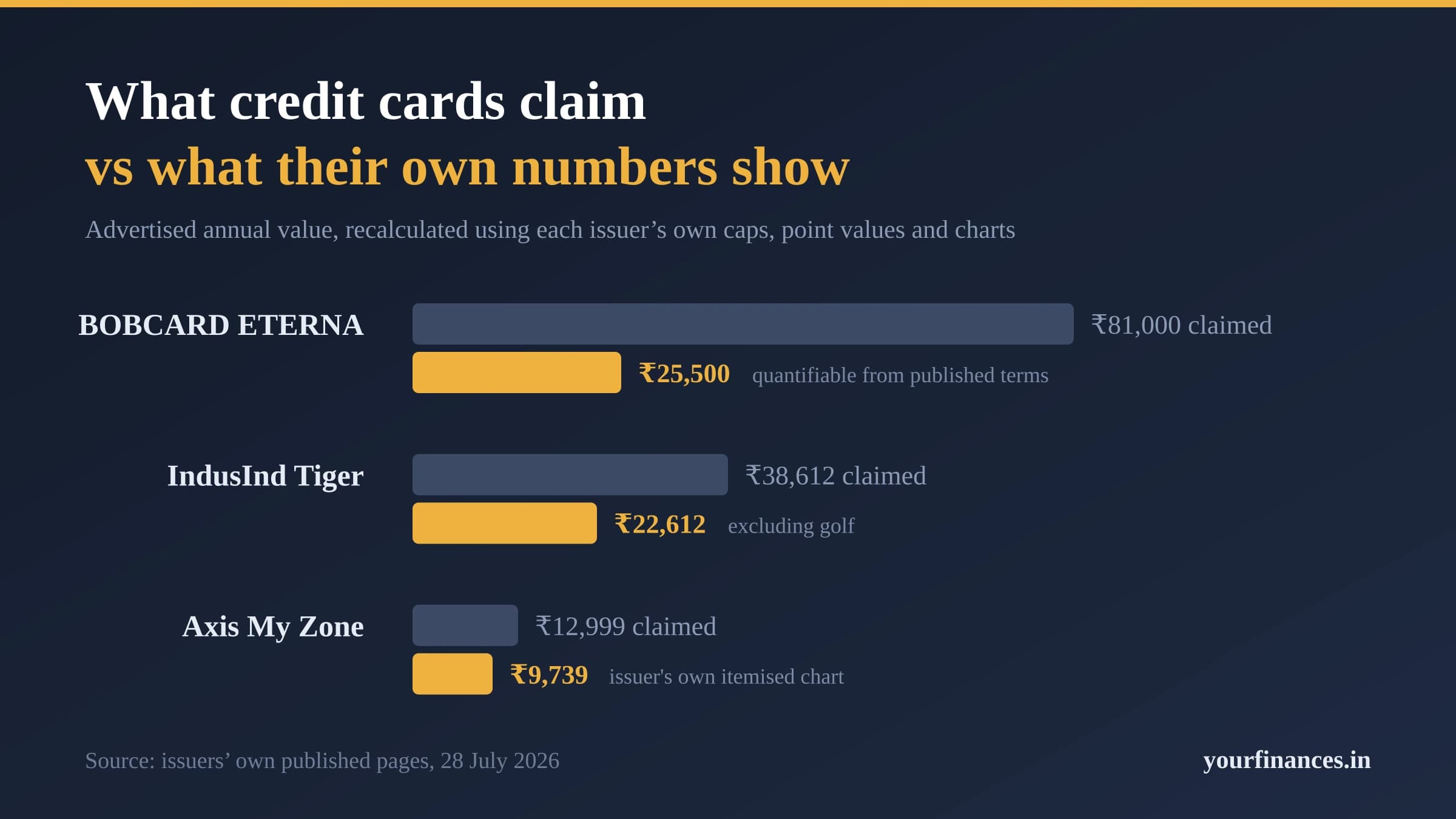
What Indian Credit Cards Claim vs What Their Own Numbers Show
An original study of eight Indian credit cards from seven issuers, using only figures each bank publishes itself. The illustrations consistently sit just inside caps the headlines never mention.

Personal Loan vs Credit Card Debt: Which Is Worse for Your Money?
Credit cards charge 36-42% interest. Personal loans charge 10-18%. The math is clear — but the real story is more nuanced. Here's the complete comparison.

The BNPL Trap: How "Buy Now Pay Later" Is Creating India's Hidden Debt Crisis
60% of BNPL users spend more than they can afford. Late fees can hit 30-40% interest. Here's how Buy Now Pay Later apps are trapping young Indians in invisible debt.