Credit Cards in India: How to Choose, Use Responsibly, and Maximise Rewards
Jaspal Singh
Author
Credit Cards: The Most Misunderstood Financial Tool
Credit cards in India have a reputation problem. Many people think they are debt traps designed to ruin you. Others use them recklessly and prove those fears right.
The truth? A credit card, used responsibly, is one of the most powerful financial tools available to you. It builds your credit score, gives you free short-term credit, earns cashback and rewards, and protects your purchases. The key word is responsibly.
How Credit Cards Actually Work
Here is the simple version:
- You buy something using your credit card (the bank pays the merchant)
- The bank sends you a bill at the end of the month
- You have 20-50 days to pay the full bill (this is your "interest-free period")
- If you pay the full bill on time, you pay zero interest — the bank effectively gave you a free loan
- If you pay only the "minimum due," the remaining amount attracts 36-42% annual interest — this is where people get trapped
The golden rule: Always pay the full bill. Never pay just the minimum due.
Best Credit Cards for Beginners in India (2026)
| Card | Annual Fee | Best For | Key Benefit |
|---|---|---|---|
| Amazon Pay ICICI | Lifetime Free | Online shopping | 5% cashback on Amazon, 2% on bill payments |
| SBI Cashback Card | ₹999 (waived on ₹2L spend) | All-round cashback | 5% cashback on online spends |
| HDFC MoneyBack+ | ₹500 (waived on ₹50K spend) | Everyday spending | 2 reward points per ₹150 spent |
| Axis Ace | Lifetime Free | Utility bills & dining | 5% cashback on bill payments via Google Pay |
| IDFC First Classic | Lifetime Free | First-time users | Easy approval, no income proof needed |
Beginner tip: Start with a lifetime-free card. Do not pay annual fees until you are sure you will use the card enough to justify the cost.
The 5 Rules of Responsible Credit Card Use
Rule 1: Always pay the full bill — never just the minimum
Credit card interest is 36-42% per annum — the most expensive form of borrowing in India. If you carry a ₹50,000 balance and pay only the minimum due (5%), you will take over 8 years to fully repay it and pay nearly ₹1 lakh in interest alone.
Set up auto-pay for the full amount from your bank account. This way, you never miss a payment and never pay interest.
Rule 2: Never spend more than you can afford
A credit card is not free money — it is borrowed money with a due date. If you would not buy something with cash, do not buy it with a credit card.
Rule 3: Keep utilization below 30%
If your card limit is ₹1 lakh, do not let your outstanding balance exceed ₹30,000 at any point. High utilization hurts your credit score.
Rule 4: Never use credit cards for cash withdrawals
Cash advances on credit cards charge 2.5-3.5% upfront fee PLUS 36-42% interest from day one (no interest-free period). This is the worst possible way to get cash.
Rule 5: Track your spending weekly
Most credit card apps let you see real-time spending. Check it every Sunday. If you are overspending in a category, course-correct before the bill arrives.
How to Maximise Rewards and Cashback
- Use the right card for each category: Amazon card for Amazon shopping, dining card for restaurants, fuel card for petrol
- Pay utility bills with your card: Electricity, phone, DTH, insurance premiums — these all earn rewards
- Convert to EMI wisely: Some cards offer 0% EMI on big purchases. Use this instead of paying interest on revolving credit.
- Redeem points before they expire: Most reward points expire after 2-3 years. Check and redeem regularly.
- Use milestone bonuses: Many cards give extra rewards if you spend ₹50K or ₹1L in a quarter. Plan big purchases accordingly.
Warning Signs You Are Using Your Card Wrong
- You are paying only the minimum due each month
- You have multiple cards with outstanding balances on all of them
- You are taking cash advances from your credit card
- Your credit card spending exceeds your monthly income
- You do not know what your total outstanding balance is
If any of these apply, stop using the card immediately. Focus on paying off the balance. Consider a personal loan at 12-15% to pay off 36-42% credit card debt — it sounds counterintuitive, but a lower-rate loan to clear a higher-rate debt saves money.
Credit Cards and Your Credit Score
Used well, credit cards are the fastest way to build a strong credit score:
- Timely payments boost your score every month
- Low utilization shows responsible behaviour
- A longer credit history (keeping old cards open) strengthens your profile
- A good credit score unlocks better loan rates — potentially saving you lakhs on a home loan
Related Reading
- Understanding Credit Scores in India — how your card usage affects your CIBIL score
- Home Loans Guide — why your credit score matters for the biggest loan of your life
- EMI Calculator — plan card EMI conversions
Disclaimer: Credit card details and benefits mentioned are based on publicly available information as of March 2026 and may change. Always read the card's terms and conditions before applying. This article is for educational purposes only.
Written by
Jaspal Singh
Founder & Editor
Personal finance writer helping Indians make smarter money decisions through clear, jargon-free guides on taxes, investments, and budgeting.
Continue Reading
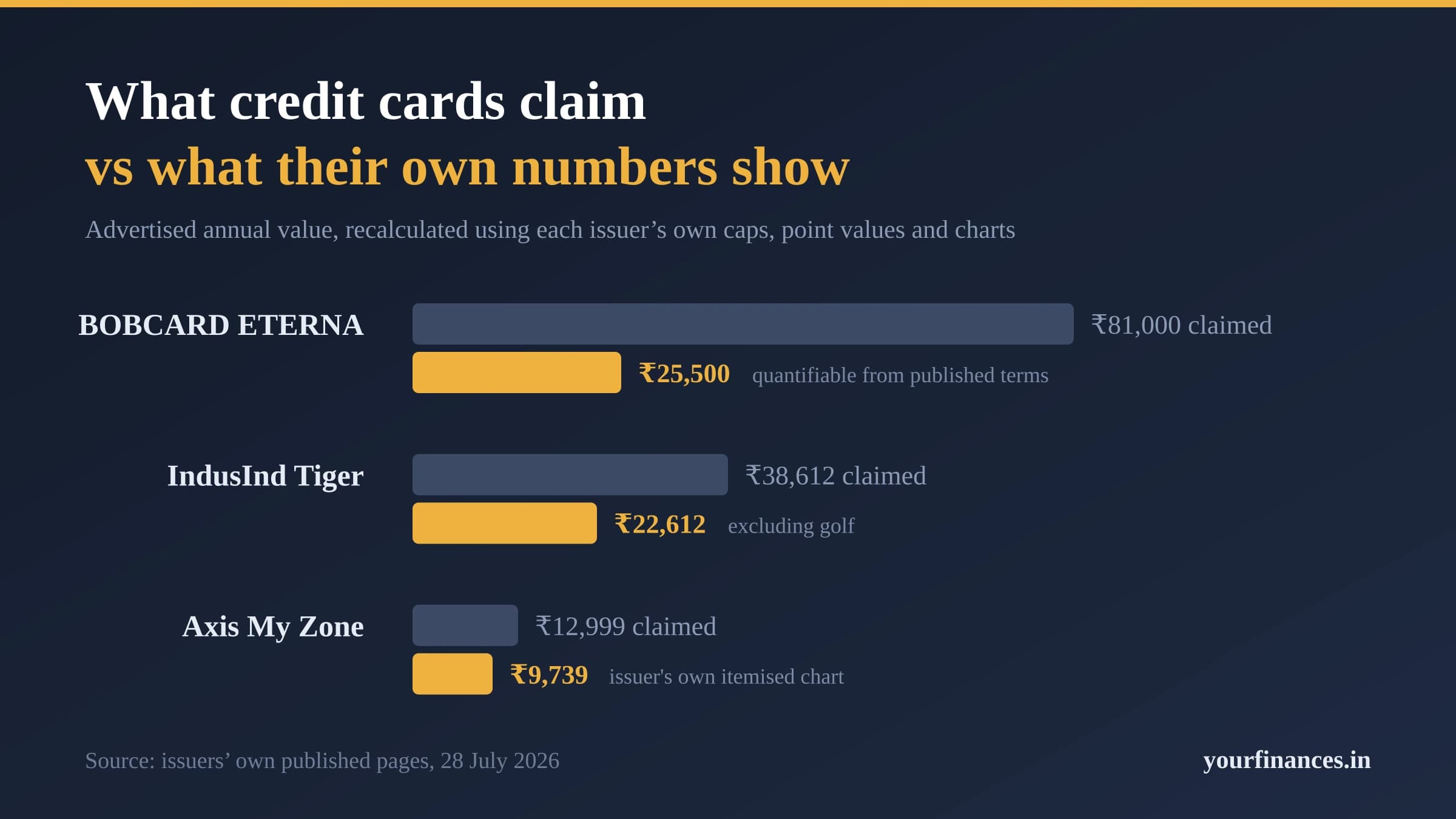
What Indian Credit Cards Claim vs What Their Own Numbers Show
An original study of eight Indian credit cards from seven issuers, using only figures each bank publishes itself. The illustrations consistently sit just inside caps the headlines never mention.
Personal Loan vs Credit Card Debt: Which Is Worse for Your Money?
Credit cards charge 36-42% interest. Personal loans charge 10-18%. The math is clear — but the real story is more nuanced. Here's the complete comparison.
The BNPL Trap: How "Buy Now Pay Later" Is Creating India's Hidden Debt Crisis
60% of BNPL users spend more than they can afford. Late fees can hit 30-40% interest. Here's how Buy Now Pay Later apps are trapping young Indians in invisible debt.