PSU Pension Rules in India: UPS, NPS & OPS Explained
Jaspal Singh
Author
Last updated: 6 May 2026
What Changed: The Unified Pension Scheme (UPS) Is Now Live
The Government of India approved the Unified Pension Scheme (UPS) on 24 August 2024 and implemented it from 1 April 2025. This is the biggest pension reform since the National Pension System (NPS) was introduced in 2004. Meanwhile, a separate May 2025 CCS Pension Rules amendment has put retirement benefits at risk for PSU employees dismissed for misconduct.
This guide covers both developments and explains how they affect government and PSU employees in India.
Unified Pension Scheme (UPS): Key Features
The UPS is a voluntary pension framework for Central Government employees, offering assured, inflation-indexed retirement benefits. Here are the five pillars of the scheme:
1. Assured Pension
- 50% of average basic pay drawn in the last 12 months before retirement
- Requires minimum 25 years of qualifying service
- For service between 10-25 years, pension is proportionate
2. Assured Minimum Pension
- ₹10,000 per month guaranteed on superannuation
- Available after minimum 10 years of service
3. Assured Family Pension
- 60% of the employee's pension paid to the legally wedded spouse
- Payable immediately upon the employee's death
4. Lump Sum Payment at Retirement
- Formula: (1/10) × (Last Drawn Basic Pay + DA) × completed six-month periods of service
- Paid on superannuation or voluntary retirement
- Does not reduce the assured pension amount
5. Inflation Protection
- Dearness Relief (DR) linked to the All India Consumer Price Index for Industrial Workers
- Applied on both pension and family pension
UPS Contributions: Who Pays What
| Contributor | NPS Rate | UPS Rate |
|---|---|---|
| Employee | 10% of (Basic + DA) | 10% of (Basic + DA) |
| Government | 14% of (Basic + DA) | 18.5% of (Basic + DA) |
Under UPS, the government's contribution rises from 14% to 18.5%, with the additional 4.5% going into a pool corpus to fund the assured pension guarantee.
UPS Adoption: How Many Employees Have Opted In
As of November 2025, over 1.22 lakh (122,000) central government employees — including new joinees, existing employees, and past retirees — had opted for the UPS. The option window was extended multiple times, from June 2025 to September 2025 and finally to 30 November 2025.
Notably, the adoption rate has been modest. Fewer than 5% of eligible employees opted in early, though the numbers grew significantly as the deadline approached. The government has also allowed a one-time, one-way switch from UPS back to NPS for those who change their mind.
Which States Have Adopted UPS
While the UPS was introduced for Central Government employees, several states have also adopted it for their state government staff:
- Maharashtra — First state to implement UPS (August 2024), covering state government employees, recognised educational institutions, universities, and zilla parishad employees
- Uttarakhand — Approved UPS implementation for state officers and employees
- Goa — Implemented UPS as per Central Government norms
- Assam — Cabinet approved UPS from 1 April 2025, with a one-year window for NPS employees to switch
Several other states, including Punjab, Rajasthan, Jharkhand, Himachal Pradesh, and Chhattisgarh, have instead reverted to or announced plans for the Old Pension Scheme (OPS).
UPS vs NPS vs OPS: Complete Comparison
| Feature | OPS | NPS | UPS |
|---|---|---|---|
| Pension Guarantee | Yes — 50% of last drawn salary | No — market-linked | Yes — 50% of average basic pay (last 12 months) |
| Employee Contribution | None | 10% of (Basic + DA) | 10% of (Basic + DA) |
| Government Contribution | Funded from Consolidated Fund | 14% of (Basic + DA) | 18.5% of (Basic + DA) |
| Minimum Pension | No fixed minimum | No minimum | ₹10,000/month (after 10 years) |
| Family Pension | Yes — 50% of pension | Corpus to nominee | Yes — 60% of pension |
| Inflation Protection | Yes — DA linked | No direct protection | Yes — Dearness Relief linked |
| Lump Sum at Retirement | Gratuity only | 60% corpus tax-free withdrawal | Additional lump sum (does not reduce pension) |
| Investment Risk | None (government-funded) | Market risk on employee | Hybrid — government bears shortfall |
| Portability | No | Yes | No (government employees only) |
| Available To | Pre-2004 government employees | All citizens | Central & select state government employees |
Key takeaway: UPS combines the security of OPS (guaranteed pension, inflation indexing, family pension) with the contributory structure of NPS. However, unlike OPS, employees must contribute 10% of their salary.
Want to estimate your NPS corpus? Try our NPS Calculator to see how your contributions could grow.
May 2025 CCS Pension Amendment: 7 Benefits at Risk for PSU Employees
Separately from the UPS rollout, the Government of India issued a critical amendment to pension regulations on May 22, 2025, through G.S.R. 340(E) under the Ministry of Personnel, Public Grievances and Pensions.
This amendment to Rule 37(29C) of the Central Civil Services (Pension) Rules, 2021, fundamentally changes how pension benefits are protected for PSU employees.
What Changed
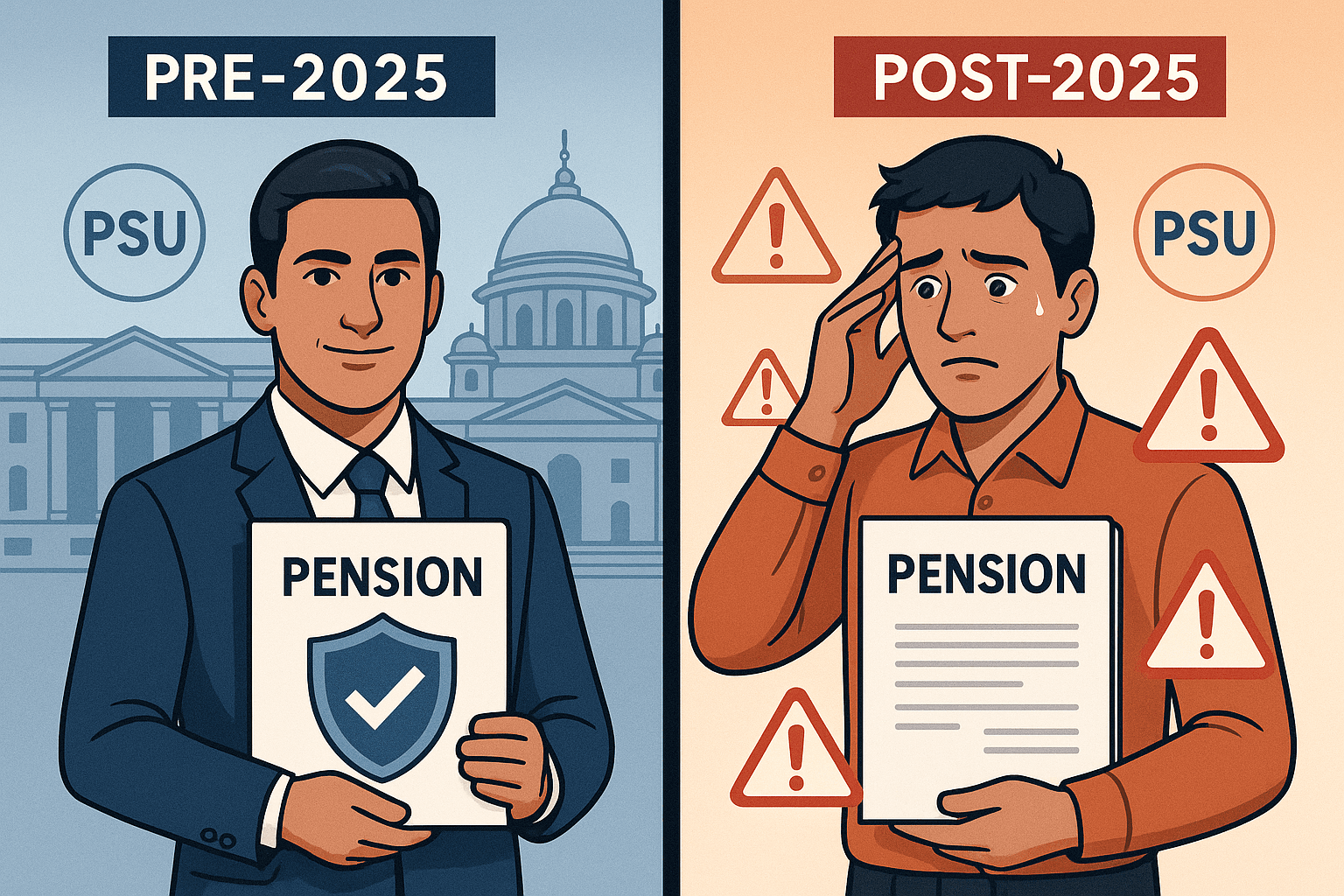
- Before (Pre-May 2025): PSU employees retained their government pension benefits even if dismissed from PSU service for misconduct
- After (May 2025): Dismissal from a PSU for misconduct can now lead to forfeiture of ALL retirement benefits, including those earned during government service
- Scope: Applies to employees originally appointed to government service on or before 31 December 2003 who were later absorbed into PSUs
Official Source: Department of Pension & Pensioners' Welfare | DoPT Circulars
The 7 Retirement Benefits Now at Risk

Based on official government notifications, the following retirement benefits can now be forfeited for PSU employees dismissed for misconduct:
- Monthly Pension — Basic pension from government service period. Complete forfeiture possible.
- Family Pension — Benefit payable to family members (typically 50% of basic pension). Complete forfeiture possible.
- Provident Fund — Accumulated PF from government service, including employer contributions. Subject to forfeiture provisions.
- Gratuity — Lump sum calculated as Last Drawn Salary × 15/26 × completed years. Complete forfeiture possible.
- Dearness Allowance (DA) — Inflation-linked allowance on pension. Complete forfeiture possible.
- 7th Pay Commission Benefits — Enhanced pension under 7th CPC, including arrears. Complete forfeiture possible.
- Leave Encashment — Encashment of earned leave (up to 300 days). Subject to CCS (Leave) Rules provisions.
Who Is Affected by the CCS Amendment
Eligibility Criteria
The amendment specifically applies to employees who meet ALL of the following:
- Original Appointment: Government service on or before 31 December 2003
- Current Status: Absorbed in a Public Sector Undertaking
- Service Type: Transferred en-masse during departmental conversion to PSU
- Risk Factor: Potential for misconduct-based dismissal
PSU Categories Covered
- Maharatna PSUs (e.g., ONGC, Coal India, NTPC)
- Navratna PSUs (e.g., BHEL, GAIL, NLC India)
- Miniratna PSUs
- Other Central PSUs and departmental undertakings converted to PSU status
According to government data, approximately 2.5 lakh employees across 56 major PSUs could be affected.
Safeguards and Appeal Process

Built-in Protections
- Administrative Ministry Review — All dismissal decisions must be reviewed by the concerned ministry before pension forfeiture takes effect
- Due Process — Fair inquiry, employee representation, natural justice principles, and documentary evidence are mandatory
- Constitutional Safeguards — Article 14 (equality), pension as property right doctrine, and proportionality of punishment
Appeal Mechanisms
- First Appeal: To the appointing authority's superior
- Second Appeal: Administrative ministry level
- Central Administrative Tribunal (CAT)
- High Court under Article 226
Action Steps for Government and PSU Employees
If You're a Central Government Employee (NPS Subscriber)
- Evaluate UPS — If you value pension certainty over market-linked growth, the UPS may be a better fit. The option window has closed for existing employees, but new joinees can still choose.
- Use the NPS Calculator — Compare your projected NPS corpus with the assured UPS pension. Our NPS Calculator can help you estimate returns.
- Understand the one-way switch — If you've already opted for UPS, you can switch back to NPS once. But the reverse (NPS to UPS) is no longer available for those who missed the deadline.
If You're a PSU Employee (Pre-2003 Appointee)
Immediate Actions
- Document Review — Obtain your original government appointment order, service records, absorption/transfer documents, and pension calculation worksheets
- Risk Assessment — Review performance records, address pending disciplinary matters, ensure compliance with PSU conduct rules
- Legal Preparation — Consult a pension law specialist to understand your exposure under the amended Rule 37(29C)
Long-term Strategy
- Diversify Retirement Planning — Don't rely solely on pension. Consider PPF, mutual funds (via SIP), and other investments
- Maintain Exemplary Conduct — The amendment only triggers on misconduct-based dismissal. A clean record is your best protection.
- Stay Updated — Monitor DoPT circulars and legal challenges. Constitutional law experts suggest the amendment may face challenges on grounds of retrospective application and proportionality.
For Families and Dependents
- Ensure all nominee documents are updated
- Understand family pension entitlements under both UPS and NPS
- Consider life insurance to supplement pension income
8th Pay Commission and Pension Impact
The 8th Central Pay Commission, approved by the Union Cabinet in January 2025, is expected to revise salaries, allowances, and pensions for central government employees and retirees effective 1 January 2026. This will affect pension calculations under both UPS and NPS, potentially increasing the assured pension amounts under UPS as basic pay levels are revised upward.
Frequently Asked Questions (FAQs)
What is the Unified Pension Scheme (UPS)?
The UPS is a voluntary pension scheme for Central Government employees, launched on 1 April 2025. It guarantees a pension of 50% of average basic pay (last 12 months) for employees with 25+ years of service, with a minimum pension of ₹10,000/month after 10 years.
Can private sector employees opt for UPS?
No. UPS is only available for Central Government employees and state government employees in states that have adopted it (Maharashtra, Uttarakhand, Goa, Assam). Private sector employees should continue with NPS or other retirement options.
Is UPS better than NPS?
It depends on your priorities. UPS offers guaranteed, inflation-indexed pension — ideal for risk-averse employees. NPS offers market-linked growth with potentially higher returns but no guarantee. Use our NPS Calculator to compare projected outcomes.
Can I switch from UPS back to NPS?
Yes. The government allows a one-time, one-way switch from UPS back to NPS at any point during service. However, you cannot switch from NPS to UPS after the option window has closed.
Does the CCS amendment affect all PSU employees?
No. It only applies to employees originally appointed to government service on or before 31 December 2003 who were later absorbed into PSUs. Employees hired directly by PSUs are not affected.
What constitutes "misconduct" under the CCS amendment?
Misconduct is defined per the respective PSU's conduct rules and generally includes corruption, insubordination, unauthorized absence, and breach of discipline.
How does the 8th Pay Commission affect pensions?
The 8th CPC (effective January 2026) will revise basic pay scales upward, which in turn increases the assured pension under UPS (calculated as 50% of average basic pay). NPS pensioners may also benefit from higher contributions.
Official Resources
- UPS — Department of Financial Services (Official)
- PFRDA — Unified Pension Scheme
- Department of Pension & Pensioners' Welfare
- DoPT Circulars Portal
- Central Pension Accounting Office
Disclaimer
This article is for informational purposes only and does not constitute legal or financial advice. Pension rules are subject to change based on government notifications. Individuals should consult qualified professionals for advice specific to their circumstances. Use our NPS Calculator for retirement planning estimates — actual pension amounts will depend on final government rules and pay commission recommendations.
Related Guides
Written by
Jaspal Singh
Founder & Editor
Personal finance writer helping Indians make smarter money decisions through clear, jargon-free guides on taxes, investments, and budgeting.
Continue Reading

Gold, Silver Import Duty Raised to 15%: What It Means for Prices, Rupee, and India's Trade Balance
India has raised import duty on gold and silver to 15% from 6%. Here is what the move means for bullion demand, trade deficit, forex reserves, and everyday buyers.
Your Take-Home Salary Just Got Cut — Here’s Why
From April 2026, your basic pay must be at least 50% of your CTC. That means lower take-home pay but significantly higher EPF and gratuity. Here’s what changed and what it means for your wallet.
Silver Loans Are Now Legal in India — Here’s How to Get One
From April 1, the RBI allows banks and NBFCs to give loans against your silver jewelry and coins. Up to 85% LTV, 10kg silver limit, and strict borrower protections. Here’s everything you need to know.