US Fed Rate Decision: How It Impacts Indian Markets, Rupee & Investors
Jaspal Singh
Author
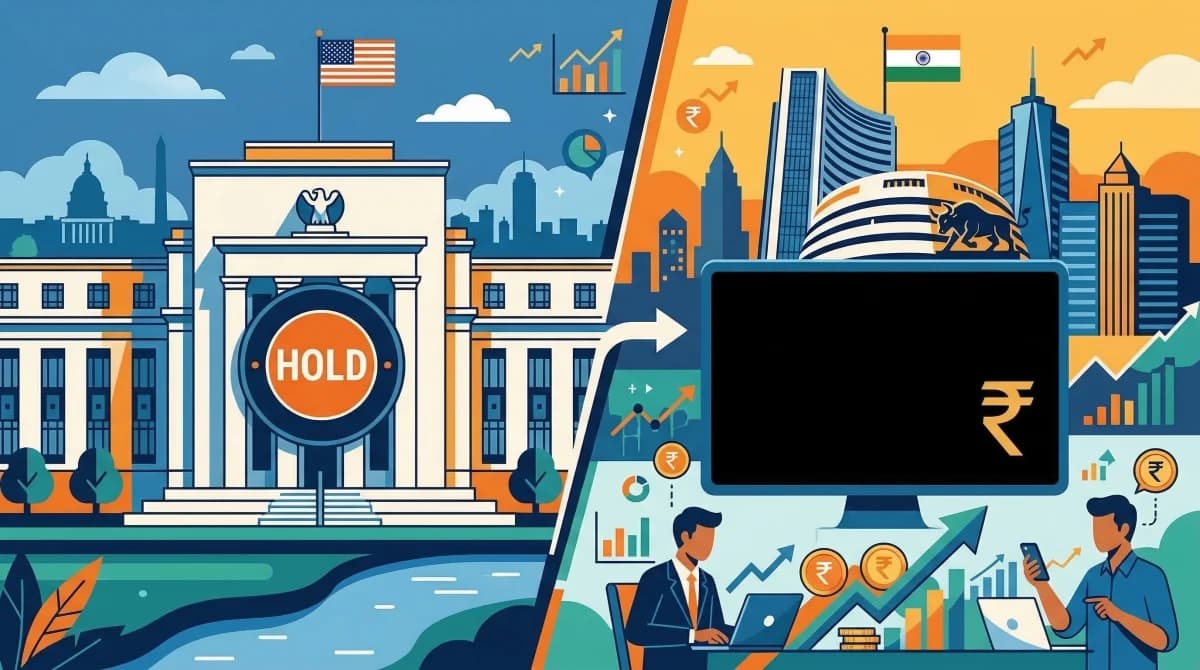
Every US Federal Reserve rate decision sends shockwaves through Indian markets — sometimes within minutes. The rupee moves, FIIs reposition, IT stocks swing, gold reacts. Most retail investors panic-respond without understanding why the connection exists. This article explains the four channels through which Fed decisions actually affect Indian investors — and what to do (or not do) when the next decision lands.
We'll use the March 2026 Fed pause — when the Fed held rates steady amid the Iran crisis and oil at $100+ — as a case study, because it captured all four transmission channels in a single decision.
Last updated: 5 May 2026
Case Study: The March 2026 Fed Pause
The US Federal Reserve wraps up its two-day meeting on March 19, 2026, and the verdict is almost certain — rates will stay at 3.5% to 3.75%. Markets are pricing in a 99% probability of no change.
But here's the thing: the reason the Fed is standing pat matters more than the decision itself. Two months ago, most analysts expected at least two rate cuts in 2026. Now? We might not see even one.
Why the Fed Can't Cut Rates Right Now
One word: Iran.
The ongoing conflict in the Middle East has pushed crude oil prices to around $100 per barrel. That's a problem. Higher oil means higher inflation — exactly what central banks have been fighting for the past three years.
Just when inflation was cooling down globally, oil prices have thrown a spanner in the works. The Fed is now stuck between two bad choices:
- Cut rates → risk inflation flaring up again
- Keep rates high → risk slowing the economy further
For now, the Fed is choosing to wait and watch. Some analysts even warn that if oil stays above $100 for long, the next move could be a rate hike, not a cut.
How Does This Affect Indian Markets?
Every time the Fed speaks, Indian markets listen. Here's the chain reaction:
1. The Rupee Stays Under Pressure
When US rates stay high, the dollar stays strong. A strong dollar means a weaker rupee. India imports over 80% of its crude oil — so a weak rupee + expensive oil = higher import costs. This squeezes everything from petrol prices to airline tickets.
2. Foreign Investors May Stay Away
High US interest rates make American bonds more attractive than Indian stocks. Foreign Institutional Investors (FIIs) have already been net sellers in Indian markets this year. If the Fed signals rates will stay high through 2026, more money could flow out of India.
3. IT Stocks Could See Mixed Impact
Indian IT companies earn most of their revenue in dollars. A strong dollar helps their earnings. But if the US economy slows down (because of high rates), American companies may cut their tech spending — which hurts demand for Indian IT services.
4. Gold Gets a Boost
Uncertainty is gold's best friend. With war, inflation fears, and rate confusion, gold has already hit record highs above ₹1.70 lakh per 10 grams in India. If the Fed's outlook remains hawkish, gold could climb even higher.
What About Rate Cuts Later This Year?
The Fed will also release its Summary of Economic Projections (the famous "dot plot") at this meeting. This will tell us how many cuts Fed officials expect in 2026.
Current market expectations:
- Before the Iran war: 2 rate cuts expected in 2026
- Now: Maybe 1 cut, probably in December — or none at all
Fewer rate cuts mean tighter financial conditions globally for longer. That's not great news for emerging markets like India.
What Should Indian Investors Do?
Don't panic, but do prepare:
- Stay diversified. Don't put all your money in equities. A mix of stocks, debt funds, and gold helps in uncertain times.
- Keep your SIPs running. Market dips driven by global events are temporary. Use our SIP calculator to see how consistent investing beats timing the market.
- Consider debt funds. With Indian interest rates still relatively high, short-to-medium duration debt funds offer decent returns with lower risk.
- Watch the rupee. If you're investing in international funds or planning foreign travel, the rupee's direction matters. A weaker rupee makes foreign investments more expensive.
- Don't ignore gold. A small allocation (5–10% of your portfolio) to gold — via ETFs or sovereign gold bonds — can act as insurance against global chaos.
The Bigger Picture
India's economy is in a fundamentally different place than the US. Our growth rate is strong, domestic consumption is rising, and the RBI has been cutting rates (the last cut brought the repo rate down). But we don't operate in isolation — global liquidity, oil prices, and FII flows all affect us.
The Fed's decision today won't crash Indian markets. But it sets the tone for how much foreign money flows into (or out of) India over the coming months. Stay informed, stay invested, and stay patient.
Frequently Asked Questions
Why does a US Fed decision move Indian markets?
The transmission happens through four channels: (1) Rupee — higher US rates pull capital toward dollar, weakening rupee; (2) FII flows — global investors rebalance from emerging markets to US assets when US yields rise; (3) IT stocks — Indian IT exporters benefit from a weaker rupee but suffer from US recession risk; (4) Gold — moves inversely to dollar strength.
Should I sell stocks before a Fed announcement?
No. Fed announcements rarely justify panic selling. Most market moves are temporary (1-3 days), and over a 5+ year horizon, individual Fed decisions are noise. SIP investors should ignore Fed dates entirely; lump-sum investors should use Fed-induced dips as buying opportunities, not selling triggers.
What happens to home loan EMIs when the Fed cuts rates?
Indirectly: a Fed cut tends to push the rupee stronger, easing inflation, giving RBI room to cut its repo rate. Lower repo means lower home loan rates (linked to RLLR). The chain takes 1-3 months, not days.
How does a Fed rate hold affect Indian gold prices?
A Fed hold (no change) usually keeps gold range-bound. A Fed cut weakens the dollar and pushes gold up. A Fed hike strengthens the dollar and pulls gold down. Gold is essentially a bet on dollar weakness.
When does the Fed announce rate decisions?
The FOMC (Federal Open Market Committee) announces rate decisions 8 times a year — typically in late January, March, May, June, July, September, November, and December. Each meeting is followed by a press conference and "dot plot" projections. Indian market traders watch the dot plot more closely than the rate change itself.
Disclaimer: This article is for educational purposes only and does not constitute financial advice. Please consult a qualified financial advisor before making investment decisions.
Written by
Jaspal Singh
Founder & Editor
Personal finance writer helping Indians make smarter money decisions through clear, jargon-free guides on taxes, investments, and budgeting.
Continue Reading

Gold, Silver Import Duty Raised to 15%: What It Means for Prices, Rupee, and India's Trade Balance
India has raised import duty on gold and silver to 15% from 6%. Here is what the move means for bullion demand, trade deficit, forex reserves, and everyday buyers.
Your Take-Home Salary Just Got Cut — Here’s Why
From April 2026, your basic pay must be at least 50% of your CTC. That means lower take-home pay but significantly higher EPF and gratuity. Here’s what changed and what it means for your wallet.

Silver Loans Are Now Legal in India — Here’s How to Get One
From April 1, the RBI allows banks and NBFCs to give loans against your silver jewelry and coins. Up to 85% LTV, 10kg silver limit, and strict borrower protections. Here’s everything you need to know.