How to Read Daily Indian Stock Market Movements: A Complete Framework
Jaspal Singh
Author

Open any business newspaper or news app at 4 PM and you'll see breathless coverage: "Sensex falls 800 points!" or "Nifty hits new high!". Most retail investors panic-respond, ignoring that these moves often unwind within days. This article gives you the framework professionals use to read daily Indian stock market movements — distinguishing signal from noise.
You'll learn how to interpret FII/DII data, why sector rotation matters more than headline index moves, what oil prices and rupee tell you about tomorrow, and the daily data points that genuinely move markets vs the noise that doesn't.
The world of stock markets is inherently volatile, magnified further by geopolitical issues such as trade tariffs. The recent market performance on April 9, 2025, exemplifies this scenario, with the Sensex and Nifty indices witnessing significant declines. This blog post aims to provide a comprehensive analysis of the factors influencing these downturns and offers insights into potential next steps for investors.
April 9, 2025 Market Recap
In a significant move, global trade tensions have again rattled investors, contributing to a volatile trading day in Indian markets. The Sensex closed with a decline of 379.93 points, or 0.51%, settling at 73,847.15. Simultaneously, the Nifty was down by 136.70 points, or 0.61%, ending at 22,399.15. These declines highlight the growing concerns regarding the broader economic implications of increased tariffs imposed by the United States.
Impact of Tariffs: A Double-Edged Sword
The Tariff Scenario
The U.S. government's decision to enforce a 26% tariff on Indian goods has spurred investor anxiety. This tariff imposition is presumed to affect several sensitive sectors with U.S. exposure, notably the IT and pharmaceutical industries.
Broader Market Reactions
While market declines were prevalent, sectoral performances varied:
- IT and Pharma Sectors: Both sectors exhibited significant downturns, with IT alone dropping by 2.3%. We anticipated this reaction, given their significant reliance on the U.S. for a substantial portion of their revenues.
- Consumer Durables and FMCG: Contrary to the general trend, these sectors managed to stay afloat, with FMCG gaining 1.5%. External trade dynamics generally have less impact on these sectors, which explains their resilience.
Sectoral Performance: Winners and Losers
Major Winners
- Nestle and HUL led the charge among gainers, benefiting from domestic demand resilience and limited international vulnerability.
- Tata Consumer and Titan Company also posted positive performance, underscoring the strength of consumer-focused businesses.
Major Losers
- Companies such as Wipro, SBI, Tech Mahindra, L&T, and Trent were among the primary losers on the Nifty, indicative of their significant exposure to international markets and resulting vulnerability to global trade policies.
Key Insights from Analysts
Prashanth Tapse, Mehta Equities
Prashanth Tapse underlined the potential for continued volatility, driven by investor caution following the imposition of differential tariffs. With external factors now contributing to market uncertainty, the expectation is for measured and cautious investment decisions moving forward.
Rajesh Sinha, Bonanza
According to Rajesh Sinha, despite the RBI's attempts to enhance economic activity through interest rate cuts, global factors, predominantly tariffs, have overshadowed domestic efforts, contributing substantially to subdued market sentiment.
Investor Guidance: Navigating Uncertainty
Investors need to adopt a strategic approach in light of the recent market developments:
- Diversification: Investors should consider diversifying their portfolios to include sectors like FMCG and domestic-focused stocks, which are less vulnerable to external shocks.
- Short-Term Caution: Given the technical indicators, including the RSI showing bearish tendencies and resistance observed near crucial levels such as 22,500, a cautious stance is advisable for short-term investors.
- Focus on Fundamentals: While market fluctuations can be challenging, a focus on strong fundamental stocks that demonstrate resilience amid volatility is critical.
Finally
As global trade dynamics shift, the interplay between international policies like tariffs and market performances continues to present challenges and opportunities. Understanding these dynamics, maintaining diverse portfolios, and aligning with robust sectors are vital strategies for navigating the current market landscape.
Frequently Asked Questions
What time does the Indian stock market open and close?
The Indian stock market (NSE and BSE) operates Monday to Friday, 9:15 AM to 3:30 PM IST. Pre-open session runs 9:00-9:15 AM (price discovery). Post-close session is 3:40-4:00 PM (some block deals). Equity F&O segment also runs 9:15 AM - 3:30 PM. Currency derivatives: 9:00 AM - 5:00 PM. Markets are closed on weekends and notified holidays (Republic Day, Holi, Diwali, etc.).
Why do Sensex and Nifty move differently sometimes?
Sensex tracks 30 large-cap stocks; Nifty 50 tracks 50. Different weights mean they can diverge — a sharp move in HDFC Bank (high weight in both) moves both indices similarly, but a move in Reliance vs Infosys may affect them differently. Generally, Nifty is the better daily indicator because of its broader composition.
What does FII selling tell me about the market?
FII (Foreign Institutional Investor) data is published daily at ~6 PM by NSE. Sustained FII selling (₹1,000+ crore daily for 5+ days) signals: dollar strengthening, US rates rising, geopolitical tensions, or oil/commodity shocks. Single days of large selling are often noise. Watch the 5-day cumulative number, not single-day spikes.
How does the rupee affect Indian stocks?
A weakening rupee hurts: airlines, oil marketing companies, importers, FMCG. It helps: IT services, pharma, textile exporters. A 1% rupee depreciation typically causes 0.5-1% Nifty volatility. Sustained rupee weakness (3+ months below trend) usually correlates with FII outflows and mid-cap underperformance.
What is sector rotation in Indian markets?
Sector rotation is when investor money moves from one sector to another based on macro changes. Example: when interest rates rise, IT and banks gain (rate-sensitive plays); when rates fall, real estate and auto gain. Tracking sector rotation gives early signals — when defensive sectors (FMCG, pharma) outperform, markets are turning cautious.
Why do markets often fall on Mondays?
Statistically, Mondays carry slightly more volatility because: (a) two days of weekend news (US data, geopolitics) gets priced in at once; (b) Friday closes often see profit-booking that flips to selling on Monday; (c) global markets that traded over the weekend (US, Europe) influence Monday opens. The "Monday effect" isn't universal but exists on average.
Should I panic when the Sensex falls 1000+ points?
1000 points on a 75,000 base is 1.3% — historically routine. Indian markets see 5-10 days per year with 1.3%+ moves. Daily moves matter only when accompanied by: sustained volume, broad-based selling across sectors, rupee weakness, FII outflows. Single big-down days that reverse the next day are noise.
How do US markets affect Indian stocks the next day?
S&P 500 movements typically cause 30-50% directional follow-through on the next Indian session — strong US gains lift Nifty, US falls drag it. The transmission is via: (1) Asian markets opening first, (2) FII overnight orders, (3) global risk sentiment. SGX Nifty (now NSE IFSC Nifty) gives early hints during Indian pre-open.
What data points should I watch daily?
Five core daily data points: (1) Nifty 50 close and breadth (advance/decline ratio); (2) FII/DII activity (after 6 PM); (3) USD/INR close; (4) Brent crude price; (5) India VIX. Together these tell you whether a market move is technical noise or a genuine shift.
Should I trade based on daily market news?
Almost never. Daily news is mostly noise — the actual signal-to-noise ratio of news is below 5%. SIP investors should ignore daily news entirely. Long-term investors should glance at it but never trade based on it. Daily trading requires deep technical skills and is unprofitable for 95%+ of retail participants.
Written by
Jaspal Singh
Founder & Editor
Personal finance writer helping Indians make smarter money decisions through clear, jargon-free guides on taxes, investments, and budgeting.
Continue Reading

Gold, Silver Import Duty Raised to 15%: What It Means for Prices, Rupee, and India's Trade Balance
India has raised import duty on gold and silver to 15% from 6%. Here is what the move means for bullion demand, trade deficit, forex reserves, and everyday buyers.
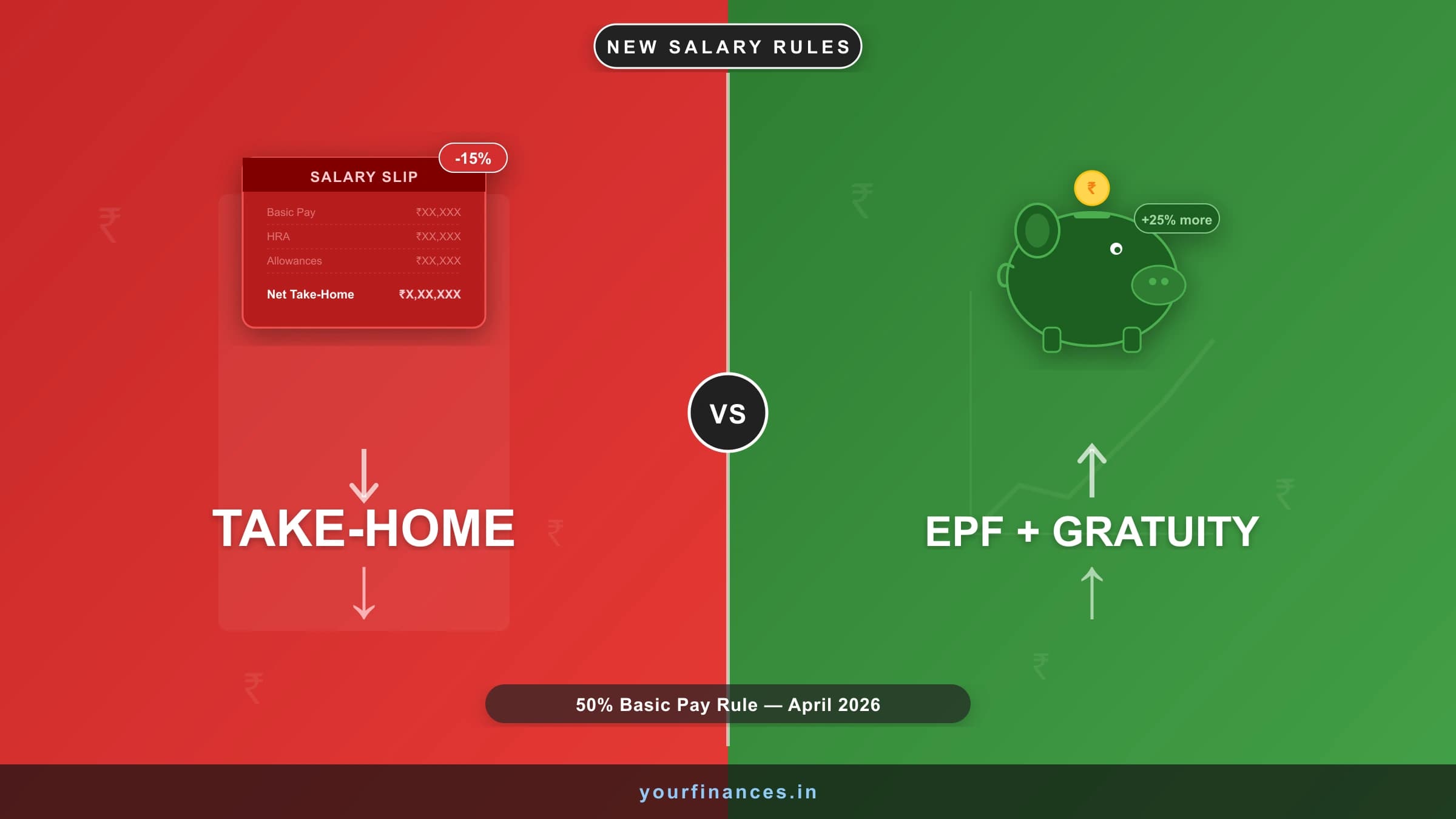
Your Take-Home Salary Just Got Cut — Here’s Why
From April 2026, your basic pay must be at least 50% of your CTC. That means lower take-home pay but significantly higher EPF and gratuity. Here’s what changed and what it means for your wallet.

Silver Loans Are Now Legal in India — Here’s How to Get One
From April 1, the RBI allows banks and NBFCs to give loans against your silver jewelry and coins. Up to 85% LTV, 10kg silver limit, and strict borrower protections. Here’s everything you need to know.