Stock Market Crash: A Complete Investor's Survival Guide
Jaspal Singh
Author
The Indian stock market crash is significant now, reflecting broader global concerns spurred by the US tariff increases and growing fears of a recession.
The Sensex and Nifty, two of India's premier stock indices, witnessed their steepest single-day fall in months, shedding a substantial amount of investor wealth.
Also read - 10 Common Stock Market Mistakes to Avoid in India
While these developments might unsettle market participants, experts urge investors not to succumb to panic over short-term "˜noise'.
Here's why maintaining composure during market fluctuations could benefit investors in the long run.
Last updated: 6 May 2026
Understanding the Market Crash: A Snapshot
Indian stock markets plummeted sharply as global apprehension set in following President Donald Trump's escalated tariff measures, which have heightened fears of a global recession.
On the opening day of the downturn, Nifty50 plunged by 1,150 points or 5%, recording its most severe single-day decline since the COVID-19 crisis in March 2020. While the indices managed a partial recovery by the session's end, closing 726 points down was still a significant drop.
- Sensex and Nifty Performance: Beyond the daily fluctuations, the larger impact was visible as investor wealth eroded by Rs 14 lakh crore due to a global market meltdown over recession concerns. The total market capitalisation of BSE-listed companies fell to Rs 3,89,25,660.75 crore (USD 4.54 trillion).
- Sectoral Losses: The Metal Index fell nearly 7% amid escalating US-China tensions, with China imposing restrictions on rare metal exports. The Nifty IT index also suffered, emphasizing the US as a crucial market for India's tech services.
Short-Term Market Outlook
Market analysts predict ongoing volatility, postulating that the turbulence from tariff anxieties might extend into the next two quarters. Technical analysis shows critical support and resistance levels, with risks of further declines if markets break past established support zones. Despite these immediate challenges, experts like Rahul Jain from Nuvama Wealth and Jigar S Patel from Anand Rathi stress the importance of not overreacting to daily market movements.
- Technical Analysis Indicators: A close below key support levels could signal further declines, while resistance levels hint at pivotal points for potential recoveries.
- Global Influences: Announcements from major economies like China regarding retaliatory tariffs could exacerbate market turbulence.
Long-Term Growth Potential Remains Robust
Despite immediate challenges, industry voices maintain an optimistic outlook for India's stock market driven by strong domestic fundamentals and strategic positioning against tariffs:
- Economic Fundamentals: India remains comparatively shielded from global anxieties due to lesser dependence on American exports and a reduction in tariffs compared to other nations.
- Macroeconomic Factors: Lower crude prices, moderating inflation, strong domestic institutional investments, and favorable weather forecasts (such as a positive monsoon projection) bolster India's economic forecast. These factors contribute to a stable foundation, ensuring long-term market resilience and recovery.
- Policy and Structural Strength: Analysts like Siddhartha Khemka from Motilal Oswal Financial Services emphasize India's structural strengths and policy resilience, which continue to attract investments.
Key Takeaways for Investors
- Stay Informed but Avoid Knee-Jerk Reactions: It's imperative for investors not to be swayed excessively by volatile short-term movements. Continuous monitoring and informed decision-making should guide investment strategies.
- Reevaluate Asset Allocations: Current market conditions provide an opportunity to assess and strategically rebalance investment portfolios, focusing on sectors with robust recovery potential.
- Patience and Strategic Planning: Given India's steady macroeconomic health, the market correction could present strategic entry points for long-term investors. Leveraging reduced asset valuations can yield future gains as the market stabilizes.
Investors are recommended to keep a balanced perspective, resisting impulsive actions driven by current market sentiment. By focusing on the broader economic context and underlying growth prospects, stakeholders are more likely to navigate these choppy waters advantageously.
Also read - Best Stocks to Buy Now in India for Long-Term Growth [2025]
Frequently Asked Questions
What causes a stock market crash?
Crashes are typically triggered by a combination: (1) macro shock — pandemic, war, oil crisis, banking failure; (2) excessive valuations entering the crash; (3) leveraged positions forcing forced selling; (4) liquidity withdrawal by FIIs or large investors. Single triggers rarely cause crashes — it's the combination of weak structure + shock that breaks markets.
Should I sell stocks during a market crash?
Almost never. Selling during crashes locks in losses and is statistically the worst time to exit. Indian markets have recovered from every major crash — 2008 (recovered in 18 months), 2020 COVID (recovered in 8 months), 2026 Iran crisis (recovered in 4 months). Investors who held through crashes outperformed those who tried to time exits.
How long do stock market crashes typically last?
Indian market crashes last 2-12 months in their bottom phase. Recovery to previous highs takes 6-24 months for most crashes. The 2008 crisis was the longest at ~18 months to bottom + 18 months to recover. The 2020 COVID crash bottomed in 1 month + recovered in 8 months — the fastest in modern history.
What stocks should I buy during a market crash?
Quality large-cap stocks with strong moats: HDFC Bank, ITC, TCS, Hindustan Unilever, Asian Paints, Reliance Industries. These companies have weathered every Indian crisis since 1990. Avoid penny stocks, leveraged companies, and PSU stocks during crashes — they may not survive prolonged downturns.
Should I stop my SIP during a market crash?
Absolutely not — that's mathematically the worst possible decision. Crashes mean lower NAVs, so your SIP buys more units. Investors who continued SIPs through 2008-09, 2020, and 2026 saw their best returns specifically because of crash-period accumulation. Use our SIP Calculator to model the impact.
How do I know if a market crash is over?
Three signals of bottoming: (1) VIX above 25 for 2+ weeks; (2) Capitulation selling — broad indiscriminate selling across sectors; (3) Sentiment extreme low — survey indicators, panic in social media, "market crash" headlines daily. None are 100% reliable; bottom-fishing requires patience.
Can I make money during a market crash?
Yes — but with cautious leverage and clear strategy. Three approaches: (1) Lump sum into quality stocks/ETFs during the crash; (2) Step-up SIPs — increase SIP amount by 30-50% during crashes; (3) STP from debt to equity — systematic transfer over 6-12 months. Avoid options trading during crashes — volatility kills both calls and puts.
What is the worst Indian stock market crash in history?
The 2008 global financial crisis was the worst — Sensex fell 60%+ from January 2008 peak (~21,000) to October 2008 low (~8,500). The 2020 COVID crash was sharpest (38% in 1 month). The 1992 Harshad Mehta scam crash and 2000 dotcom crash were also severe. Each was followed by multi-year bull runs.
Should I move to bonds during a crash?
Only if your asset allocation has drifted out of target. If you targeted 70:30 equity:debt and equity falls have made it 60:40, rebalance back to 70:30 by buying equity (counter-intuitive but profitable). Don't make full switches — they crystallize losses and miss recovery.
What is the best preparation for the next market crash?
Three preparations: (1) Emergency fund — 6-12 months of expenses in liquid funds (so you don't have to sell stocks during crashes); (2) Asset allocation discipline — never go 100% equity, maintain 20-30% in debt for rebalancing opportunities; (3) Cash reserves — 5-10% of investments in liquid funds for crash buying. Markets crash every 5-7 years; prepare during good times.
Related Guides
Written by
Jaspal Singh
Founder & Editor
Personal finance writer helping Indians make smarter money decisions through clear, jargon-free guides on taxes, investments, and budgeting.
Continue Reading

Gold, Silver Import Duty Raised to 15%: What It Means for Prices, Rupee, and India's Trade Balance
India has raised import duty on gold and silver to 15% from 6%. Here is what the move means for bullion demand, trade deficit, forex reserves, and everyday buyers.
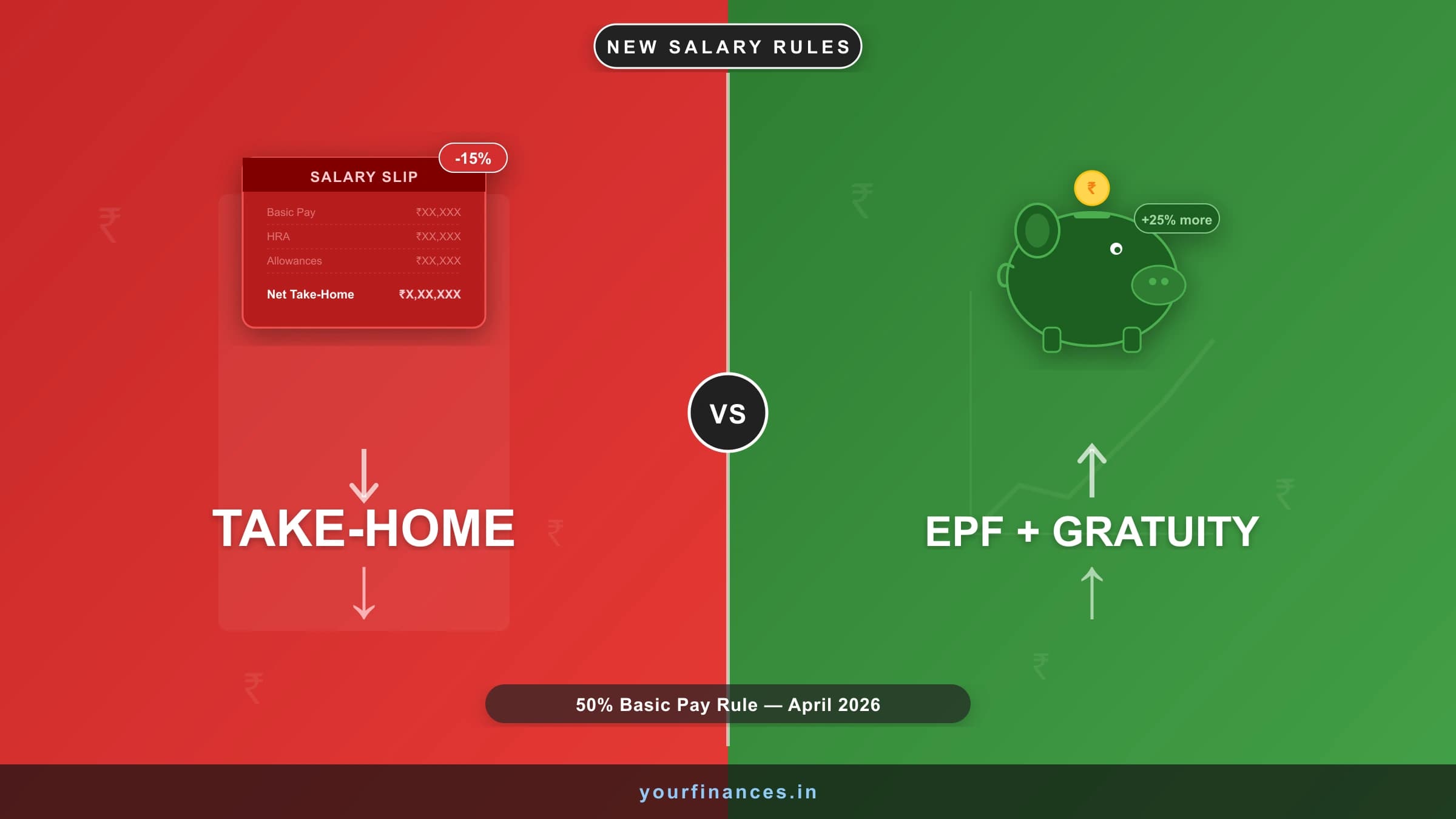
Your Take-Home Salary Just Got Cut — Here’s Why
From April 2026, your basic pay must be at least 50% of your CTC. That means lower take-home pay but significantly higher EPF and gratuity. Here’s what changed and what it means for your wallet.

Silver Loans Are Now Legal in India — Here’s How to Get One
From April 1, the RBI allows banks and NBFCs to give loans against your silver jewelry and coins. Up to 85% LTV, 10kg silver limit, and strict borrower protections. Here’s everything you need to know.