What Happens If Oil Hits $100 Again? The Impact on India Economy
Jaspal Singh
Author
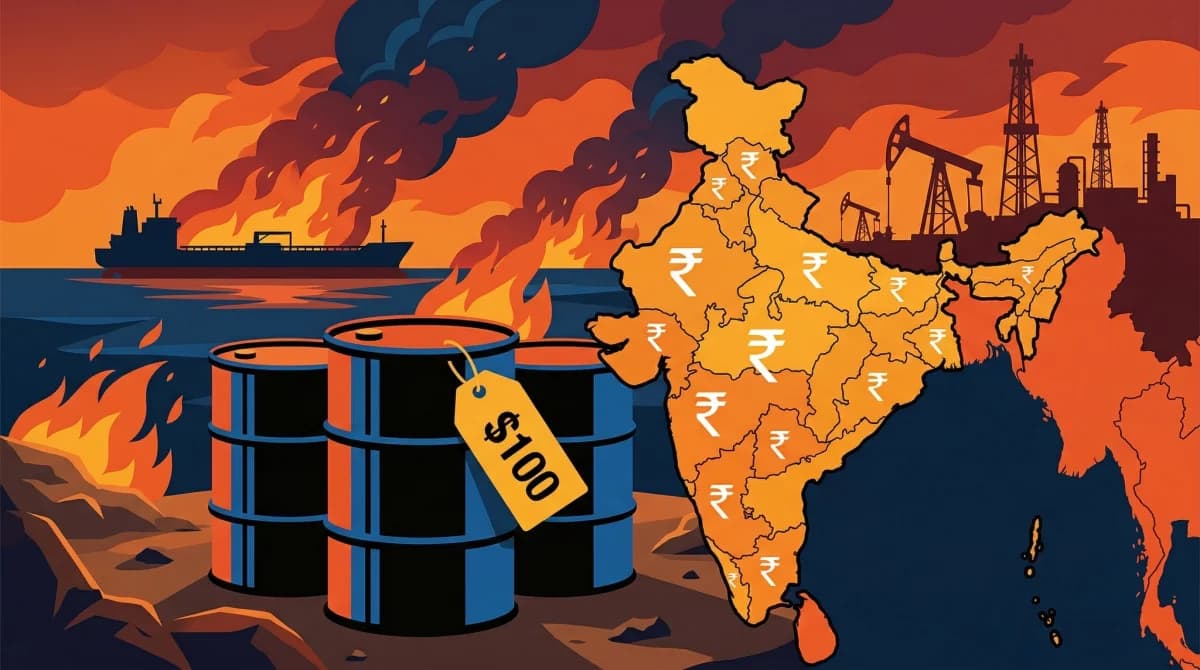
Imagine you run a kitchen that needs cooking oil every single day. You buy 85% of your oil from a shop across a bridge. Now, someone has blocked that bridge. The shop is still there, but you can't easily get to it. So the little oil available near you becomes very, very expensive.
That's roughly what's happening to India right now — except the "cooking oil" is crude oil, the "bridge" is the Strait of Hormuz, and the blockage is the US-Israel war with Iran.
On March 9, 2026, Brent crude oil crossed $100 per barrel for the first time since Russia invaded Ukraine in 2022. It even touched $119 at one point before cooling to around $103. This isn't just a number on a trading screen — it directly affects the price of petrol in your car, the LPG cylinder in your kitchen, and even the cost of tomatoes at your local sabzi mandi.
Let's break it all down in simple terms.
What's Happening in the Middle East?
In late February 2026, the United States and Israel launched joint military strikes on Iran. Iran retaliated by targeting ships in the Strait of Hormuz — a narrow waterway between Iran and Oman through which roughly 20% of the world's oil supply passes every day.
Think of the Strait of Hormuz as a one-lane highway for oil tankers. When Iran's military started threatening ships passing through, most tankers simply stopped going. The result?
- Iraq's oil production collapsed by 70% — from 4.3 million barrels per day to just 1.3 million
- Kuwait cut production because it can't safely ship oil out
- The UAE is carefully rationing its offshore output
- About one-fifth of global crude and natural gas supply has been suspended
According to energy consulting firm Rapidan Energy, this is the biggest oil supply disruption in history.
Where Are Oil Prices Right Now?
| Benchmark | Price (March 9, 2026) | Weekly Change |
|---|---|---|
| Brent Crude (Global) | ~$103–104/barrel | +35% this week |
| WTI (US) | ~$101/barrel | +30% this week |
| Brent (Intraday High) | $119/barrel | Highest since 2022 |
Oil has surged 91% in just three months — the biggest three-month jump in 36 years. Analysts warn that if the Strait of Hormuz remains blocked, oil could hit $150/barrel by end of March.
Why Should Indians Care?
Here's the simple truth: India imports over 85% of its crude oil. We are the world's third-largest oil importer. And roughly half of our crude imports pass through the Strait of Hormuz — from Iraq, Saudi Arabia, UAE, and Kuwait.
Even more critically, 80–85% of India's LPG (cooking gas) comes through this same route.
So when oil prices shoot up globally, India gets hit harder than most countries.
The Numbers That Matter
- Every $10/barrel increase in crude oil adds $14–16 billion to India's annual oil import bill
- Every $1 rise in crude increases India's import bill by roughly ₹16,000 crore
- If crude averages $110–115/barrel in FY27, India's oil import bill could balloon by $56–64 billion
Impact on Petrol, Diesel, and LPG
Here's what's already happened and what could follow:
LPG Cylinder Prices — Already Up
From March 7, 2026, domestic LPG cylinder prices (14.2 kg) were hiked by ₹60 — the first major revision in nearly a year. Commercial cylinders (19 kg) used by restaurants and hotels saw a bigger jump of ₹115.
If you're a Pradhan Mantri Ujjwala Yojana beneficiary, you still get a subsidy of around ₹300 per cylinder, bringing your effective cost to about ₹613.
Petrol and Diesel — Stable For Now, But...
As of today, petrol and diesel prices haven't been hiked in major cities. But analysts say this calm won't last. If crude stays above $100/barrel, fuel price hikes of ₹5–10 per litre could become unavoidable in the coming weeks.
Remember: higher diesel prices don't just mean more expensive road trips. Diesel powers trucks that carry your food, goods, and raw materials. When diesel gets costlier, everything gets costlier.
How This Hits India's Economy
1. Inflation Goes Up
India's retail inflation had come down to a comfortable 1.7% in 2025-26. But every $10/barrel increase in crude pushes CPI inflation up by 40–60 basis points and WPI inflation by 80–100 basis points.
If crude stays at $110+, expect food prices, transport costs, and manufactured goods to become noticeably more expensive in the next 2–3 months.
2. Current Account Deficit (CAD) Widens
India's CAD was a healthy 0.8% of GDP in H1 FY26. But every $10/barrel rise widens CAD by 30–40 basis points. At $120/barrel, India's oil trade deficit could hit $220 billion, pushing CAD beyond 3% of GDP — a danger zone.
3. Rupee Weakens
The Indian rupee has already hit a record low of ₹92.18 against the US dollar. A weaker rupee makes oil imports even more expensive (since oil is priced in dollars), creating a vicious cycle.
4. Stock Market Takes a Hit
On March 9, the Sensex crashed 1,353 points to close at 77,566 — its lowest since April 2025. The Nifty fell 422 points to 24,028. Foreign investors (FIIs) sold ₹3,296 crore worth of Indian stocks in a single day.
If you have a SIP (Systematic Investment Plan) running, don't panic. Market corrections during geopolitical crises are temporary. In fact, continuing your SIP during downturns helps you buy more units at lower prices — a strategy called rupee cost averaging.
5. Fiscal Deficit Pressure
India's fiscal deficit target for FY27 is 4.3% of GDP. If the government absorbs part of the oil price rise through subsidies (to avoid passing full costs to consumers), the fiscal deficit could overshoot. That means less money for roads, schools, and hospitals.
Does India Have Enough Oil Reserves?
Petroleum Minister Hardeep Singh Puri told Parliament that India has oil and petroleum product reserves for 74 days. Here's the breakdown:
| Type | Capacity | Days of Supply |
|---|---|---|
| Strategic Petroleum Reserves (SPR) | 5.33 million metric tonnes | ~9.5 days |
| Commercial Storage (OMCs) | — | ~64.5 days |
| Total | — | ~74 days |
India's strategic reserves are stored underground at Mangaluru, Visakhapatnam, and Padur (Karnataka). Two new facilities at Chandikhol and Padur are being built to add another 12 days of reserve capacity.
74 days sounds reasonable, but if the Hormuz crisis drags on for months, it won't be enough. India will need to diversify supply routes — buying more from the US, Russia, and West Africa.
What About the G7 Emergency Reserve Release?
There's some good news. On March 9, French President Emmanuel Macron (currently leading the G7) confirmed that "the use of strategic reserves is an envisaged option." G7 finance ministers are discussing a coordinated release of 300–400 million barrels from global stockpiles.
Three G7 countries, including the US, have already expressed support. If it happens, it would be the biggest coordinated oil market intervention since the Russia-Ukraine war in 2022. This news alone pulled oil prices back from $119 to around $103.
What Should You Do Right Now?
For Your Daily Budget
- Expect food prices to rise in 2–4 weeks as higher diesel costs hit the supply chain
- Stock up on LPG if you can — another price hike is possible in April
- Carpool or use public transport if petrol prices rise
- Review your monthly budget using a simple expense tracker
For Your Loans
If inflation rises, the RBI may pause or reverse rate cuts, which means your home loan and car loan EMIs could stay high for longer. If you're planning a big loan, consider locking in current rates before any hike.
For Your Investments
- Don't stop your SIPs. Market dips during crises are temporary. Use our SIP Calculator to see how staying invested through downturns builds wealth over the long term
- Avoid panic selling — FIIs are selling, but historically, markets recover within 6–12 months after geopolitical shocks
- Consider oil-linked funds if you believe the crisis will continue — but only with money you can afford to risk
- Gold may be a good hedge — it typically rises during global uncertainty
For Your Travel Plans
- Flight tickets may get costlier as jet fuel (ATF) prices rise
- Book any international travel soon before fares adjust upward
- Domestic airlines may add fuel surcharges
The Bottom Line
The Iran war and the Strait of Hormuz crisis are creating a perfect storm for India's economy. With oil above $100, the rupee at record lows, and stock markets sliding, things may get harder before they get better.
But India has been through oil shocks before — in 1990 (Gulf War), 2008 (financial crisis), and 2022 (Ukraine war). Each time, the economy adjusted, markets recovered, and life moved on.
The key is to stay informed, stay calm, and make smart financial decisions. Don't panic about your investments. Budget carefully for the next few months. And keep an eye on how the G7 reserve release and any ceasefire talks play out.
Stay alert. Stay financially prepared.
Disclaimer: This article is for informational purposes only and does not constitute financial advice. Oil prices and market conditions are highly volatile and can change rapidly. Please consult a qualified financial advisor before making investment decisions. The data and figures mentioned are based on publicly available reports as of March 9, 2026, and may have changed by the time you read this.
Update: Oil hit $108. Goldman Cuts India GDP Forecast to 5.9%
Written by
Jaspal Singh
Founder & Editor
Personal finance writer helping Indians make smarter money decisions through clear, jargon-free guides on taxes, investments, and budgeting.
Continue Reading

Gold, Silver Import Duty Raised to 15%: What It Means for Prices, Rupee, and India's Trade Balance
India has raised import duty on gold and silver to 15% from 6%. Here is what the move means for bullion demand, trade deficit, forex reserves, and everyday buyers.

Your Take-Home Salary Just Got Cut — Here’s Why
From April 2026, your basic pay must be at least 50% of your CTC. That means lower take-home pay but significantly higher EPF and gratuity. Here’s what changed and what it means for your wallet.

Silver Loans Are Now Legal in India — Here’s How to Get One
From April 1, the RBI allows banks and NBFCs to give loans against your silver jewelry and coins. Up to 85% LTV, 10kg silver limit, and strict borrower protections. Here’s everything you need to know.