10 Money Rules Changing in India: New Tax, Credit Card & TCS Rules
Jaspal Singh
Author
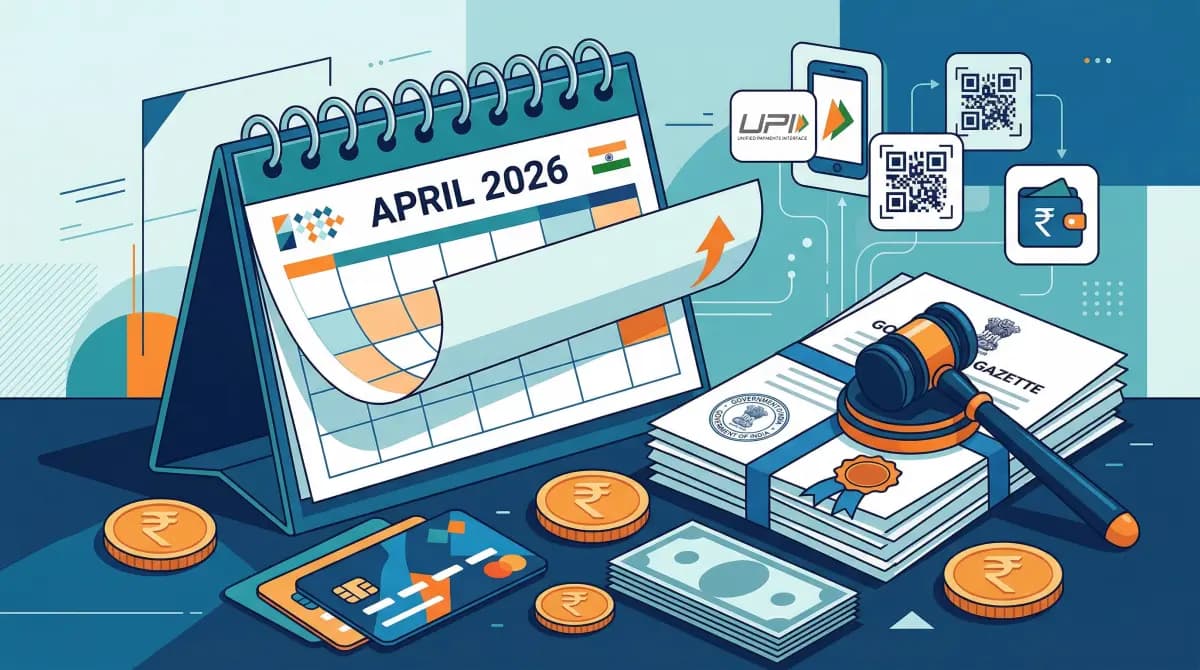
Every April 1 brings a fresh batch of financial rule changes. The set that took effect on 1 April 2026 was arguably the biggest overhaul in Indian tax and financial regulations in decades. The 63-year-old Income Tax Act has been replaced, derivatives traders now face steeper costs, and large credit card spends attract far more scrutiny than before.
Here are 10 money rule changes that affect your wallet, your investments, and your tax filing. Use our Tax Calculator to see how the new rules impact your tax liability.
Last updated: 28 July 2026
1. New Income Tax Act 2025 Replaces the 1961 Act
This is the headline change. The Income Tax Act, 1961 — which has been amended, patched, and modified over 4,000 times in 63 years — is finally being replaced by the new Income Tax Act, 2025. The new law takes effect from April 1, 2026, for the assessment year 2026-27.
The good news? The new Act is mostly a simplification and reorganisation of the existing law, not a fundamental change in tax rates or slabs. The number of sections has been reduced from over 800 to around 536, the language has been simplified, and redundant provisions have been removed. Your actual tax liability is unlikely to change significantly just because of this switch.
2. STT on Futures and Options Goes Up Sharply
If you trade in futures and options (F&O), brace yourself. The Securities Transaction Tax (STT) is getting a significant hike:
- Futures: STT increases from 0.02% to 0.05% (a 150% jump)
- Options: STT increases from 0.1% to 0.15% (a 50% jump)
For active traders doing crores in monthly turnover, this is a meaningful increase in transaction costs. The government has been vocal about discouraging speculative F&O trading — 93% of individual F&O traders lost money according to SEBI data — and this STT hike is the latest step in that direction. If you are a casual derivatives trader, this is another reason to reconsider whether F&O is the right strategy for you.
3. Sovereign Gold Bond Tax Exemption Gets Restricted
Until now, Sovereign Gold Bonds (SGBs) held to maturity were completely tax-free on capital gains — regardless of whether you were the original subscriber or bought them on the secondary market. From April 1, this tax exemption will apply only to original subscribers.
If you bought SGBs from the stock exchange (secondary market), the capital gains on maturity or redemption will now be taxable as per applicable rates. This is a significant change for investors who were buying discounted SGBs on exchanges specifically for the tax-free maturity benefit.
4. Credit Card Spends Over ₹10 Lakh to Be Reported
Starting April 1, if your total credit card spending exceeds ₹10 lakh in a financial year, your credit card company will report this to the Income Tax Department. This information will show up in your Annual Information Statement (AIS).
This does not mean you will be taxed on your credit card spending — it simply means the tax department will cross-check your spending against your declared income. If you are spending ₹10 lakh on credit cards but declaring an income of ₹5 lakh, expect a notice. For salaried employees with legitimate income, this should not be a concern.
5. TCS on Foreign Education and Medical Gets Cheaper
Here is some good news if you are sending a child abroad for studies. The Tax Collected at Source (TCS) on foreign remittances for education and medical purposes is being reduced from 5% to 2% (for amounts above ₹7 lakh in a financial year).
This means if you are remitting ₹20 lakh for your child's university fees, the TCS drops from ₹65,000 to ₹26,000 — a saving of ₹39,000. Remember, TCS is not an additional tax — it is collected upfront and can be claimed as a credit when you file your ITR. But the reduced rate means less money locked up with the government during the year.
6. TCS on Overseas Tour Packages Drops to Flat 2%
Planning a holiday abroad? The TCS on overseas tour packages has been simplified. Earlier, the rate was 5% up to ₹7 lakh and 20% above ₹7 lakh. From April 1, it becomes a flat 2% regardless of the amount.
For a ₹10 lakh international holiday package, the TCS drops from ₹95,000 (under the old slab structure) to just ₹20,000. Again, this is refundable when you file your ITR, but the cash flow benefit is significant.
7. MAT Rate Reduced to 14%
The Minimum Alternate Tax (MAT) rate is being reduced from 15% to 14%. This primarily affects companies, not individual taxpayers. But if you own or run a business, this marginal reduction lowers your effective tax floor, especially if your company has significant book profits but lower taxable income due to exemptions.
8. ITR-3 and ITR-4 Filing Deadline Extended to August 31
If you file ITR-3 (for individuals with business/professional income) or ITR-4 (for presumptive taxation), the filing deadline has been extended from July 31 to August 31, starting from the assessment year 2026-27.
This gives freelancers, consultants, small business owners, and professionals an extra month to get their books in order. However, this does not apply to salaried individuals filing ITR-1 or ITR-2 — their deadline remains July 31.
9. Form 15G/15H Can Be Submitted Directly to Depositories
Senior citizens and individuals with income below the taxable limit use Form 15G and 15H to avoid TDS on interest income. Until now, these forms had to be submitted to each bank or institution separately.
From April 1, you can submit Form 15G/15H directly to depositories (NSDL/CDSL), and it will automatically apply to all your demat-linked fixed deposits and bonds. This is a small but welcome simplification, especially for senior citizens who hold FDs across multiple banks. Check your FD returns with our FD Calculator.
10. Two-Factor Authentication Mandatory for All Digital Payments
The RBI has mandated that all digital payment transactions — including UPI, net banking, and card payments — must have two-factor authentication (2FA) from April 1. While UPI already uses a PIN, this rule extends stronger authentication requirements to all payment modes.
For consumers, this means slightly more friction during payments but significantly better security. With digital payment fraud on the rise, this is a necessary safeguard. Make sure your mobile number and email are updated with your bank to receive OTPs without issues.
The Bottom Line
Most of these changes are either simplifications or tweaks rather than dramatic overhauls. The big winners are:
- Parents sending children abroad — lower TCS on education
- International travellers — cheaper TCS on tour packages
- Freelancers and business owners — extra month for ITR filing
- Senior citizens — easier Form 15G/15H submission
The ones who need to pay attention are:
- F&O traders — higher STT will eat into profits
- SGB investors — secondary market purchases lose tax-free status
- High credit card spenders — your spending is now on the tax radar
Mark your calendar. April 1 is just 11 days away. Plan your SIPs with our SIP Calculator for the new financial year.
Frequently Asked Questions
What are the biggest money rule changes from April 2026?
Five major changes: (1) New Income Tax Act replaces the 1961 Act with simplified language and Tax Year concept; (2) STT on F&O increased to 0.02% (from 0.0125%) on options selling; (3) Credit card monitoring — 1% TCS on aggregate spending above ₹7 lakh/year; (4) TCS on foreign trips reduced to 5% from 20% on amounts above ₹10 lakh; (5) Form 121 replaces 15G/15H.
How does the new Income Tax Act affect me?
Most individuals see minimal direct impact. Tax slabs continue (New Regime default), Section 87A rebate continues (₹7L tax-free under New). The biggest changes are administrative — Tax Year replaces FY/AY, sections renumbered (80C → 81), faceless assessment becomes default. Use our Income Tax Calculator for FY26-27.
What is the new credit card spending rule?
From April 2026, aggregate credit card spending above ₹7 lakh per year per person attracts 1% TCS (Tax Collected at Source). The TCS is deducted automatically by the issuer and reflected in Form 26AS. You can claim refund when filing ITR if your total tax liability is lower. Salaried high-spenders are most affected.
How does the new STT on F&O affect traders?
STT on options selling rose from 0.0125% to 0.02% — a 60% increase. For a trader selling ₹10 crore worth of options weekly, this means ₹2 lakh/year additional cost (vs ₹1.25 lakh earlier). Retail F&O traders should reconsider scale; many small traders may exit due to slimmer margins.
Why was TCS on foreign trips reduced?
The earlier 20% TCS on foreign remittances above ₹7 lakh was politically unpopular and discouraged legitimate travel. The new 5% rate (above ₹10 lakh threshold) is a compromise. Foreign trip packages, education abroad, and gift remittances all benefit from the lower rate.
What is Form 121 and how does it affect me?
Form 121 replaces both Forms 15G (non-seniors) and 15H (seniors) for TDS self-declaration on FD interest, dividends, etc. Single unified form, digital filing through bank apps. Eligibility unchanged (income below taxable threshold). Filing once a year before April covers most banks.
How do these rule changes affect my SIPs?
Minimal direct impact. Equity mutual fund LTCG remains at 12.5% above ₹1.25 lakh/year. SIP investments themselves are unchanged. The bigger impact: ELSS deduction (₹1.5 lakh under 80C) only applies under Old Regime, which most investors are leaving for the New Regime — making ELSS less attractive going forward.
Are home loans affected by these rule changes?
Section 24(b) interest deduction (₹2L for self-occupied) and Section 80C principal deduction (₹1.5L) only apply under Old Regime. New Regime borrowers don't get these. Home loan benefit math has tilted toward those who claim under Old Regime — typically high-EMI borrowers with substantial interest payments.
What about gold and SGB rules?
Sovereign Gold Bonds remain tax-free at maturity (8-year hold). The 2.5% interest stays taxable at slab rate. Physical gold rules unchanged. Gold ETFs continue at slab rate (since the April 2023 change). SGBs are now significantly more tax-efficient than Gold ETFs.
How do I prepare for these changes?
Three-step prep: (1) Review your tax regime choice (Old vs New) — many should switch under new rules; (2) File Form 121 at your bank in April to avoid TDS; (3) Track credit card spending if you exceed ₹7L/year — the 1% TCS will hit; (4) Re-evaluate F&O strategies if you're a retail options trader. Use our Income Tax Calculator to model both regimes.
Disclaimer: This article is for informational purposes only and does not constitute tax or financial advice. Tax rules and rates mentioned are based on the Union Budget 2025 announcements and may be subject to official notifications. Please consult a qualified chartered accountant or tax professional for advice specific to your situation. Information is accurate as of March 21, 2026.
Related: SEBI MF Borrowing Rules from April 1 | Finance Bill 2026: 32 Amendments Explained
Written by
Jaspal Singh
Founder & Editor
Personal finance writer helping Indians make smarter money decisions through clear, jargon-free guides on taxes, investments, and budgeting.
Continue Reading

Belated & Revised ITR: Deadlines & Penalties
Missed the ITR deadline or made a mistake? Here's how belated, revised and updated returns work for AY 2026-27 — the dates, the ₹1,000–₹5,000 late fee, and the other penalties.

ELSS Funds: Save Tax + Grow Wealth
ELSS funds give you an 80C tax deduction, a 3-year lock-in and equity-linked returns. Here's how they're taxed, ELSS vs PPF, and whether they still make sense in the new tax regime.

How to Save Tax Beyond Section 80C
Maxed out your ₹1.5 lakh under Section 80C? Save more with 80D, the extra ₹50,000 NPS deduction, home loan interest and more — and see what still works in the new tax regime.