What You Lose Under the New Tax Regime — Complete List
Jaspal Singh
Author
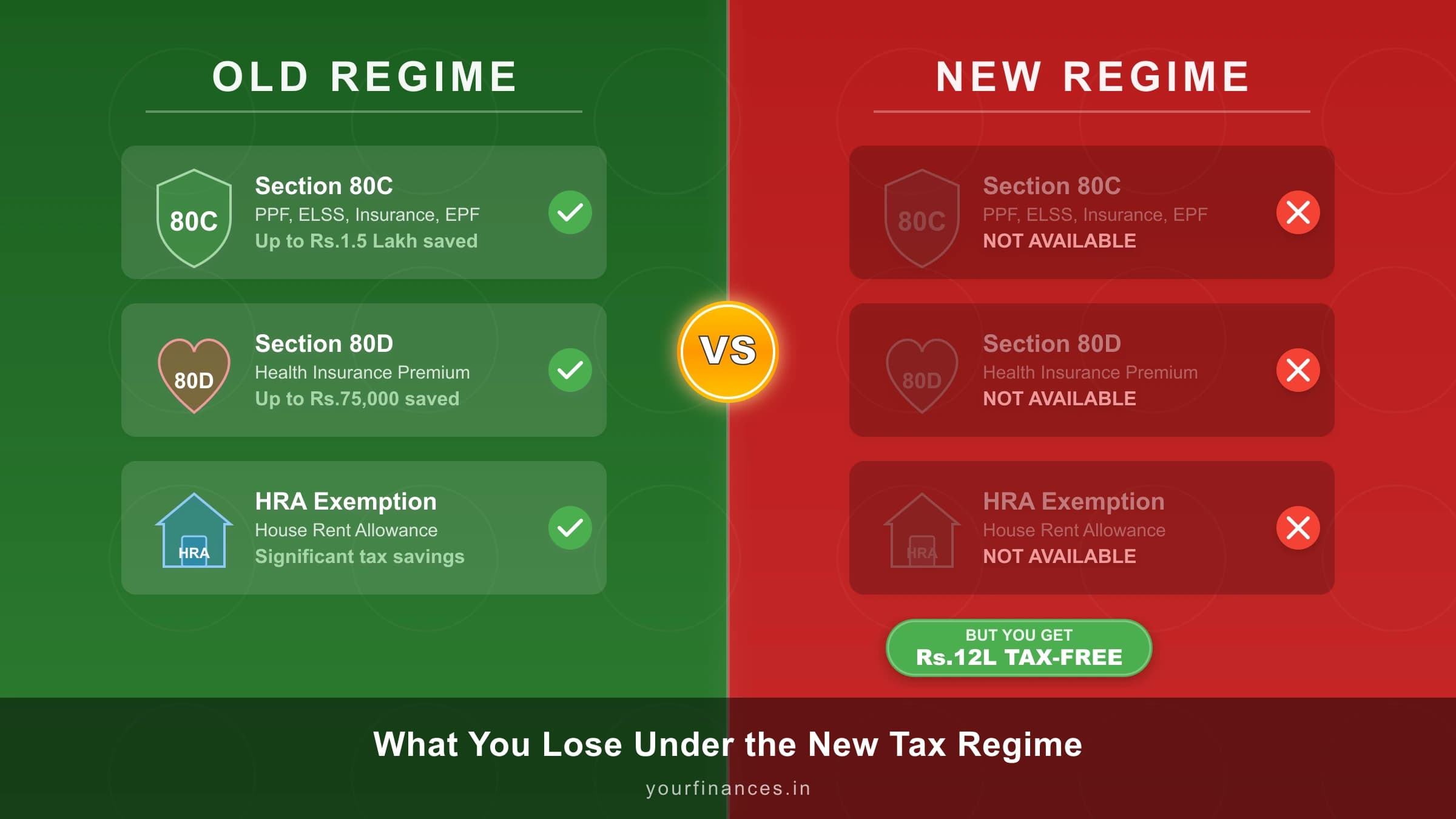
The Trade-Off You Need to Understand
The new tax regime (default from April 2026) offers a tempting deal: zero tax on income up to ₹12 lakh, lower slab rates, and a higher standard deduction of ₹75,000.
But there’s a catch. You give up nearly all deductions and exemptions that the old regime offered. For some people, the old regime with its deductions is still better. For others, the new regime wins hands down.
Here’s exactly what you lose, what you keep, and how to decide.
Deductions You LOSE Under New Regime
Section 80C Investments (₹1.5 Lakh)
The biggest loss. Under the old regime, you could save up to ₹46,800 in tax by investing ₹1.5 lakh in:
- PPF (Public Provident Fund) — use our PPF Calculator
- ELSS (Tax-saving mutual funds)
- Life insurance premiums (LIC, term plans)
- NSC (National Savings Certificate)
- 5-year tax-saving FDs
- Children’s tuition fees
- Home loan principal repayment
Under new regime: None of these are deductible. You still invest in them — but you don’t get tax benefit.
Section 80D: Health Insurance (₹25,000–₹1 Lakh)
- Self + family premium: up to ₹25,000
- Parents (non-senior): ₹25,000
- Parents (senior citizen): ₹50,000
- Total possible: up to ₹1 lakh
Under new regime: Zero deduction. You still need health insurance — but no tax benefit.
HRA (House Rent Allowance)
One of the biggest deductions for salaried people in metros. If you pay ₹25,000/month rent in Mumbai, HRA could save you ₹60,000–80,000/year in tax.
Under new regime: Completely gone. Rent payments get no tax benefit.
LTA (Leave Travel Allowance)
Tax-free domestic travel twice in 4 years. Could save ₹10,000–30,000 depending on salary.
Under new regime: Not available.
Section 80E: Education Loan Interest
Full interest deduction on education loans (no cap). Extremely valuable for those with ₹30–80 lakh foreign education loans.
Under new regime: Not available. This alone could make old regime better for education loan borrowers.
Section 80G: Donations
50-100% deduction on donations to approved charities.
Under new regime: Not available.
Home Loan Interest (Section 24b)
Up to ₹2 lakh/year deduction on home loan interest for self-occupied property. Use our EMI Calculator to check your interest component.
Under new regime: Not available. This is a big loss for new home buyers paying high EMIs.
Other Deductions Lost
| Deduction | Old Regime | New Regime |
|---|---|---|
| Professional Tax | ₹2,500/year | ✘ Not available |
| Entertainment Allowance | Govt employees | ✘ Not available |
| Minor Child Income Exemption | ₹1,500/child | ✘ Not available |
| Additional Depreciation | Business owners | ✘ Not available |
| House Property Loss Offset | Up to ₹2L | ✘ Cannot offset |
Deductions You KEEP Under New Regime
The new regime isn’t completely bare. You still get:
| Benefit | Amount | Details |
|---|---|---|
| Standard Deduction | ₹75,000 | Automatic, no investment needed |
| Employer NPS Contribution | Up to 14% of salary | If employer contributes to NPS on your behalf |
| Section 87A Rebate | Income up to ₹12L = zero tax | The main advantage of new regime |
| Agnipath Scheme | As applicable | Contributions deductible |
| Gift Vouchers | ₹15,000/year | From employer (newly increased) |
Who Should Stay on Old Regime?
The old regime wins only if your total deductions are large — roughly ₹5.9 lakh at ₹15 lakh of salary, and ₹7.6 lakh at ₹20 lakh (including the standard deduction). The break-even table further down shows the exact arithmetic. You likely benefit from the old regime if:
- ₹2 lakh home loan interest + ₹1.5 lakh 80C + ₹50,000 80CCD(1B) + ₹25,000 80D + ₹2.5 lakh HRA = ₹6.75 lakh in deductions — comfortably past break-even
- You pay high rent in a metro — HRA is usually the deciding factor, not 80C
- You have an education loan (80E interest is uncapped)
- Your total deductions exceed roughly 40% of your salary
Who Should Switch to New Regime?
- Income under ₹12 lakh: Zero tax under new regime. No-brainer.
- No home loan, no HRA: If you don’t rent or own a home, you lose the two biggest deductions anyway.
- Minimal investments: If you don’t invest ₹1.5 lakh in 80C instruments, old regime gives less benefit.
- Income above ₹20 lakh with few deductions: The lower slab rates (10%, 15%, 20%) save more than the deductions would.
How to Decide: Use the Calculator
The best way to decide is to calculate both scenarios with your actual numbers. Use our Tax Calculator — it compares old vs new regime side by side with your income and deductions.
You can switch between regimes every year when filing ITR. Salaried employees can inform their employer to deduct TDS under either regime. You’re not locked in.
The Bottom Line
The new tax regime is simpler but inflexible. The old regime is complex but rewards those who plan.
If you earn under ₹12 lakh — switch to new regime, pay zero tax, and stop worrying.
If you earn more and have significant deductions (home loan + 80C + 80D + HRA), the old regime could save you ₹50,000–1,50,000 more per year. Run the numbers before deciding.
Disclaimer: This article is for educational purposes only and does not constitute tax advice. Tax rules are subject to change. Please consult a chartered accountant for advice specific to your situation.
Master Table: Everything You Lose vs Everything You Keep
Here is the consolidated list for FY 2025-26 (AY 2026-27), so you can scan it in one go instead of hunting section by section. The rule of thumb: under Section 115BAC the new regime strips out deductions you have to claim, but leaves most exemptions built into salary structure untouched.
| Section / Benefit | Old Regime | New Regime (FY 2025-26) |
|---|---|---|
| 80C — PPF, ELSS, EPF, life insurance, tuition fees, home loan principal | Up to ₹1.5 lakh | ✘ Lost |
| 80CCD(1B) — extra NPS self-contribution | Up to ₹50,000 | ✘ Lost |
| 80D — health insurance (self, family, parents) | Up to ₹1 lakh | ✘ Lost |
| HRA exemption — Section 10(13A) | Rent-based formula | ✘ Lost |
| LTA — Section 10(5) | Twice in 4 years | ✘ Lost |
| 24(b) — home loan interest, self-occupied house | Up to ₹2 lakh | ✘ Lost |
| 80TTA — savings account interest | Up to ₹10,000 | ✘ Lost |
| 80TTB — deposit interest, senior citizens | Up to ₹50,000 | ✘ Lost |
| 80E — education loan interest | Unlimited, 8 years | ✘ Lost |
| 80G — donations | 50% or 100% | ✘ Lost |
| 80DD / 80DDB / 80U — disability & treatment | ₹40,000–₹1.25 lakh | ✘ Lost |
| Professional tax — Section 16(iii) | Up to ₹2,500 | ✘ Lost |
| Entertainment allowance — Section 16(ii) | Govt employees | ✘ Lost |
| Standard deduction — Section 16(ia) | ₹50,000 | ✔ ₹75,000 |
| 80CCD(2) — employer's NPS contribution | Up to 10% of salary | ✔ Up to 14% of salary |
| Employer's EPF contribution (within statutory limits) | ✔ Exempt | ✔ Exempt |
| Gratuity — Section 10(10) | ✔ Exempt | ✔ Exempt |
| Leave encashment on retirement — Section 10(10AA) | ✔ Exempt | ✔ Exempt |
| Interest on loan for a let-out property — 24(b) | ✔ Allowed | ✔ Allowed (against rent only) |
| 80CCH — Agniveer Corpus Fund | ✔ Allowed | ✔ Allowed |
| Rebate u/s 87A | ₹12,500 (income ≤ ₹5 lakh) | ₹60,000 (income ≤ ₹12 lakh) |
One nuance people miss on the last "kept" item: interest on a let-out property is still deductible under the new regime, but the resulting loss from house property cannot be set off against your salary, and it cannot be carried forward. So the deduction only helps to the extent of the rent you actually declare.
New Regime Slabs for FY 2025-26 (AY 2026-27)
These are the rates notified under Section 115BAC for the year you are filing now, per the Income Tax Department's AY 2026-27 slab page:
| Taxable income | New regime rate | Old regime rate (below 60) |
|---|---|---|
| Up to ₹2.5 lakh | Nil | Nil |
| ₹2.5–4 lakh | Nil | 5% |
| ₹4–5 lakh | 5% | 5% |
| ₹5–8 lakh | 5% | 20% |
| ₹8–10 lakh | 10% | 20% |
| ₹10–12 lakh | 10% | 30% |
| ₹12–16 lakh | 15% | 30% |
| ₹16–20 lakh | 20% | 30% |
| ₹20–24 lakh | 25% | 30% |
| Above ₹24 lakh | 30% | 30% |
Health and education cess of 4% applies on top in both regimes. The rebate under Section 87A is up to ₹60,000 for a resident individual whose taxable income does not exceed ₹12 lakh — which is why ₹12 lakh of taxable income (₹12.75 lakh of salary, after the ₹75,000 standard deduction) attracts zero tax. Marginal relief softens the jump for taxable incomes just above ₹12 lakh. We break the mechanics down in our guide to the Section 87A rebate.
Break-Even Analysis: How Many Deductions Do You Actually Need?
The only honest way to answer "should I stay on the old regime?" is arithmetic. Below, we compute the new regime tax at each salary level, then solve for the level of old-regime deductions that would produce exactly the same tax. Assumptions: salaried individual below 60, income below ₹50 lakh (no surcharge), 4% cess, ₹75,000 standard deduction in the new regime and ₹50,000 in the old.
| Gross salary | Tax under new regime | Deductions needed in old regime to match (over and above standard deduction) | Total deductions incl. standard deduction |
|---|---|---|---|
| ₹10 lakh | ₹0 | Old regime cannot win — it needs ₹4.5 lakh merely to also reach zero | ₹5,00,000 |
| ₹15 lakh | ₹97,500 | ₹5,43,750 | ₹5,93,750 |
| ₹20 lakh | ₹1,92,400 | ₹7,08,333 | ₹7,58,333 |
| ₹25 lakh | ₹3,19,800 | ₹8,00,000 | ₹8,50,000 |
The ₹15 lakh case, worked out
New regime: taxable income = ₹15,00,000 − ₹75,000 = ₹14,25,000. Tax = ₹20,000 (₹4–8 lakh at 5%) + ₹40,000 (₹8–12 lakh at 10%) + ₹33,750 (₹12–14.25 lakh at 15%) = ₹93,750, or ₹97,500 with cess.
Old regime: to pay the same ₹93,750, taxable income must fall to ₹9,06,250 — because ₹12,500 + 20% of (₹9,06,250 − ₹5,00,000) = ₹93,750. Starting from ₹15 lakh minus the ₹50,000 standard deduction, that means ₹5,43,750 of further deductions.
To put that in context, the standard tax-saver stack — ₹1.5 lakh under 80C, ₹50,000 under 80CCD(1B), ₹75,000 under 80D and ₹2 lakh of home loan interest — adds up to ₹4.75 lakh. You still need roughly ₹70,000 of HRA exemption on top just to break even at ₹15 lakh, and about ₹2.3 lakh of HRA at ₹20 lakh. That is the real reason the new regime now wins for most people.
Who Should Still Choose the Old Regime?
- High rent plus a home loan. Someone paying ₹35,000–₹50,000 a month rent in Mumbai, Delhi, Bengaluru or Chennai while servicing a housing loan on another property can clear ₹6–8 lakh of deductions. This is the single strongest old-regime profile.
- Large education loan under 80E. There is no cap on the interest deduction, and on a ₹40 lakh loan the interest alone can run past ₹3 lakh a year.
- Senior citizens living on deposit interest. ₹50,000 under 80TTB plus ₹50,000 of 80D premium is worth more than the lower slabs at moderate income levels.
- Serious medical or disability claims. 80DD, 80DDB and 80U claims are not discretionary spending — they push a household past break-even without any "extra" investment.
- Anyone whose deductions genuinely exceed the break-even figure above. Not a guess — run both numbers on our income tax calculator, or read the fuller comparison in old vs new tax regime.
If your deductions fall short, the answer is not to force-fit investments purely for tax. Look at what still works structurally — employer NPS under 80CCD(2), for instance, survives in the new regime. Our guide on saving tax beyond 80C covers those options.
The Default Regime Rule — and How to Switch
Since AY 2024-25, the new regime is the default. If you do nothing, your return and your employer's TDS are computed under Section 115BAC. Opting for the old regime is now the active choice, and the process depends on your income type:
- Salaried and other non-business taxpayers: you can switch every single year, simply by selecting the old regime in your ITR — no separate form is needed. Your employer's TDS declaration in April is only for cash-flow purposes; you can still choose the other regime at filing time, provided you file by the due date under Section 139(1).
- Taxpayers with business or professional income: you must file Form 10-IEA on or before the Section 139(1) due date. And the switch is not free: per the Income Tax Department, once you have exited the old regime after entering it, you will not be eligible to opt for the old regime again unless you cease to have business or professional income.
Filing late has a second cost here: a belated return generally cannot carry the old regime, so a missed deadline can silently convert into the default new regime. Check which ITR form applies to you before the due date.
Frequently Asked Questions
Can I claim 80C deductions if I have already opted for the new tax regime?
No. Deductions under Chapter VI-A other than 80CCD(2), 80CCH and 80JJAA are not available under Section 115BAC. You may keep investing in PPF, ELSS or insurance for the underlying returns and protection, but they will not reduce your taxable income in the new regime.
Is the ₹75,000 standard deduction available to pensioners too?
Yes. The standard deduction under Section 16(ia) applies to salary and to pension taxed as salary, and it is ₹75,000 under the new regime against ₹50,000 in the old regime. It is automatic — no proof, receipts or investment is required.
If my income is below ₹12 lakh but includes capital gains, is it still tax-free?
Not entirely. The Section 87A rebate cannot be set off against tax on income charged at special rates, such as short-term capital gains under Section 111A or long-term capital gains under Section 112A. Those gains are taxed at their own rates even when your total income is under ₹12 lakh.
Can I switch back to the old regime next year if I choose the new one now?
If you are salaried or otherwise have no business income, yes — the choice is made afresh each assessment year in your return. If you have business or professional income, the exit is effectively one-way once exercised, and Form 10-IEA must be filed within the due date.
Does HRA become fully taxable under the new regime?
Yes. The HRA exemption under Section 10(13A) does not apply, so the entire house rent allowance in your CTC becomes part of taxable salary. Rent receipts and your landlord's PAN are of no use for tax purposes under the new regime — though you should still retain them if you may switch back.
Figures in this section are based on the slab rates and rebate limits published by the Income Tax Department for AY 2026-27 and are illustrative. Verify against your own numbers or with a chartered accountant before choosing a regime.
Written by
Jaspal Singh
Founder & Editor
Personal finance writer helping Indians make smarter money decisions through clear, jargon-free guides on taxes, investments, and budgeting.
Continue Reading

Belated & Revised ITR: Deadlines & Penalties
Missed the ITR deadline or made a mistake? Here's how belated, revised and updated returns work for AY 2026-27 — the dates, the ₹1,000–₹5,000 late fee, and the other penalties.

ELSS Funds: Save Tax + Grow Wealth
ELSS funds give you an 80C tax deduction, a 3-year lock-in and equity-linked returns. Here's how they're taxed, ELSS vs PPF, and whether they still make sense in the new tax regime.

How to Save Tax Beyond Section 80C
Maxed out your ₹1.5 lakh under Section 80C? Save more with 80D, the extra ₹50,000 NPS deduction, home loan interest and more — and see what still works in the new tax regime.