Finance Bill 2026 Passed: 32 Amendments and What They Mean for You
Jaspal Singh
Author
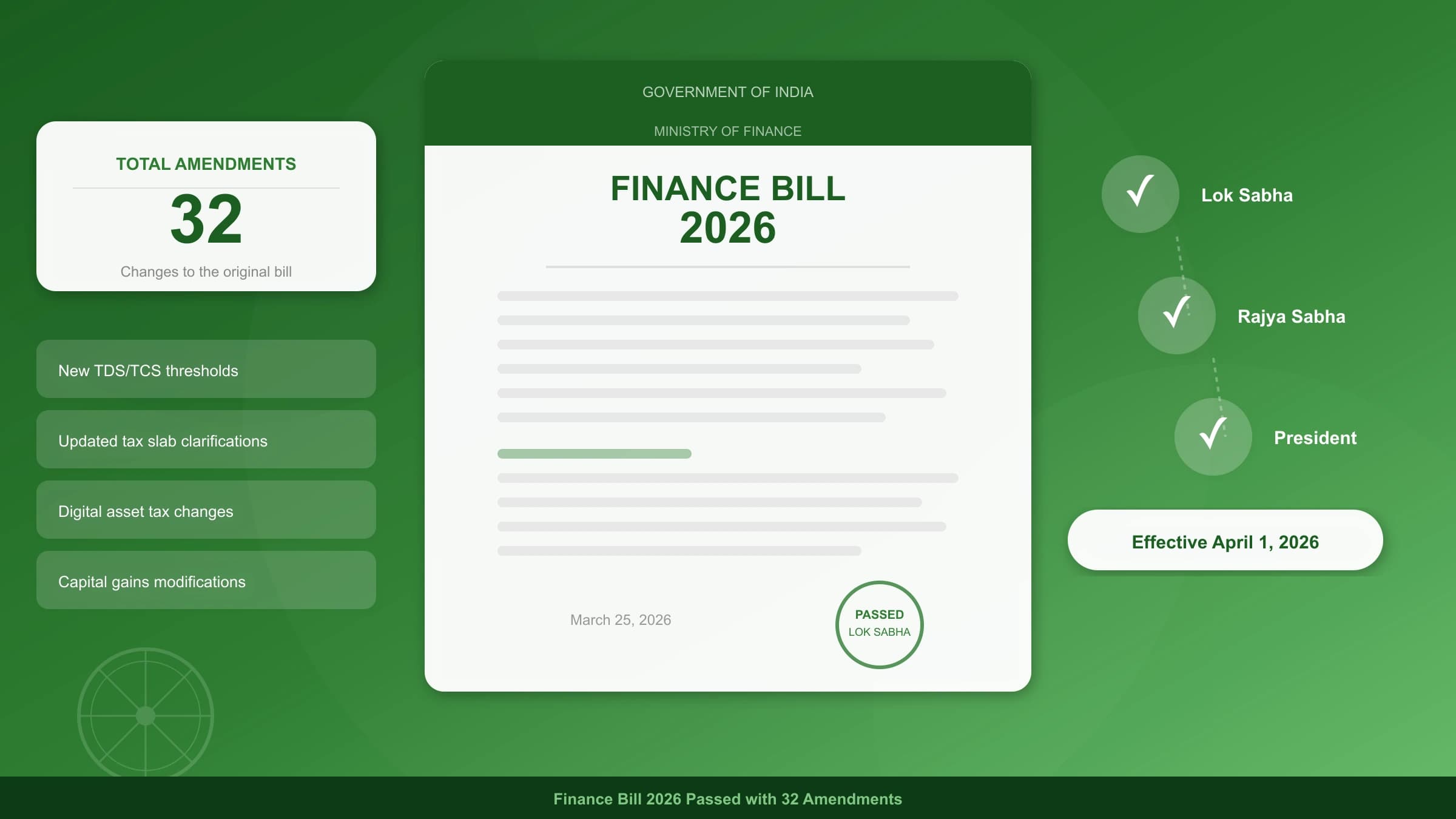
Finance Bill 2026: Passed with 32 Amendments
The Finance Bill 2026 has been passed by the Lok Sabha with 32 government amendments, and the Rajya Sabha has taken it up for consideration on March 27. Once the upper house gives its recommendations, it becomes the Finance Act 2026 — turning the Union Budget proposals into law for FY 2026-27.
Finance Minister Nirmala Sitharaman described the Bill as part of India "riding on the reform express," with a focus on trust-based tax administration. Here's what the key changes mean for you.
The Big Changes in Finance Bill 2026
1. 12% Flat Surcharge on Buyback Capital Gains
This is the most talked-about amendment. When a company buys back its own shares, the profit you make will now attract a flat 12% surcharge — regardless of your income level.
Currently, the surcharge on capital gains varies:
- Nil — if your taxable income is up to ₹50 lakh
- 10% — if income is between ₹50 lakh and ₹1 crore
- 15% — if income is ₹1-2 crore
The new flat 12% surcharge means small investors with income under ₹50 lakh will pay more on buyback gains than before (from 0% to 12% surcharge). But those with very high incomes may actually pay slightly less.
Who's affected: Primarily shareholders in IT and pharma companies that regularly announce buybacks. If you hold stocks in companies like TCS, Infosys, or Wipro that frequently buy back shares, this increases your tax on buyback profits.
2. Three-Year Tax Exemption for Cooperative Federations
National cooperative federations will get a three-year tax exemption on dividend income. This is a significant relief for the cooperative sector, which includes agricultural cooperatives, dairy federations (like Amul's parent GCMMF), and credit societies.
For regular investors, this doesn't directly affect you. But if you're invested in cooperative banks or have deposits in cooperative societies, this strengthens their financial position.
3. Retrospective Amendments to Sections 144B and 148
The government has introduced two key retrospective amendments that override recent court rulings:
- Section 144B: Now enables electronic communication for tax assessments and prescribes a minimum response period for taxpayers
- Section 148: Changes to reassessment notice procedures — the government can now reopen old tax cases based on appellate or court orders, subject to specific timelines
- Section 150: Substituted to allow reassessment pursuant to appellate orders
What this means: If you've received a favourable court ruling on a tax dispute related to procedural lapses, the government may now be able to reassess those cases. This is controversial — it effectively undoes certain taxpayer-friendly court decisions.
The ₹53.47 Lakh Crore Budget Framework
The Finance Bill gives effect to the Union Budget 2026-27, which proposes:
| Parameter | FY 2026-27 | Change |
|---|---|---|
| Total expenditure | ₹53.47 lakh crore | +7.7% |
| New income tax slabs | No tax up to ₹12 lakh | Major relief |
| Standard deduction | ₹75,000 | Unchanged |
| Capital gains tax (LTCG) | 12.5% | Unchanged |
Trust-Based Tax Administration: What FM Said
Sitharaman emphasized that the Finance Bill 2026 aims to build a "trust-based tax administration" that:
- Reduces compliance pressure on honest taxpayers
- Makes the system more efficient and predictable
- Moves towards electronic and faceless assessments
- Simplifies procedures while maintaining accountability
What Happens Next?
The Rajya Sabha can discuss and recommend changes to the Finance Bill, but it cannot reject or amend a Money Bill. The Lok Sabha may or may not accept those recommendations. Once this process completes, the Bill becomes the Finance Act 2026, and all tax changes take effect from April 1, 2026 for the new financial year.
What Should You Do?
- If you hold buyback-prone stocks — factor in the new 12% surcharge when evaluating buyback offers
- If you have pending tax disputes — check with your CA whether the retrospective amendments affect your case
- For general tax planning — the new regime with no tax up to ₹12 lakh remains the default; evaluate whether old or new regime works better for you using our Income Tax Calculator
Use our SIP Calculator to plan investments for the new financial year, or check our Compound Interest Calculator to see how your money grows over time.
Disclaimer: This article is for educational purposes only and does not constitute financial advice. Tax laws and amendments are subject to change. Please consult a qualified chartered accountant or tax advisor for advice specific to your situation.
Written by
Jaspal Singh
Founder & Editor
Personal finance writer helping Indians make smarter money decisions through clear, jargon-free guides on taxes, investments, and budgeting.
Continue Reading

Gold, Silver Import Duty Raised to 15%: What It Means for Prices, Rupee, and India's Trade Balance
India has raised import duty on gold and silver to 15% from 6%. Here is what the move means for bullion demand, trade deficit, forex reserves, and everyday buyers.

Your Take-Home Salary Just Got Cut — Here’s Why
From April 2026, your basic pay must be at least 50% of your CTC. That means lower take-home pay but significantly higher EPF and gratuity. Here’s what changed and what it means for your wallet.

Silver Loans Are Now Legal in India — Here’s How to Get One
From April 1, the RBI allows banks and NBFCs to give loans against your silver jewelry and coins. Up to 85% LTV, 10kg silver limit, and strict borrower protections. Here’s everything you need to know.