Form 121 Replaces 15G and 15H: TDS Self-Declaration Guide
Jaspal Singh
Author
Last updated: 6 May 2026
Forms 15G and 15H Are Gone — Meet Form 121
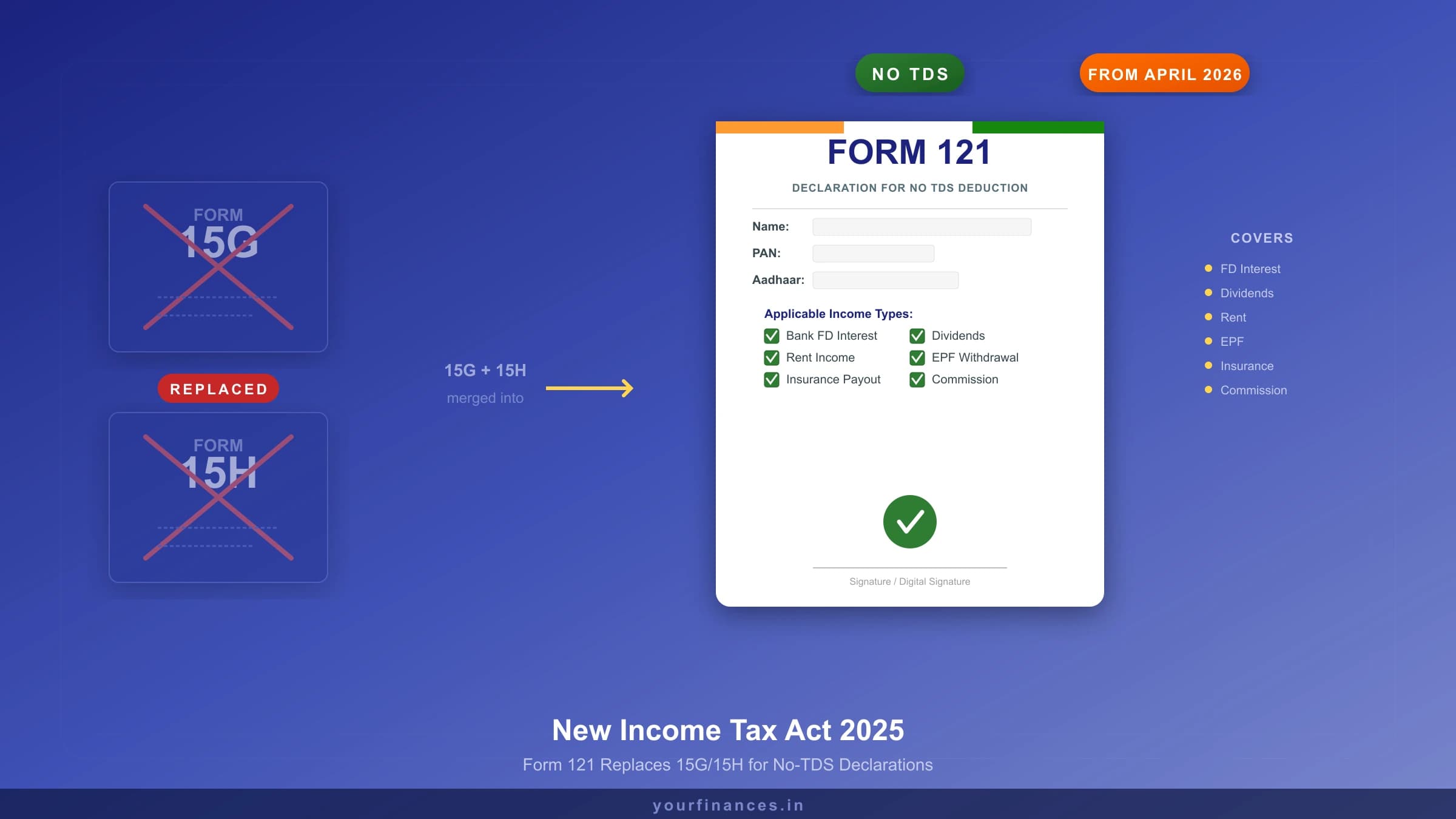
If you’ve ever submitted Form 15G or Form 15H to your bank to avoid TDS on your fixed deposit interest, you need to know this: those forms no longer exist.
From April 1, 2026, the new Income Tax Act 2025 has replaced both with a single, unified form called Form 121. Whether you’re 25 or 75, there’s now just one form for everyone.
This is one of the simplest but most impactful changes in the new tax law. Here’s everything you need to know.
What Is Form 121?
Form 121 is a self-declaration you submit to a payer (like your bank, post office, or tenant) to tell them: “My total income for this year is below the taxable limit, so please don’t deduct TDS.”
It works exactly like the old Forms 15G and 15H did — but now it’s one form for all eligible taxpayers, regardless of age.
Why Did This Change?
Under the old system, people under 60 had to file Form 15G, while senior citizens (60+) filed Form 15H. Same purpose, different forms. This caused confusion, wrong form submissions, and rejected declarations. Form 121 eliminates all of that.
Who Can File Form 121?
Eligible
- Resident individuals — any age (below 60, senior citizens 60+, super seniors 80+)
- Hindu Undivided Families (HUFs)
- Other specified entities meeting the criteria
Not Eligible
- Companies and firms
- Non-resident Indians (NRIs)
- Anyone whose estimated tax liability is not zero
The key condition remains the same: your estimated total income for the tax year must result in zero tax liability. Under the new tax regime, this means income up to ₹12 lakh (thanks to the Section 87A rebate).
What Income Types Does It Cover?
Form 121 prevents TDS deduction on a wide range of income types:
| Income Type | Common Example |
|---|---|
| Interest on deposits | Bank FDs, RDs, post office deposits |
| Dividends | Dividend from shares and mutual funds |
| Rent | Rental income from tenants |
| PF withdrawals | EPF withdrawal before 5 years |
| Pension | Monthly pension payments |
| Insurance commission | Commission earned by insurance agents |
| Life insurance payouts | Maturity proceeds of certain policies |
| Mutual fund income | Redemption proceeds, dividends |
The most common use case remains the same as before: stopping TDS on FD interest. If your total income is below the taxable limit, your bank shouldn’t be deducting tax on your interest — and Form 121 ensures that.
Use our FD Calculator to check your expected interest income for the year.
How to File Form 121: Step by Step
- Check your eligibility — Will your total income for the tax year result in zero tax? If yes, you qualify.
- Download the form from the Income Tax Department website or your bank’s portal.
- Fill in your details — Name, PAN (mandatory), residential status, estimated total income, and the income on which you want TDS exemption.
- Submit to each payer separately — If you have FDs in 3 banks, you need to submit Form 121 to each bank individually.
- Submit before the income is credited — You must file it before the bank credits your interest, not after.
- Keep a copy for your records.
Important: You can submit online (if your bank offers it) or as a physical paper form at the branch.
The New UIN System
One of the smartest upgrades in Form 121 is the Unique Identification Number (UIN) system.
When your bank receives your Form 121, they assign it a UIN that contains:
- A sequence number
- The relevant tax year
- The payer’s TAN (Tax Account Number)
This UIN is then quoted in the bank’s quarterly TDS statement (Form 140), making it easy for the Income Tax Department to track and verify every declaration. No more mismatches or lost forms.
Key Deadlines
| Action | Deadline |
|---|---|
| Submit Form 121 to payer | Before income is credited/paid |
| Payer uploads monthly statement | By 7th of the following month |
| Payer files quarterly TDS return | Along with Form 140 |
Pro tip: Submit Form 121 to your bank at the start of the financial year (April itself) to ensure no TDS is deducted from your very first interest payment.
Form 121 vs Old Forms 15G/15H
| Feature | Old System (15G/15H) | New Form 121 |
|---|---|---|
| Number of forms | Two (15G for under 60, 15H for 60+) | One unified form |
| Age-based selection | Yes — had to choose correctly | No — one form for all ages |
| Tracking system | Manual, error-prone | UIN-based digital tracking |
| Smart features | None | Auto-population, validations, API integration |
| Applicable law | Income Tax Act, 1961 | Income Tax Act, 2025 |
| Effective from | Until March 31, 2026 | April 1, 2026 onwards |
Common Mistakes to Avoid
- Filing without PAN: Your declaration is invalid without a valid PAN. The bank will deduct TDS at the higher rate of 20%.
- Submitting after interest is credited: Form 121 must be submitted before the income is paid or credited. Late submissions won’t stop TDS already deducted.
- Filing when your income exceeds the limit: Form 121 is only for those with zero tax liability. Filing falsely can attract penalties under the Income Tax Act.
- Submitting to only one bank: You need to file separately with each payer — each bank, post office, or tenant.
- Thinking it exempts you from tax: Form 121 only prevents TDS deduction. If your income turns out to be taxable, you still owe tax when filing your return.
Other New Tax Forms You Should Know About
Form 121 isn’t the only change. The new Income Tax Act 2025 has overhauled several forms:
| Old Form | New Form | Purpose |
|---|---|---|
| Form 16 | Form 130 | Salary TDS certificate from employer |
| Form 15G/15H | Form 121 | TDS exemption declaration |
| Form 26AS | Form 155 | Annual tax statement |
| — | Form 123 | Perquisites and fringe benefits (new) |
| Form 140 | Form 140 | Quarterly TDS statement (retained) |
If you’re a salaried employee, the biggest change for you will be Form 130 (replacing Form 16), which your employer will issue from June 2027 for Tax Year 2026-27.
Who Should File Form 121 Right Now?
If any of these apply to you, submit Form 121 to your bank this month:
- Retirees and senior citizens with FD interest as primary income, where total income is below ₹12 lakh
- Homemakers with FDs in their name earning interest above ₹50,000/year (₹1,00,000 if aged 60+)
- Students or young earners with savings accounts or FDs but no taxable income
- Anyone earning below the taxable threshold who receives interest, rent, dividends, or pension
Use our Tax Calculator to check whether your total income results in zero tax liability under the new regime.
The Bottom Line
Form 121 is a welcome simplification. One form instead of two, a smart UIN tracking system, and the same fundamental purpose: preventing unnecessary TDS when your income is below the taxable limit.
If you used to file Form 15G or 15H every year, just switch to Form 121. The process is nearly identical — the form name and number have changed, but the idea hasn’t. Submit it to your bank early in April and you won’t lose a rupee to unnecessary TDS all year.
Frequently Asked Questions
What is Form 121 in income tax?
Form 121 is the new unified TDS self-declaration form introduced from April 2026. It replaces both Forms 15G (for non-senior citizens) and 15H (for senior citizens). It allows you to declare that your total annual income is below the taxable threshold so banks/payers don't deduct TDS on your interest income.
Who can file Form 121?
Residents whose estimated total income is nil after rebate. Under the default new regime the basic exemption is a flat ₹4 lakh with no age enhancement (the ₹2.5/₹3/₹5 lakh figures are old-regime limits). Both individuals and Hindu Undivided Families (HUFs) can file. NRIs cannot file Form 121.
What is the difference between Form 121 and Forms 15G/15H?
Form 121 unifies what 15G and 15H did separately. Single form, single PAN-linked declaration. The eligibility thresholds remain the same — based on total annual income. The biggest change: Form 121 supports digital filing through bank apps, eliminating paper forms.
How do I file Form 121?
Three routes: (1) Bank/AMC online portal — most banks now have Form 121 in their net banking; (3) Bank branch — submit physical form for those without digital access. The form must be filed before the first interest credit of the financial year (typically April).
What income types does Form 121 cover?
Form 121 covers: bank FD interest, RD interest, dividend income, EPF withdrawal interest, post office FD/SCSS interest, debenture/bond interest, and rental income. Salaries are not covered (employer handles TDS based on Form 16).
What happens if I don't file Form 121?
The bank/payer will deduct TDS at the prescribed rate (typically 10% for residents, 20% for non-PAN holders). You can claim a refund when filing your ITR — but the money is locked with the government for 6-15 months. Filing Form 121 timely avoids this lock-in.
How is Form 121 different for senior citizens?
Senior citizens (60+) have a higher TDS threshold — interest up to ₹1,00,000 a year attracts no TDS. Section 80TTB's ₹50,000 deduction on deposit interest exists only under the old regime. Super-seniors (80+) get ₹5 lakh basic exemption. Form 121 has senior-specific fields to capture these. Senior citizens may also be eligible for partial TDS waivers.
Can I file Form 121 if I have multiple bank accounts?
Yes. Form 121 is filed at each bank/AMC where you have FDs/RDs. The same PAN-linked declaration applies across all institutions. However, you must aggregate income from all sources when calculating eligibility — banks may cross-verify via PAN.
When should I file Form 121 each year?
File at the start of every financial year, ideally before the first interest payment. For most banks, this means before April 30. Late filing means TDS is deducted on early interest payments — refund possible only via ITR. Re-file annually as eligibility may change.
Is Form 121 mandatory?
No, it's voluntary — a self-declaration to avoid TDS. If you're comfortable having TDS deducted (and claiming refund later), filing isn't required. But for retirees and low-income individuals, filing saves cash flow and reduces the wait for tax refunds.
Disclaimer: This article is for educational purposes only and does not constitute tax advice. Please consult a qualified tax advisor or chartered accountant for advice specific to your situation.
First Check the TDS Threshold — You May Not Need Form 121 at All
Form 121 only matters if your payer is actually going to deduct TDS. The thresholds that trigger deduction were raised sharply by the Finance Act 2025, with effect from 1 April 2025, and those higher limits carry over unchanged into Section 393(1) of the Income-tax Act, 2025 — the successor to the old Section 194A.
| Who is paying you | Ordinary depositor | Depositor aged 60+ |
|---|---|---|
| Banks, co-operative banks, post office deposit schemes | ₹50,000 a year (was ₹40,000) | ₹1,00,000 a year (was ₹50,000) |
| Everyone else — company deposits, NBFC deposits, bonds, debentures, loans to friends | ₹10,000 a year (was ₹5,000) | ₹10,000 a year |
Three things people get wrong about these numbers:
- The limit is per payer, not per account. A bank aggregates interest on every FD and RD you hold with it, across branches. Three FDs paying ₹20,000 each cross the ₹50,000 line.
- It runs on accrual, not payout. Banks credit interest quarterly on cumulative FDs even though you get nothing in hand until maturity. That credited interest counts.
- Savings account interest is not covered at all. Section 393(1), like Section 194A before it, does not apply to savings bank interest — no TDS, regardless of amount. (The ₹10,000 people remember is the old Section 80TTA deduction cap, unavailable under the default new regime.)
Below the line, no declaration is needed. Above it, TDS is 10% — or 20% if the payer has no valid PAN for you. Our guide on how FD interest is taxed covers the gap between TDS and the tax you finally owe.
The ₹12 Lakh Trap: Nil Tax Is Not Always Enough
This is the most misunderstood point about Form 121, and getting it wrong costs you either a wrongly withheld TDS or, worse, a false declaration. Section 393(6) carries forward the old two-tier eligibility test rather than flattening it — one form, two sets of conditions underneath:
- If you are below 60 (the old Form 15G footing): tax on your estimated total income for the tax year must be nil, and the aggregate of the incomes you are covering with the declaration must not exceed the basic exemption limit — ₹4,00,000 under the new regime for Tax Year 2026-27.
- If you are 60 or above (the old Form 15H footing): only the nil-tax condition applies. There is no separate ceiling on the declared income.
The ₹12 lakh figure everyone quotes is the ceiling for the rebate under Section 156 of the Income-tax Act, 2025 (successor to Section 87A), worth up to ₹60,000. A rebate is not an exemption — tax is computed first, then knocked down. So a 45-year-old whose only income is ₹5,50,000 of FD interest pays nil tax after the rebate but is still not eligible to file Form 121, because the declared interest exceeds ₹4,00,000. A 65-year-old in the same position is eligible.
Estimated total income on the form is computed after Chapter VIII deductions, any house-property loss set-off, and the Section 156 rebate. Our old vs new tax regime comparison and the Section 87A / 156 rebate explainer cover the arithmetic.
Worked Example: A Senior Citizen With ₹30 Lakh in SCSS
Take Mrs Rao, aged 68, with the full ₹30 lakh permitted in the Senior Citizen Savings Scheme. SCSS pays 8.2% for the July–September 2026 quarter.
- Annual interest: ₹30,00,000 × 8.2% = ₹2,46,000, paid quarterly at ₹61,500.
- Threshold test: ₹2,46,000 is well past the ₹1,00,000 senior limit, so the post office deducts 10% TDS — ₹24,600 for the year, ₹6,150 off every quarterly payout.
- Eligibility test: if this is her only income, ₹2,46,000 sits below the ₹4,00,000 basic exemption, so tax is nil before any rebate. Form 121 is clearly valid, and filing it in early April keeps the full ₹61,500 in her hands each quarter.
Now add a pension of ₹6,00,000. Total income becomes ₹8,46,000, less the ₹75,000 standard deduction, leaving ₹7,71,000. Under the new-regime slabs (nil to ₹4 lakh, 5% from ₹4–8 lakh), tax is ₹18,550 — fully wiped out by the Section 156 rebate. Because she is 60+, nil tax is the only condition she must satisfy, so her Form 121 is valid even though her income is far above ₹4 lakh. A 50-year-old with identical income could not file it.
One caveat: the rebate does not cover income taxed at special rates. If Mrs Rao books a large capital gain, tax may survive the rebate — and the moment any tax is payable, the declaration is invalid.
Where Form 121 Goes — and Where It Does Not
Form 121 is furnished to the payer, not uploaded by you to the e-filing portal. The payer generates the 26-character UIN and reports it in the quarterly Form 140 statement. Practically:
- Banks: net banking, usually under Deposits or Tax (most have relabelled the old "Form 15G/H" menu), or a paper form at the branch.
- Post office: at the branch holding your SCSS, TD or MIS account. Company deposits, NBFCs and bonds: the issuer's or registrar's investor-services portal. Rent: the tenant deducting tax.
- EPF: attach it to a withdrawal claim before five years of continuous service where the amount exceeds ₹50,000 — premature EPF withdrawal TDS now sits in Section 392(7). See our guide on how to withdraw PF.
It does not work on salary, and it does nothing for mutual fund redemption proceeds paid to a resident — those are capital gains with no TDS in the first place. Formats for all statutory forms are listed on the Income Tax Department's forms page.
What Happens If You Get the Declaration Wrong
Form 121 is signed under a verification clause — a statement made to a tax authority, not a bank formality. Knowingly making a false statement in a verification attracts prosecution under Section 482 of the Income-tax Act, 2025, which provides for rigorous imprisonment and a fine. The UIN system makes detection trivial: every declaration at every bank is tagged, quoted in Form 140, and visible against your PAN.
The realistic risk is not fraud but drift — you file in April expecting ₹3.2 lakh of interest, a maturing FD is reinvested at a better rate, and you end up at ₹4.6 lakh. If circumstances change mid-year, tell the payer in writing and let them resume deducting. A declaration covers one tax year only and must be filed afresh each April.
TDS Already Deducted? You Have Not Lost It
If tax was withheld before your declaration reached the payer, that money is not gone — it is parked with the government until you claim it. The deducted amount is credited against your PAN once the payer files its quarterly statement, and you recover it by filing your return and claiming a refund; utilities are on the e-filing portal's downloads section.
You cannot ask a bank to reverse TDS it has already deposited — the return is the only route, and money deducted in April is refunded well over a year later. That cash-flow cost, not any tax saving, is the whole case for filing Form 121 in the first week of April.
More Questions on Form 121
Does the ₹12 lakh rebate limit mean anyone earning under ₹12 lakh can file Form 121?
Only if you are 60 or above. For declarants aged 60+, nil tax after the Section 156 rebate is enough, so income well above ₹4 lakh can qualify. Below 60, you must also clear a second test — the income covered by the declaration must not exceed the ₹4,00,000 basic exemption limit — even if your final tax is nil because of the rebate.
What are the TDS thresholds on interest for Tax Year 2026-27?
For banks, co-operative banks and post office schemes, TDS starts once interest crosses ₹50,000 a year for ordinary depositors and ₹1,00,000 for those aged 60 and above. The Finance Act 2025 raised these from ₹40,000 and ₹50,000 with effect from 1 April 2025, and they continue under Section 393(1). For all other payers — company deposits, NBFCs, bonds — the threshold is ₹10,000.
Is TDS deducted on my savings bank account interest?
No. TDS on interest has never applied to savings bank account interest, and that has not changed under the Income-tax Act, 2025, so you do not need Form 121 for it. The interest is still taxable and must be reported in your return; only the withholding step is absent.
Can I file Form 121 on the income tax e-filing portal?
No. Form 121 goes to the payer — your bank, post office, issuer, EPFO or tenant — through their net banking portal or branch. The payer allots the UIN and reports the declaration in its quarterly Form 140 statement. There is no facility to file it directly with the department.
How much TDS would a senior citizen with ₹30 lakh in SCSS face without Form 121?
At 8.2%, ₹30 lakh in SCSS generates ₹2,46,000 of interest a year — above the ₹1,00,000 senior threshold, so 10% TDS applies to the whole amount: ₹24,600 a year, or ₹6,150 out of each quarterly payout. If total income leaves nil tax, Form 121 filed in April prevents all of it.
Related Guides
- How to Withdraw PF Online — how TDS applies to EPF withdrawals and when a Form 121 / 15H declaration can prevent it.
- Senior Citizen Savings Scheme (SCSS) Guide — where senior-citizen TDS self-declarations matter most.
- Best FD Rates in India — compare the latest fixed-deposit rates before you lock in.
Written by
Jaspal Singh
Founder & Editor
Personal finance writer helping Indians make smarter money decisions through clear, jargon-free guides on taxes, investments, and budgeting.
Continue Reading
Belated & Revised ITR: Deadlines & Penalties
Missed the ITR deadline or made a mistake? Here's how belated, revised and updated returns work for AY 2026-27 — the dates, the ₹1,000–₹5,000 late fee, and the other penalties.

ELSS Funds: Save Tax + Grow Wealth
ELSS funds give you an 80C tax deduction, a 3-year lock-in and equity-linked returns. Here's how they're taxed, ELSS vs PPF, and whether they still make sense in the new tax regime.

How to Save Tax Beyond Section 80C
Maxed out your ₹1.5 lakh under Section 80C? Save more with 80D, the extra ₹50,000 NPS deduction, home loan interest and more — and see what still works in the new tax regime.