India Cement Cartel Exposed — How Price-Fixing Hit Your Pocket
Jaspal Singh
Author
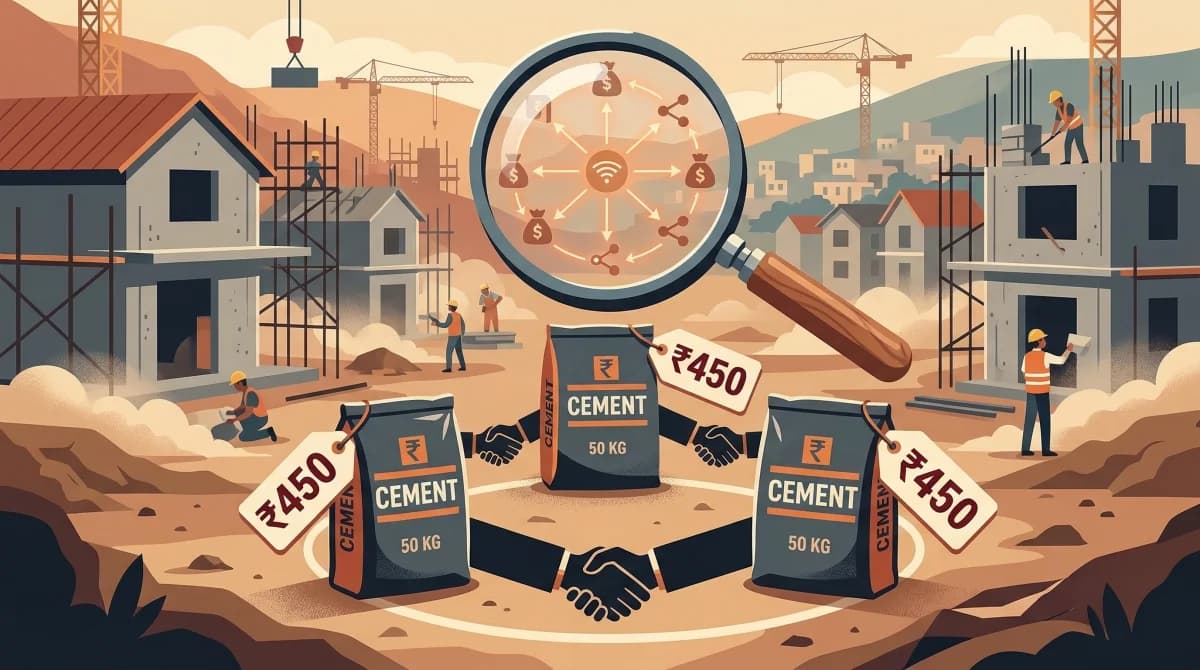
Imagine three sweet shops on your street. Instead of competing to offer you the best price for gulab jamun, they secretly meet every night and agree: "Let's all charge exactly Rs 100." You'd never get a good deal, right? That's exactly what three of India's cement companies allegedly did — not for sweets, but for cement — and they got away with it for 12 long years.
A Reuters exclusive investigation published in March 2026 revealed the details of a confidential Competition Commission of India (CCI) report that exposed a price-fixing cartel among three cement makers targeting India's biggest oil company, ONGC.
What Happened? The "Lucky Number 7" Story
Here's where it gets almost funny — if it weren't so serious.
In 2018, ONGC (Oil and Natural Gas Corporation) put out a tender to buy 1,70,000 tonnes of oil well cement. Oil well cement is a special, premium-grade cement used to seal and strengthen oil wells — both onshore and offshore. It's a niche product, and only a few companies in India make it.
When ONGC opened the sealed bids from three competing companies — Dalmia Cement, Shree Digvijay Cement, and India Cements — something looked very suspicious. All three had quoted nearly identical prices: either Rs 7,000 or Rs 7,350 per tonne.
When questioned, an executive at India Cements gave a response that would make any detective raise an eyebrow. He said seven was his "lucky number." In a written submission, India Cements actually stated: "The financial bid was also supported by the numerology factor of 7."
ONGC wasn't buying that explanation. They looked back at older tenders and found a pattern — bids had come in at the exact same or very similar prices in four different tenders for oil well cement. This was no coincidence. ONGC filed a formal complaint with the CCI in 2020.
The CCI Investigation: What Did They Find?
After a five-year investigation, the CCI produced a confidential report — reviewed by Reuters in early 2026 — that laid bare the full extent of the collusion. Here's what the probe uncovered:
12 Years of Price Fixing
The CCI report identified a "cartel period" of 12 years — from 2007 to 2018 — for Dalmia Cement (Bharat) and Shree Digvijay Cement. India Cements was found to be part of the cartel for a shorter period: 2017-2018.
How the Cartel Actually Worked
This wasn't just companies coincidentally quoting similar prices. The investigation found a well-organised system:
- Meetings and emails: Executives from the rival companies coordinated pricing and supply strategies before submitting their bids
- Office visits: A senior vice president of Shree Digvijay actually visited Dalmia's office for "directly assisting" them in filing their 2018 tender bid
- Excel sheets: The companies created shared spreadsheets comparing distances from their factories to ONGC delivery destinations — to decide how to divide territories
- Volume sharing: According to testimony, "the prime objective for quoting the identical price was to allocate almost equal volumes and revenue amongst companies"
- Freight calculation: They jointly calculated rail freight costs and then bid accordingly to avoid actually competing with each other
In simple terms: instead of trying to win the contract by offering the lowest price, these three companies sat together, decided the price, split the territory, and divided the money equally. ONGC — a government company funded by taxpayer money — was paying artificially inflated prices all along.
Who Are These Three Companies?
| Company | Details | Cartel Period |
|---|---|---|
| Dalmia Cement (Bharat) | A unit of Dalmia Bharat — India's 4th largest cement maker | 2007–2018 (12 years) |
| Shree Digvijay Cement | A niche oil well cement manufacturer | 2007–2018 (12 years) |
| India Cements | Acquired by UltraTech (India's No. 1 cement company) in 2024 | 2017–2018 (1 year) |
What Do the Companies Say?
Not much, frankly:
- Dalmia Bharat declined to comment, citing the "pendency of the matter" before the CCI, but has previously said it is cooperating with authorities
- India Cements (now owned by UltraTech) did not respond to Reuters
- Shree Digvijay also did not respond
What Penalties Could They Face?
The CCI has asked the companies to respond to the report, and a final order is expected within months. The watchdog has the power to either drop the findings or impose heavy penalties:
- Fines of up to 3 times the company's profit, OR
- 10% of the company's turnover for each year of wrongdoing
Given that the cartel ran for 12 years, these penalties could run into hundreds of crores of rupees.
This Isn't the First Time: India's Cement Cartel History
What makes this case even more alarming is that India has dealt with cement cartels before — and the same pattern keeps repeating.
The 2012 Landmark Case
In 2012, the CCI imposed a record penalty of Rs 6,317 crore (approximately $933 million) on 11 cement companies — including big names like UltraTech, ACC, Ambuja, JK Cements, India Cements, and Lafarge. The Builders Association of India had complained that these companies were using the Cement Manufacturers' Association (CMA) platform to fix prices and limit cement supply.
The case went through legal challenges, but the CCI reaffirmed its findings in 2016. It remains one of the largest antitrust penalties in Indian history.
A Recurring Problem
The fact that India Cements appears in both the 2012 case and this new 2026 investigation raises a troubling question: are penalties strong enough to deter cartelisation?
How Does This Affect You as a Homebuyer?
You might wonder: this case is about oil well cement for ONGC, not the cement I use to build my house. So why should I care?
Here's why:
- It reveals an industry culture: If companies collude on specialised cement, what's stopping the same behaviour in the general cement market that affects your home construction costs?
- Cement is expensive: A 50 kg bag of cement in India currently costs between Rs 340 and Rs 450, depending on the brand. Top brands like UltraTech, Ambuja, and ACC charge Rs 385–440 per bag.
- You need a lot of it: Building a typical 1,000 sq ft house requires about 400 bags of cement. That's roughly Rs 1.5–1.8 lakh just on cement.
- Every Rs 10 matters: If cartel behaviour pushes cement prices up by even Rs 10–20 per bag, you're paying Rs 4,000–8,000 extra on a small house — and much more on larger projects.
- It affects your home loan EMI: Higher construction costs mean bigger home loans and heavier EMIs. You can calculate the impact on your monthly payments using our EMI Calculator.
Quick Example
| Item | Amount |
|---|---|
| House size | 1,000 sq ft |
| Cement bags needed | ~400 bags |
| Cost at Rs 380/bag | Rs 1,52,000 |
| Cost at Rs 420/bag (cartel-inflated) | Rs 1,68,000 |
| Extra cost due to price fixing | Rs 16,000 |
Now multiply that across millions of homes being built every year across India. The total money going from ordinary people's pockets into inflated corporate profits is staggering.
What Should Change?
This investigation highlights some important things that need to happen:
- Stronger deterrents: Current fines clearly aren't scary enough if companies keep forming cartels. India could consider criminal penalties for executives involved in price-fixing, like the US and EU do.
- Faster investigations: A 5-year probe means companies enjoy cartel profits for years before facing consequences.
- More transparency in tendering: Government companies like ONGC need better systems to flag identical bids immediately.
- Consumer awareness: As homebuyers and taxpayers, we should demand accountability from cement companies and support the CCI's enforcement actions.
The Bottom Line
The Reuters expose has pulled back the curtain on how three cement companies allegedly treated government tenders like a private sharing arrangement for over a decade. The "lucky number 7" excuse will go down as one of the most creative — and least convincing — defences in Indian corporate history.
As the CCI prepares its final order, one thing is clear: India's cement industry has a cartelisation problem that keeps coming back. Whether it's the 2012 mega-case or this 2026 ONGC scandal, the pattern of collusion, identical pricing, and territory sharing looks disturbingly similar.
For millions of Indians dreaming of building their own home, every rupee matters. If you're planning construction or considering a home loan, use our EMI Calculator to plan your budget carefully — and keep an eye on cement prices.
Disclaimer: This article is for informational purposes only and is based on publicly available media reports, including Reuters and Business Standard. The companies mentioned have not been found guilty — the CCI investigation is ongoing and a final order is pending. "Alleged" and "reportedly" apply throughout. Your Finances does not provide legal advice.
Written by
Jaspal Singh
Founder & Editor
Personal finance writer helping Indians make smarter money decisions through clear, jargon-free guides on taxes, investments, and budgeting.
Continue Reading

Gold, Silver Import Duty Raised to 15%: What It Means for Prices, Rupee, and India's Trade Balance
India has raised import duty on gold and silver to 15% from 6%. Here is what the move means for bullion demand, trade deficit, forex reserves, and everyday buyers.
Your Take-Home Salary Just Got Cut — Here’s Why
From April 2026, your basic pay must be at least 50% of your CTC. That means lower take-home pay but significantly higher EPF and gratuity. Here’s what changed and what it means for your wallet.
Silver Loans Are Now Legal in India — Here’s How to Get One
From April 1, the RBI allows banks and NBFCs to give loans against your silver jewelry and coins. Up to 85% LTV, 10kg silver limit, and strict borrower protections. Here’s everything you need to know.