New Income Tax Act 2025: 11 Key Changes From April 1
Jaspal Singh
Author
Why a New Income Tax Act?
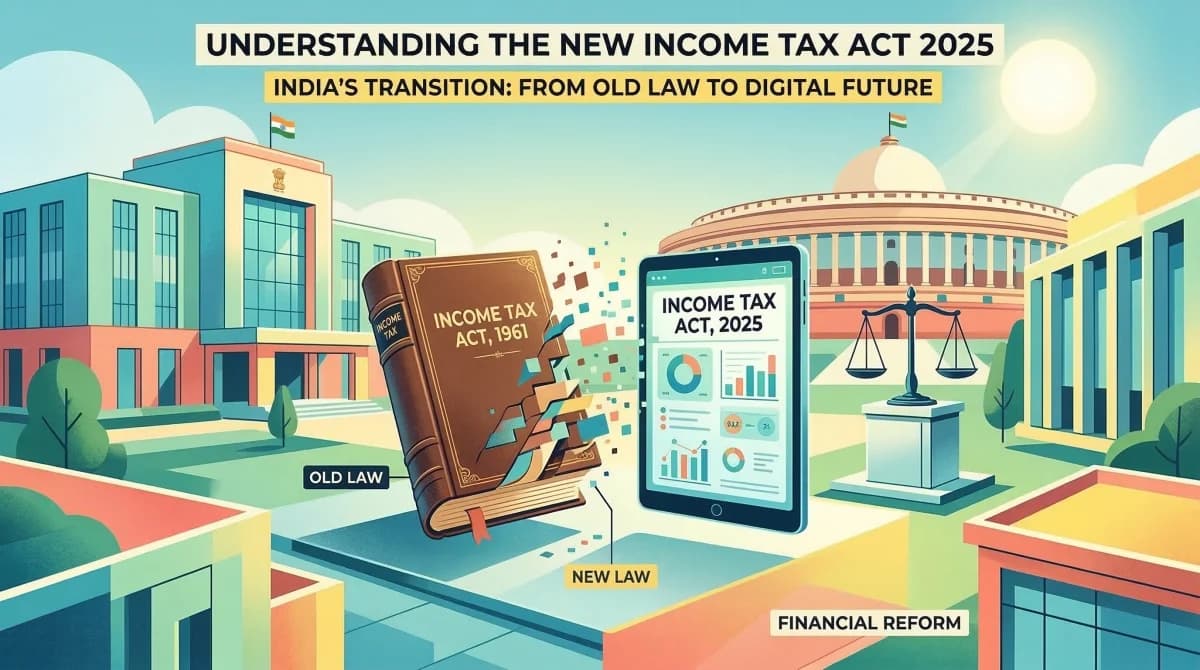
India's old Income Tax Act was written in 1961 — when there were no computers, no UPI, no mutual funds as we know them, and certainly no cryptocurrency. Over 63 years, the government kept adding sections, provisos, and explanations until the law became a 819-section monster that even chartered accountants found hard to navigate.
Finance Minister Nirmala Sitharaman announced in Budget 2026 that the new Income Tax Act, 2025 will come into force from April 1, 2026. It applies to income earned in Tax Year 2026-27 onwards.
Here's what's actually changing — and what it means for you.
1. "Tax Year" Replaces Financial Year and Assessment Year
This is the biggest conceptual change. For decades, taxpayers have been confused by two terms:
Financial Year (FY) — the year you earn income (e.g., April 2025 to March 2026)
Assessment Year (AY) — the year you file your return for that income (e.g., 2026-27)
The new act scraps both and introduces a single term: Tax Year. So instead of saying "FY 2026-27" or "AY 2027-28," you'll simply say "Tax Year 2026-27." One term, zero confusion.
2. 819 Sections Cut Down to 536
The old act had grown into a maze of 819 sections spread across 47 chapters and 25+ schedules. The new act trims this to:
Parameter | Old Act (1961) | New Act (2025) |
|---|---|---|
Sections | 819 | 536 |
Chapters | 47 | 23 |
Schedules | 25+ | 16 |
The government also introduced tables and formulas within the act itself, making it easier to interpret without needing a CA to decode legal jargon.
3. TDS Rules Consolidated Under One Section
Under the old act, TDS provisions were scattered across Sections 192 to 194T — over 30 different sections, each covering a different type of payment (salary, rent, professional fees, etc.).
The new act consolidates all TDS rules under Section 393. This means businesses and employers have one place to check TDS rates, thresholds, and compliance requirements instead of hunting through dozens of sections.
4. Tax Slabs Remain the Same
Here's the important part for your wallet: no tax rates have changed. The new act is a structural overhaul, not a rate revision. The tax slabs under both old and new regimes remain exactly as they were in Budget 2026:
New Tax Regime (Default)
Income Range | Tax Rate |
|---|---|
Up to ₹4 lakh | Nil |
₹4 lakh – ₹8 lakh | 5% |
₹8 lakh – ₹12 lakh | 10% |
₹12 lakh – ₹16 lakh | 15% |
₹16 lakh – ₹20 lakh | 20% |
₹20 lakh – ₹24 lakh | 25% |
Above ₹24 lakh | 30% |
The rebate under Section 87A means if your income is up to ₹12 lakh (₹12.75 lakh for salaried with standard deduction), you pay zero tax under the new regime. Use our income tax calculator to compare both regimes for your income.
5. New Regime Becomes the Default
Under the old act, taxpayers had to actively opt for the new tax regime. Now, the new regime is the default under Clause 202 of the new act. If you want to continue with the old regime (with its deductions like 80C, 80D, HRA), you'll need to explicitly opt out.
This matters because if you forget to choose, you'll automatically be taxed under the new regime — which may or may not be beneficial depending on your deductions. Compare both regimes here before deciding.
6. Nearly 30 Tax Forms Renumbered
The government has renumbered almost 30 commonly used forms. The biggest change: the Tax Audit forms (earlier Forms 3CA and 3CB) are now replaced by Form 26, which reportedly has 55 segment-wise clauses.
Other changes include new numbers for PAN applications, TDS return forms, and ITR forms. If you're a business owner or a CA, you'll need to get familiar with the new form numbers before April.
7. New HRA Disclosure Rules — Form 124
This is a big change for salaried employees claiming House Rent Allowance (HRA). Under the Draft Income Tax Rules 2026, a new Form 124 replaces the earlier Form 12BB for HRA claims.
The key change: if your annual rent exceeds ₹1 lakh, you must now disclose your relationship with the landlord — especially when paying rent to family members like parents, spouse, or siblings. This is targeted at the common practice of showing inflated rent payments to relatives to claim higher HRA exemptions.
Metro vs Non-Metro HRA Rates
Eight metro cities continue to qualify for the higher 50% of salary HRA exemption:
Mumbai, Delhi, Kolkata, Chennai, Hyderabad, Pune, Ahmedabad, and Bengaluru
All other cities remain at 40% of salary. If you're claiming HRA under the old regime, make sure your rental agreement and payment receipts are in order — scrutiny is likely to increase from April 2026.
8. Cryptocurrency and Digital Assets Get Formal Recognition
The old act added crypto taxation almost as an afterthought in 2022. The new act formally recognizes Virtual Digital Assets (VDAs) — including cryptocurrency, NFTs, and other digital tokens — as taxable assets from the ground up.
The 30% flat tax on crypto gains and 1% TDS on transactions continue, but now they're part of the act's core framework rather than being patched in.
9. MAT Rate Reduced to 14%
Minimum Alternate Tax (MAT) — which applies to companies whose tax liability falls below a minimum threshold — has been reduced from 15% to 14%. Additionally, MAT is now proposed as a final tax, meaning companies won't accumulate MAT credit for future years.
While this mainly affects companies, it's a signal that the government is simplifying corporate tax compliance too.
10. Extended Deadline for Revised Returns
Good news for taxpayers who make mistakes in their ITR. Under the old act, you could file a revised return only until December 31 of the assessment year. The new act extends this deadline to March 31 — giving you three extra months to correct errors, add missed income, or claim forgotten deductions.
Similarly, taxpayers can now claim TDS refunds even after missing the original filing deadline, without facing penalties.
11. Simpler Compliance for Ordinary Citizens
FM Sitharaman stated that "the forms have been redesigned such that ordinary citizens can comply without difficulty." The new act focuses on:
Faceless, digital-first assessments — reducing the need for in-person interactions with tax officers
Fewer cross-references — the old act was notorious for "read Section X with Section Y read with Explanation Z" chains
Plain language — replacing archaic legal terminology with modern, accessible wording
Improved dispute resolution — clearer appeal mechanisms to reduce litigation
What Should You Do Right Now?
Since the new act is revenue-neutral (no rate changes), you don't need to panic or make any immediate financial moves. But here's what you should keep in mind:
Get familiar with "Tax Year" terminology — you'll start seeing it on all forms from April 2026
Compare tax regimes: The new regime is now the default. Use our tax calculator to check which regime saves you more money
If you're a business owner or CA: Study the new form numbers, especially Form 26 for tax audits
File your FY 2025-26 ITR under the old act: The current year's return will still use the old act. The new act applies from April 1, 2026 onwards
Watch for updated ITR forms: The income tax department will release new ITR forms for Tax Year 2026-27 — expect them by May-June 2026
The Bottom Line
The Income Tax Act, 2025 is the most significant tax reform in India since 1961. While it doesn't change how much tax you pay, it fundamentally changes how tax laws are organized, read, and complied with. Fewer sections, simpler language, one "Tax Year" instead of FY/AY confusion, and consolidated TDS rules — it's a welcome modernization.
The real test will be how smoothly the IT department transitions its systems and forms to the new framework by April. For now, focus on filing your current year's taxes and start getting familiar with the changes.
Disclaimer: This article is for educational purposes only and does not constitute financial or tax advice. Tax laws are subject to change. Please consult a qualified chartered accountant for advice specific to your situation.
Written by
Jaspal Singh
Founder & Editor
Personal finance writer helping Indians make smarter money decisions through clear, jargon-free guides on taxes, investments, and budgeting.
Continue Reading

Belated & Revised ITR: Deadlines & Penalties
Missed the ITR deadline or made a mistake? Here's how belated, revised and updated returns work for AY 2026-27 — the dates, the ₹1,000–₹5,000 late fee, and the other penalties.

ELSS Funds: Save Tax + Grow Wealth
ELSS funds give you an 80C tax deduction, a 3-year lock-in and equity-linked returns. Here's how they're taxed, ELSS vs PPF, and whether they still make sense in the new tax regime.

How to Save Tax Beyond Section 80C
Maxed out your ₹1.5 lakh under Section 80C? Save more with 80D, the extra ₹50,000 NPS deduction, home loan interest and more — and see what still works in the new tax regime.