GST in India: A Simple Guide to Rates, Registration, Filing, and Input Tax Credit
Jaspal Singh
Author
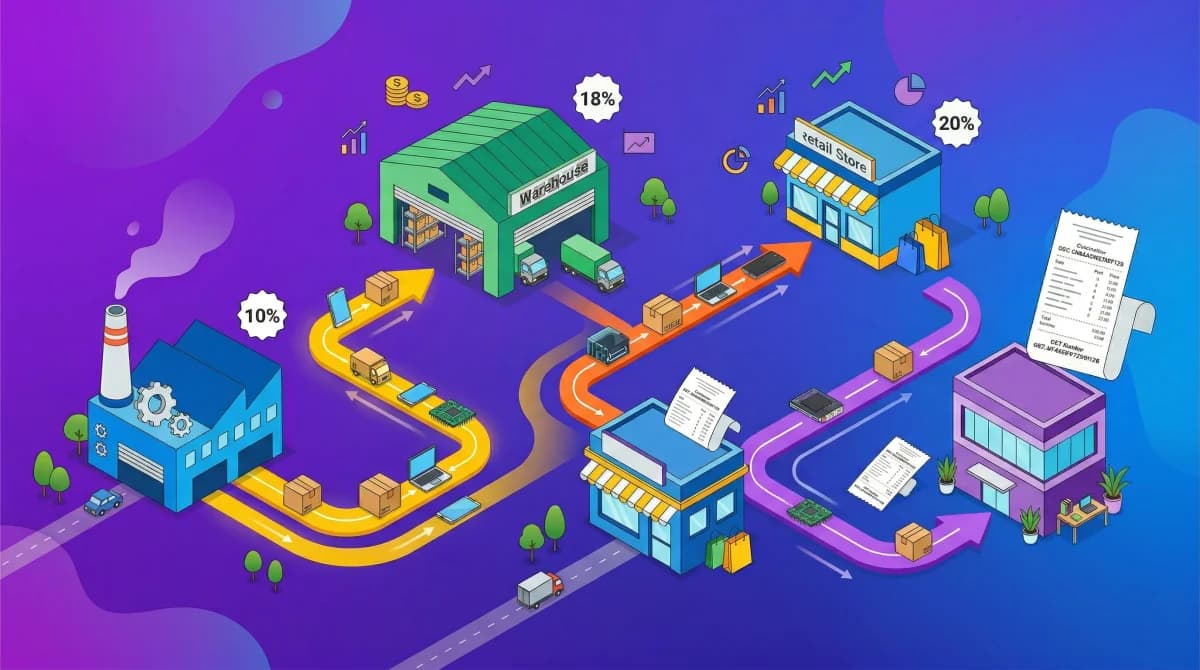
GST Made Simple
The Goods and Services Tax (GST) replaced a confusing web of state and central taxes in 2017. But even after 9 years, many small business owners find it confusing. This guide breaks it down in plain language.
The New GST Slab Structure (2026)
Effective September 2025, GST has been simplified to mostly 2 main slabs:
| Rate | What It Covers |
|---|---|
| 0% (Nil) | Essential items: fresh fruits, vegetables, milk, bread, unbranded grains |
| 5% | Mass consumption items: packaged food, economy hotels, transport tickets, small restaurants |
| 18% | Most goods and services: electronics, financial services, restaurants with AC, professional services, software |
| 40% | Demerit goods: luxury cars, tobacco, aerated drinks, high-sugar beverages |
The old 12% and 28% slabs have been largely merged into 5% and 18% respectively.
Who Needs to Register for GST?
- Service providers: Annual turnover above ₹20 lakh (₹10 lakh in special category states like NE states, Himachal, etc.)
- Goods sellers: Annual turnover above ₹40 lakh (₹20 lakh in special category states)
- E-commerce sellers: Mandatory registration regardless of turnover
- Interstate suppliers: Mandatory registration regardless of turnover
How to Register for GST (Free, Online)
Registration is free on the official GST portal and usually takes a few working days:
- Go to gst.gov.in and start a new registration with your PAN, mobile number and email.
- Verify with the OTP to get a Temporary Reference Number (TRN).
- Fill in your business details and upload documents (PAN, proof of business address, bank details, photo).
- Complete Aadhaar authentication (fastest) or e-sign.
- Once approved, you receive your 15-digit GSTIN.
Even below the threshold, voluntary registration can be worth it — it lets you claim input tax credit and makes your business look more credible to larger clients who themselves want ITC.
Input Tax Credit (ITC) — The Core Benefit of GST
ITC is what makes GST work for businesses. The concept is simple:
- You charge GST to your customers (output tax)
- You pay GST on your business purchases (input tax)
- You only pay the government the difference (output minus input)
Example: You sell a product for ₹1,000 + 18% GST (₹180). You bought raw materials for ₹600 + 18% GST (₹108). You pay the government: ₹180 - ₹108 = ₹72.
2026 rule: ITC claims are now validated against your supplier's GSTR-2B filing. If your supplier does not file their returns, you cannot claim that ITC.
What you cannot claim ITC on: GST paid on personal expenses, most motor vehicles, food and catering, club memberships, and goods given as free samples or gifts are “blocked credits” under Section 17(5) — these cannot be offset against your output tax.
GST Filing Calendar
| Return | Frequency | Due Date | Who Files |
|---|---|---|---|
| GSTR-1 | Monthly | 11th of next month | All registered businesses |
| GSTR-3B | Monthly | 20th of next month | All registered businesses |
| GSTR-9 | Annual | 31st December | All (turnover above ₹2 crore needs audit) |
Composition Scheme: Small businesses with turnover under ₹1.5 crore can opt for the composition scheme — pay a flat 1-6% tax with quarterly filing. Simpler but no ITC benefit.
Common GST Mistakes to Avoid
- Not filing nil returns: Even if you had no sales, you must file GSTR-3B. Late fee: ₹50/day (₹20 for nil returns).
- Claiming ITC from non-compliant suppliers: Check your GSTR-2B regularly.
- Mismatch between GSTR-1 and GSTR-3B: Discrepancies trigger notices.
- Not reconciling with income tax: Your GST turnover and ITR income should match.
Frequently Asked Questions
What are the GST slabs in India now?
After the September 2025 rationalisation, GST mainly uses two slabs — 5% for mass-consumption items and 18% for most goods and services — plus 0% on essentials and a 40% rate on demerit and luxury goods. The old 12% and 28% slabs were largely merged into 5% and 18%.
What is the GST registration limit?
₹40 lakh annual turnover for goods sellers and ₹20 lakh for service providers (₹20 lakh and ₹10 lakh respectively in special-category states). E-commerce and interstate suppliers must register regardless of turnover.
What is Input Tax Credit (ITC)?
ITC lets you deduct the GST you paid on business purchases from the GST you collected on sales, so you pay only the difference to the government. You can claim it only if your supplier has filed their returns, so it appears in your GSTR-2B.
Do freelancers and small service providers need GST?
Only if your annual receipts cross ₹20 lakh (₹10 lakh in special-category states), or you supply services across states or through e-commerce platforms. Below that, GST registration is optional — see our freelancer tax guide.
What is the penalty for not filing GST returns?
A late fee of ₹50 per day (₹20 per day for nil returns) plus 18% annual interest on any unpaid tax. Persistent non-filing can lead to cancellation of your GST registration.
What is the composition scheme?
A simplified option for businesses with turnover under ₹1.5 crore — pay a flat 1–6% of turnover with quarterly filing, but you cannot claim input tax credit or charge GST separately to customers.
Related Reading
- Tax Planning for Freelancers — GST for service providers
- TDS Guide — how TDS and GST interact
- Tax Calculator
Disclaimer: GST rules change frequently via council notifications. Rates mentioned reflect the September 2025 GST rationalisation and are current for 2026. Consult a GST practitioner for business-specific advice. This article is for educational purposes only.
Written by
Jaspal Singh
Founder & Editor
Personal finance writer helping Indians make smarter money decisions through clear, jargon-free guides on taxes, investments, and budgeting.
Continue Reading
Belated & Revised ITR: Deadlines & Penalties
Missed the ITR deadline or made a mistake? Here's how belated, revised and updated returns work for AY 2026-27 — the dates, the ₹1,000–₹5,000 late fee, and the other penalties.
ELSS Funds: Save Tax + Grow Wealth
ELSS funds give you an 80C tax deduction, a 3-year lock-in and equity-linked returns. Here's how they're taxed, ELSS vs PPF, and whether they still make sense in the new tax regime.
How to Save Tax Beyond Section 80C
Maxed out your ₹1.5 lakh under Section 80C? Save more with 80D, the extra ₹50,000 NPS deduction, home loan interest and more — and see what still works in the new tax regime.