Fertiliser Crisis: How the Iran War Could Make Your Groceries Costlier
Jaspal Singh
Author
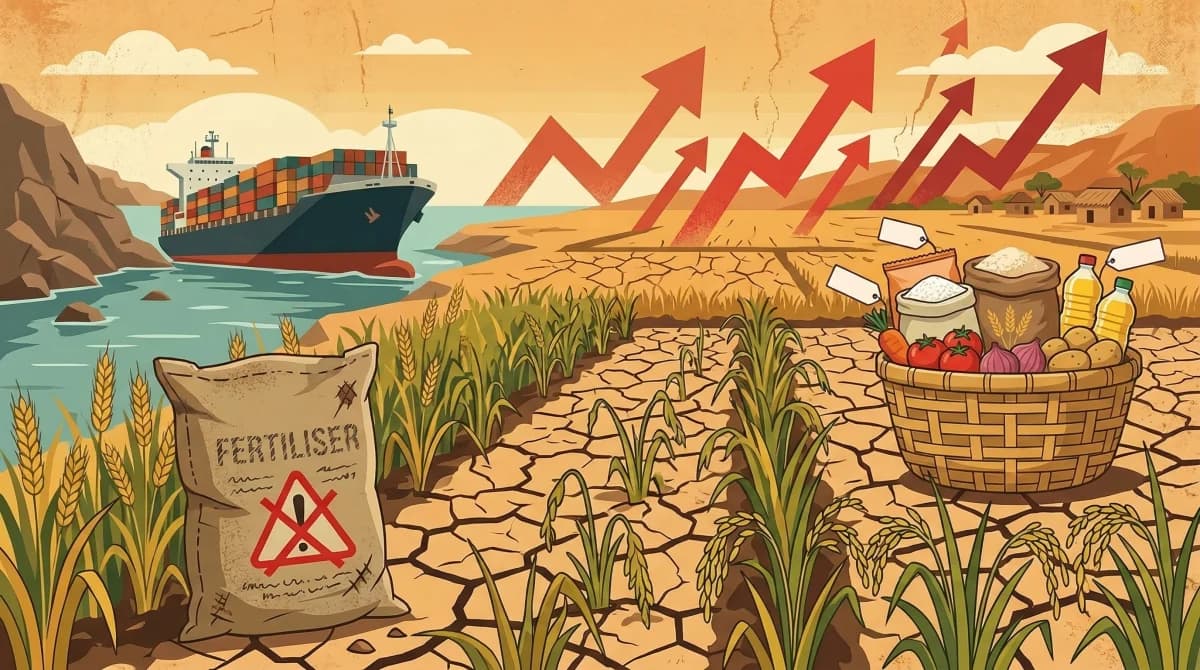
You have probably heard that the war involving the US, Israel, and Iran has sent oil prices climbing. But there is another crisis brewing quietly — one that could hit your kitchen more directly than petrol prices ever will. We are talking about fertilisers.
Yes, the same stuff farmers spread on their fields to grow the wheat for your roti, the rice for your dal chawal, and the vegetables in your sabzi. Let us break down what is happening, why it matters, and what it could mean for your monthly grocery bill — in the simplest way possible.
What Happened? The Strait of Hormuz Is Shut
Imagine a narrow 21-mile-wide road that connects the Persian Gulf to the rest of the world's oceans. That road is called the Strait of Hormuz, and it sits right between Iran and Oman. Almost every ship carrying oil, natural gas, and fertiliser from countries like Qatar, Saudi Arabia, Iran, and the UAE has to pass through it.
In early March 2026, as the Iran war escalated, commercial shipping through this strait was effectively suspended. Think of it as the biggest supply highway in the world suddenly getting a "Road Closed" sign.
Here is the scary part: roughly one-third of all globally traded fertiliser passes through this strait. That includes nearly 50% of the world's urea exports and 50% of global sulphur exports.
Why Should India Worry?
India is the world's second-largest consumer of fertilisers. We grow food for 1.4 billion people, and our farms depend heavily on fertilisers — especially urea, DAP (diammonium phosphate), and potash.
Here is the problem: India imports about 30% of its total fertiliser needs, and nearly 40% of those imports come from West Asia — the exact region now engulfed in conflict.
What India ImportsKey Source RegionWhy It MattersUreaQatar, Saudi Arabia, IranMost-used fertiliser for nitrogen; critical for wheat, rice, sugarcaneDAPWest Asia, ChinaKey phosphate fertiliser for pulses, oilseedsSulphurUAE, Qatar, Saudi ArabiaRaw material for making phosphate fertilisers in IndiaLNG (Natural Gas)QatarFuel for making urea in Indian factories
So it is not just about importing finished fertiliser. India also imports the raw materials and fuel needed to make fertiliser at home. When the Strait of Hormuz shuts down, both channels get choked.
Indian Factories Are Already Cutting Production
This is not a future worry — it is happening right now. Three Indian urea plants have already been forced to reduce output because LNG supplies from Qatar have dropped sharply. Qatar Energy has had to stop production at the world's largest single-site urea plant.
Organisations like the Indian Farmers Fertiliser Cooperative (IFFCO) have already started reductions at certain plants. The fertiliser sector uses roughly 30-35% of India's total natural gas consumption, so when gas stops flowing, urea production takes an immediate hit.
Prices Are Already Climbing
Global urea prices have surged by about ₹6,700 per tonne (approximately $80/tonne) since the war began. India's import prices of urea have jumped 20% in just one month.
Morningstar analyst Seth Goldstein has warned that nitrogen fertiliser prices could roughly double, and phosphate prices could rise 50% from current levels if the disruption continues. He compared this to the 2022 price spikes triggered by the Russia-Ukraine war.
FertiliserPrice Before WarCurrent Price (Approx.)ChangeUrea (global)$470/tonne$550/tonne+17%Urea (US benchmark)$516/tonne$683/tonne+32%DAPExpected to rise 50% if disruption persists——
Kharif Season Is at Risk
Here is where timing makes everything worse. The kharif sowing season — when farmers plant rice, pulses, cotton, soybean, and maize — begins in June-July 2026. Farmers need to buy their fertilisers in the weeks ahead to prepare.
If urea, DAP, and other fertilisers are either unavailable or too expensive, farmers face some very difficult choices:
Pay much higher prices for whatever fertiliser is available
Use less fertiliser, which means lower crop yields
Switch to cheaper crops that need less fertiliser
Any of these outcomes means less food produced — and that is what eventually pushes up prices at your local sabzi mandi and kirana store.
The good news? The government says India's fertiliser stocks are currently 36.5% higher than a year ago — at 177.31 lakh metric tonnes as of early March 2026. The government has also imported 98 lakh metric tonnes of finished fertilisers so far this year, with another 17 lakh metric tonnes lined up for the next three months.
But experts warn: if the war drags on beyond a few weeks, these reserves will not be enough.
The Government's Subsidy Bill Could Balloon
In India, the government subsidises fertilisers so that farmers can buy them at affordable rates. In FY 2024-25, the fertiliser subsidy bill was a whopping ₹1.91 lakh crore — that is nearly 70% of India's entire agriculture budget.
For FY 2025-26, the budget allocated about ₹1.68 lakh crore for fertiliser subsidies. But if global prices keep rising because of the war, the government will have to spend far more than planned.
We have seen this before. During the Russia-Ukraine war in 2022, fertiliser prices skyrocketed globally, and India's subsidy bill ballooned beyond ₹2 lakh crore. The same thing could happen again.
That extra money has to come from somewhere — either by cutting spending elsewhere, borrowing more, or eventually letting some of the price increase pass through to consumers.
How This Hits Your Grocery Bill
Let us connect the dots from the war to your kitchen:
War shuts the Strait of Hormuz → fertiliser and gas shipments stop
Fertiliser prices jump 20-50% → farmers pay more to grow crops
Some farmers use less fertiliser → crop yields drop
Less supply of crops + higher cost of production → wholesale prices rise
Wholesale price hikes trickle down → your dal, atta, rice, and vegetables get costlier
Agricultural analysts warn that the high cost of fertiliser today will show up as higher grocery prices over the next 12-18 months. This means even if the war ends tomorrow, the damage to the next growing season is already partially done.
Items most likely to be affected include:
Rice and wheat — India's staple crops, both heavy users of urea
Pulses (dal) — depend on DAP fertiliser
Vegetables — require balanced fertiliser application
Sugar — sugarcane is a nitrogen-hungry crop
Edible oils — oilseed crops need phosphate fertilisers
What Can Be Done?
The government is taking steps. It has built up buffer stocks and is actively exploring alternative supply sources. But the reality is that India cannot replace 40% of its fertiliser imports overnight.
Some measures being discussed include:
Diversifying import sources — buying more from Russia, Central Asia, and Africa
Boosting domestic production — reviving closed urea plants and investing in nano-urea technology
Promoting organic and bio-fertilisers — reducing dependence on chemical fertilisers
Strategic reserves — maintaining larger buffer stocks of critical fertilisers
The Bottom Line
The Iran war is not just about oil prices and geopolitics. It has a very direct pipeline to your kitchen table. India's heavy dependence on West Asian fertilisers means that every day the Strait of Hormuz remains shut, the risk to our food security grows.
Right now, India has enough fertiliser stocks for the immediate future. But if this conflict stretches into the kharif season, we could see the kind of food price inflation that hits middle-class and lower-income households the hardest — where grocery bills already consume 30-50% of monthly income.
Keep an eye on fertiliser news in the coming weeks. It may not be as dramatic as oil price headlines, but it could end up costing you a lot more at the end of the month.
Stay informed. Stay prepared.
Disclaimer: This article is for informational and educational purposes only. It does not constitute financial, investment, or policy advice. The situation described is evolving rapidly, and facts may change. Readers are advised to rely on official government announcements for the latest updates on fertiliser availability and pricing. YourFinances.in is not responsible for any decisions made based on this information.
Written by
Jaspal Singh
Helping Indians make better financial decisions through simple, actionable advice.
Continue Reading
Will Petrol and Diesel Prices Rise? India's 74-Day Fuel Reserve Explained
Oil prices surged past $119 per barrel after the Iran war escalated. India has 74 days of fuel reserves, but how long can prices stay frozen? Here's what it means for your monthly budget.

AI and Jobs: Which Careers Are Safe and Which Are at Risk?
Anthropic's study of 2 million AI conversations reveals which jobs are most exposed to automation. Here's what it means for Indian workers — and 5 practical steps to future-proof your career.
India's Cement Cartel: How 3 Companies Fixed Prices for 12 Years
A CCI investigation reveals how three cement companies allegedly fixed prices on ONGC tenders for 12 years. The 'lucky number 7' excuse, the cartel's inner workings, and what it means for homebuyers.