AI and Jobs: Which Careers Are Safe and Which Are at Risk?
Jaspal Singh
Author
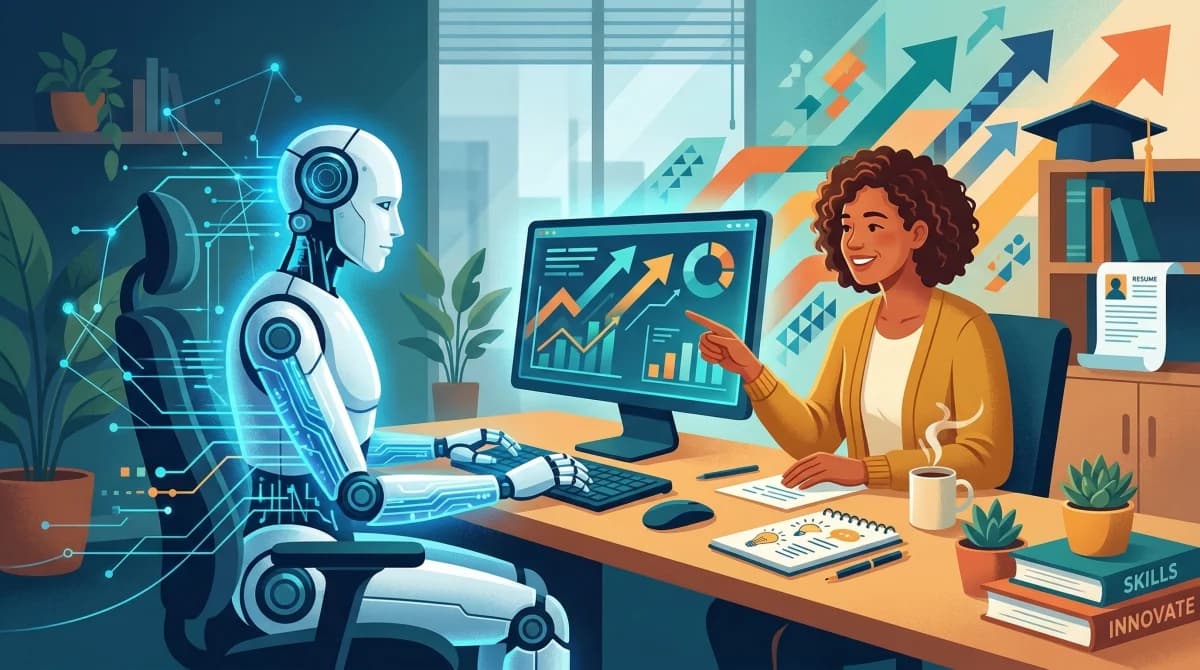
Imagine a giant robot that can write emails, answer customer calls, and even write computer code — all by itself, without getting tired. That is basically what AI (Artificial Intelligence) tools like ChatGPT and Claude are doing right now. And a brand-new study by Anthropic, the company behind Claude AI, just dropped some eye-opening numbers about which jobs this robot is learning to do.
Let us break it all down in simple language — especially what it means if you live and work in India.
What Did Anthropic Actually Find?
In March 2026, Anthropic published a major research paper called "Labor Market Impacts of AI." Their team studied 2 million real conversations people had with Claude (their AI assistant) and matched those conversations to actual job tasks.
Think of it like this: if someone asks Claude to "write a customer complaint reply," that maps to a customer service job task. By doing this millions of times, Anthropic built an AI Exposure Index — a score showing how much of each job AI can already handle.
Here is the headline finding: AI can theoretically do 94% of computer and math tasks, but people are currently only using it for about 33% of those tasks. There is a huge gap between what AI can do and what it is doing — but that gap is closing fast.
Which Jobs Are in the "Red Zone"?
Anthropic's data paints a clear picture. Some jobs are significantly more exposed to AI automation than others. Here are the most affected roles:
Job RoleAI Task CoverageRisk LevelComputer Programmers74.5%Very HighCustomer Service Representatives70.1%Very HighData Entry Clerks67.1%Very HighTechnical WritersHighHighLegal AssistantsHighHighFinancial AnalystsHighHighMedical Records SpecialistsHighHigh
The researchers also flagged an uncomfortable pattern: the workers most exposed to AI tend to be highly educated, higher-paid, and in white-collar roles. On average, they earn about 47% more than workers in jobs with little AI exposure. This is not the factory automation story of the 1990s — AI is coming for the office.
Fortune magazine called this a potential "Great Recession for white-collar workers," comparing it to the 2007–2009 crisis when US unemployment doubled from 5% to 10%.
Which Jobs Are Safe?
Here is the good news: about 30% of all workers score a flat zero on Anthropic's AI exposure index. Their daily tasks simply do not appear in AI usage data at all. These are roles that need physical presence, sensory judgment, and human interaction that no chatbot can replicate:
Healthcare workers — nurses, physiotherapists, care-givers
Skilled trades — electricians, plumbers, mechanics
Hospitality — cooks, bartenders, hotel staff
Physical safety — lifeguards, security personnel
Creative strategy — brand strategists, UX researchers, leadership roles
Healthcare is an interesting case. While AI can theoretically handle about 40% of healthcare support tasks, the observed usage is only around 5%. Humans still want a human when it comes to their health.
What Does This Mean for India?
India's story has a few extra layers, and not all of them are bad.
The IT Sector Is Transforming — Not Dying
India's IT services industry employs roughly 7.5 to 8 million people. A NITI Aayog report warns that in a worst-case scenario, this could shrink to 6 million by 2031. That is 1.5 to 2 million jobs potentially at risk.
But the full picture is more nuanced. Large IT firms like TCS and Infosys are seeing flat to single-digit revenue growth (averaging about 1.5%), while mid-tier firms like Coforge, Persistent Systems, and Mphasis are growing at 20% year-on-year by embracing AI-powered delivery models.
Coforge, for example, bagged a massive 13-year, $1.56 billion deal from Sabre and acquired Encora, a Silicon Valley AI-native firm, in December 2025. The lesson? Companies that ride the AI wave are thriving. Those that resist it are struggling.
The BPO Sector Feels the Heat
India's Business Process Outsourcing (BPO) sector — think call centres, data processing, and back-office work — is under direct threat. AI chatbots and "agentic AI" systems can now handle repetitive customer service tasks around the clock, without breaks or salaries. Globally, over 30,000 tech jobs were cut in the first weeks of 2026 alone.
Entry-Level Jobs Are Shrinking
Perhaps the most worrying finding from Anthropic's study is about young workers. There is "suggestive evidence that hiring of younger workers (ages 22–25) has slowed" in AI-exposed occupations. For a country like India, where millions of fresh graduates enter the job market every year, this is a serious concern.
The Silver Lining: New Jobs Are Being Created
It is not all doom and gloom. According to Deloitte, AI has created 1.3 million new jobs over the past two years, including roles like:
Prompt Engineers — people who know how to talk to AI tools effectively
AI Trainers — humans who teach AI systems to be better
Data Engineers — specialists who build and manage data pipelines
Ethical AI Specialists — professionals ensuring AI is fair and unbiased
Smart Grid Managers — tech roles in energy and infrastructure
India's hiring intent has actually soared 11% in 2026, fuelled partly by AI-related roles. The jobs are shifting, not vanishing.
How to Future-Proof Your Career: A Practical Guide for Indian Workers
Here is what you can do right now, regardless of your current job:
1. Learn AI Basics (You Do Not Need to Be a Coder)
95% of Indian workers say they want to develop AI skills, according to recent surveys. You do not need to build AI — you just need to know how to use it. Start with free courses:
Google AI Essentials — free on Coursera
Microsoft AI Skills Initiative — free on LinkedIn Learning
NPTEL courses — free AI/ML courses from IITs
NASSCOM FutureSkills Prime — subsidised upskilling for Indian IT workers
2. Build Skills AI Cannot Replace
Focus on what makes you human:
Critical thinking — analysing problems, not just following instructions
Communication — presenting ideas, negotiating, leading teams
Emotional intelligence — understanding people, managing conflicts
Creative strategy — coming up with new ideas, not just executing old ones
3. Consider "AI-Proof" Career Paths
If you are a student or early in your career, think about fields where AI exposure is near zero:
Healthcare and nursing (India has a massive shortage of healthcare workers)
Skilled trades — electricians, HVAC technicians, solar panel installers
Teaching and education (with a human touch)
Government and public administration
4. Use AI to Become Better at Your Current Job
Instead of competing against AI, compete with AI. Workers who learn AI tools can see salary increases of over 54%, with IT professionals enjoying up to 65% salary hikes, according to Amazon's research on the Indian market.
5. Build a Financial Safety Net
Career transitions take time, and having savings gives you the freedom to upskill without panic. Even a small monthly SIP (Systematic Investment Plan) of ₹2,000 to ₹5,000 can build a meaningful cushion over 3 to 5 years. Use our SIP Calculator to see how much your money can grow while you future-proof your skills.
The Bottom Line
Anthropic's data tells us something important: AI is not destroying jobs overnight, but it is changing them faster than most people realise. The gap between what AI can do (94% of computer tasks) and what it is doing (33%) is a ticking clock. As that gap closes over the next few years, millions of jobs — especially in India's IT and BPO sectors — will transform.
The workers who will thrive are not necessarily the most technically skilled. They are the ones who adapt fastest — who learn to use AI as a tool, build irreplaceable human skills, and stay financially prepared for change.
As the saying goes in the Indian startup world: "The best time to upskill was two years ago. The second best time is today."
Disclaimer: This article is for informational purposes only and does not constitute career advice or financial advice. Job market conditions vary by region, industry, and individual circumstances. Please consult a qualified career counsellor or financial advisor before making major career or investment decisions. Data cited is based on Anthropic's research paper and various news sources available as of March 2026.
Written by
Jaspal Singh
Helping Indians make better financial decisions through simple, actionable advice.
Continue Reading
Will Petrol and Diesel Prices Rise? India's 74-Day Fuel Reserve Explained
Oil prices surged past $119 per barrel after the Iran war escalated. India has 74 days of fuel reserves, but how long can prices stay frozen? Here's what it means for your monthly budget.
Fertiliser Crisis: How the Iran War Could Make Your Groceries Costlier
The Iran war has shut the Strait of Hormuz, choking India's fertiliser imports. With urea prices up 20% and kharif season approaching, here's how it could hit your grocery bill.
India's Cement Cartel: How 3 Companies Fixed Prices for 12 Years
A CCI investigation reveals how three cement companies allegedly fixed prices on ONGC tenders for 12 years. The 'lucky number 7' excuse, the cartel's inner workings, and what it means for homebuyers.