Advance Tax Deadline March 15: Last-Minute Guide for Taxpayers
Jaspal Singh
Author
What Is Advance Tax?
Think of advance tax as a "pay-as-you-earn" system. Instead of paying all your income tax in one shot after the year ends, the government wants you to pay it in four instalments throughout the financial year.
The logic is simple — the government needs money to run the country, and it can't wait until everyone files their ITR in July. So if your total tax liability for the year exceeds ₹10,000 (after subtracting TDS), you must pay advance tax.
Who Must Pay Advance Tax?
Advance tax isn't just for business owners. If you earn money beyond your salary — and your total tax bill crosses ₹10,000 — you're on the hook. Here's who typically needs to pay:
Freelancers and consultants — income from projects, gigs, or consulting fees
Business owners — shop owners, traders, startup founders
Salaried employees with side income — rental income, capital gains from stocks or mutual funds, interest from FDs, freelance work
Professionals — doctors, lawyers, chartered accountants with private practice
Good news for seniors: If you're 60 years or older and don't have any business or professional income, you're exempt from advance tax. Your regular salary, pension, or investment income doesn't count — only business income triggers the requirement for senior citizens.
The Instalment Schedule for FY 2025-26
Advance tax is paid in four instalments. Here's the schedule — and if you've missed earlier deadlines, March 15 is your last chance to catch up:
Instalment | Due Date | Cumulative % of Tax |
|---|---|---|
1st | June 15, 2025 | 15% |
2nd | September 15, 2025 | 45% |
3rd | December 15, 2025 | 75% |
4th (Final) | March 15, 2026 | 100% |
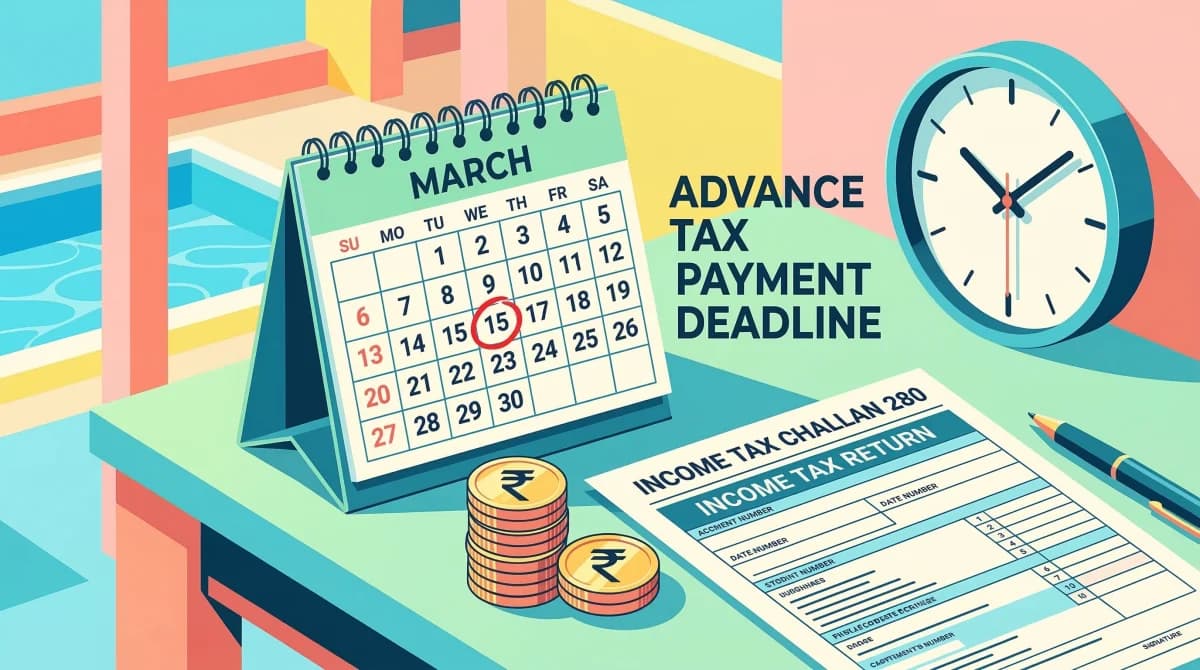
By March 15, you need to have paid 100% of your estimated tax liability for the year. If you've already paid the first three instalments, the fourth payment is simply the remaining balance.
Special Rule for Freelancers Under Presumptive Tax
If you're a freelancer or small business owner using the presumptive taxation scheme under Sections 44AD or 44ADA, you get a simpler deal. You can pay your entire advance tax in one shot by March 15 — no need to worry about quarterly instalments.
How to Calculate Your Advance Tax
Here's a step-by-step approach to figure out how much you owe:
Estimate your total income for the financial year — salary, business income, rental income, capital gains, interest, and other sources
Subtract deductions you're claiming — Section 80C (PPF, ELSS, life insurance), 80D (health insurance), HRA, NPS under 80CCD(1B), etc.
Calculate tax on the net taxable income using the income tax calculator — compare both old and new regime to pick the better one
Subtract TDS already deducted by your employer or on FD interest, etc.
If the remaining tax exceeds ₹10,000, that's your advance tax liability
For example: If your total tax works out to ₹1,80,000 and your employer has already deducted ₹1,50,000 as TDS, your remaining liability is ₹30,000. Since this exceeds ₹10,000, you must pay ₹30,000 as advance tax.
What Happens If You Miss the March 15 Deadline?
Missing the advance tax deadline isn't the end of the world, but it does cost you money. The Income Tax Act has two penalty sections that kick in:
Section 234C — Penalty for Missing Instalments
If you don't pay any instalment on time, you'll be charged interest at 1% per month (or part of a month) on the shortfall amount. Here's how it works for each missed deadline:
Missed Deadline | Interest Duration | Calculated On |
|---|---|---|
June 15 (paid less than 15%) | 3 months | Shortfall from 15% |
September 15 (paid less than 45%) | 3 months | Shortfall from 45% |
December 15 (paid less than 75%) | 3 months | Shortfall from 75% |
March 15 (paid less than 100%) | 1 month | Shortfall from 100% |
Section 234B — Penalty for Not Paying 90%
This is the bigger worry. If your total advance tax paid by March 31 is less than 90% of your actual tax liability, Section 234B charges 1% interest per month on the unpaid amount — and this interest runs from April 1 until you actually pay the tax (typically when you file your ITR).
So if you owe ₹1,00,000 in tax and paid only ₹80,000 by March 31, you'd pay 1% per month on ₹20,000 until you file your return. Over 4 months, that's ₹800 in interest — not huge, but completely avoidable.
How to Pay Advance Tax Online
Paying advance tax is straightforward. Here's the process:
Visit the Income Tax e-Filing Portal at incometax.gov.in
Go to e-Pay Tax (you don't need to log in)
Enter your PAN number and mobile number
Select Income Tax as the tax type and Advance Tax (100) as the payment type
Enter the assessment year as 2026-27 (not the financial year)
Choose your payment method — net banking, debit card, UPI, or NEFT/RTGS
Complete the payment and save your challan receipt — you'll need the BSR code and challan number when filing your ITR
5 Last-Minute Tips Before March 15
Check Form 26AS and AIS: Before calculating your advance tax, verify how much TDS has already been deducted on your behalf. Log into the income tax portal and check your Form 26AS and Annual Information Statement (AIS).
Don't forget capital gains: If you sold stocks, mutual funds, or property this year, include those gains in your calculation. Short-term capital gains from equity are taxed at 15%, and long-term gains above ₹1.25 lakh at 12.5%.
Use the new tax regime calculator: Compare your tax under both old and new tax regimes to ensure you're picking the one that saves you more.
Pay something, even if you're unsure: If you can't calculate the exact amount, pay your best estimate. Overpayment results in a refund when you file your ITR. Underpayment results in interest charges.
March 31 is the absolute last date: If you miss March 15, you can still pay by March 31 and it will be treated as advance tax — but you'll face Section 234C interest for the short delay.
The Bottom Line
March 15 is the final advance tax deadline for FY 2025-26. If your tax liability after TDS exceeds ₹10,000, don't wait — calculate your tax now and pay online in minutes. The penalty for missing the deadline is 1% per month interest, which adds up quickly.
Remember: it's always better to slightly overpay (you'll get a refund) than to underpay and face interest charges from the tax department.
Disclaimer: This article is for educational purposes only and does not constitute financial or tax advice. Please consult a qualified chartered accountant or tax advisor for advice specific to your situation.
Written by
Jaspal Singh
Founder & Editor
Personal finance writer helping Indians make smarter money decisions through clear, jargon-free guides on taxes, investments, and budgeting.
Continue Reading

Belated & Revised ITR: Deadlines & Penalties
Missed the ITR deadline or made a mistake? Here's how belated, revised and updated returns work for AY 2026-27 — the dates, the ₹1,000–₹5,000 late fee, and the other penalties.

ELSS Funds: Save Tax + Grow Wealth
ELSS funds give you an 80C tax deduction, a 3-year lock-in and equity-linked returns. Here's how they're taxed, ELSS vs PPF, and whether they still make sense in the new tax regime.

How to Save Tax Beyond Section 80C
Maxed out your ₹1.5 lakh under Section 80C? Save more with 80D, the extra ₹50,000 NPS deduction, home loan interest and more — and see what still works in the new tax regime.