Your Electricity Bill Is About to Surge This Summer — 7 Ways to Save
Jaspal Singh
Author
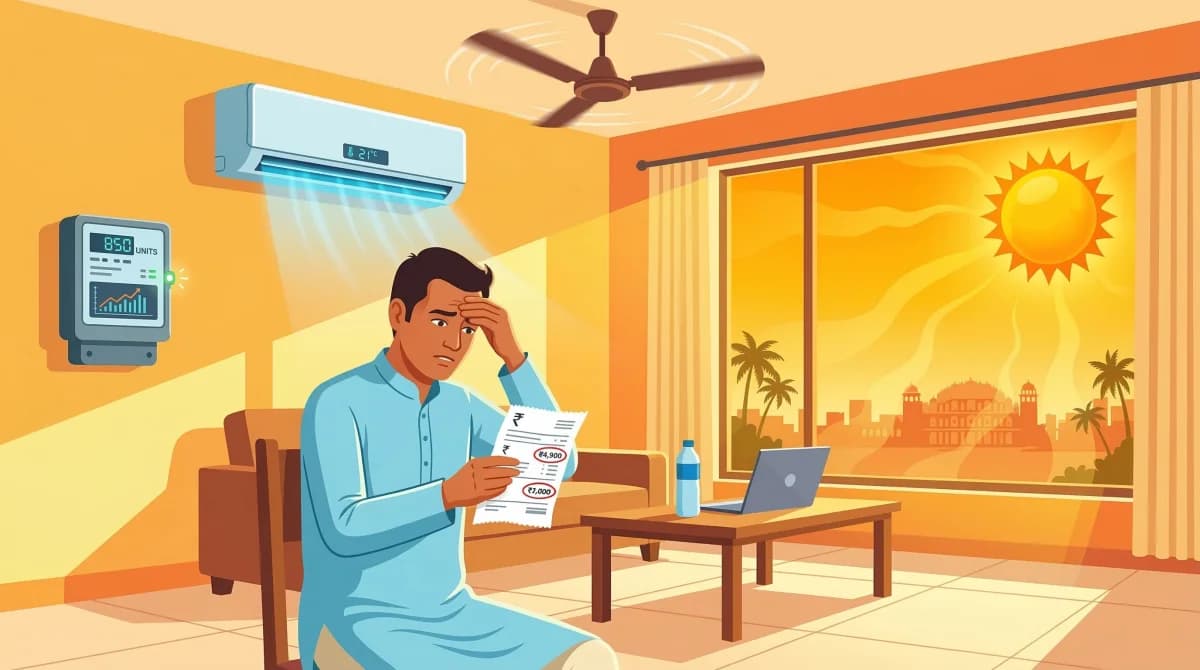
Why Your Summer 2026 Bill Will Be Higher Than Ever
Brace yourself: the India Meteorological Department (IMD) has sounded the alarm over a brutal summer in 2026, with above-normal temperatures and significantly more heatwave days across the country. The culprit? El Nino is making a comeback, with a 50-60% probability of developing by mid-2026.
Here is what this means for your wallet:
Peak power demand is expected to hit 275-285 GW this summer — driven by a 50-55 GW increase from cooling needs alone.
Delhi's peak demand could cross 9,000 MW, up from last year's 8,442 MW.
El Nino could cause a rainfall deficit, further increasing electricity demand for irrigation and cooling.
A snow drought in early 2026 has already impacted hydropower output, potentially leading to higher power costs.
Add in the fact that elevated global crude prices continue to feed into fuel costs for thermal power plants, and you have a perfect storm for record-high electricity bills this summer.
7 Practical Ways to Cut Your Summer Electricity Bill
1. Set Your AC to 24°C (Not 18°C)
This is the single biggest money-saver. The Bureau of Energy Efficiency (BEE) recommends 24°C as the optimal AC temperature. For every degree you lower below 24°C, your electricity consumption goes up by approximately 6%.
That means running your AC at 18°C instead of 24°C costs you roughly 36% more electricity. Over a summer, that could be ₹3,000-5,000 extra on your bill for no real comfort gain.
2. Switch to a 5-Star Inverter AC
If you are still using an old non-inverter AC, this summer is the time to upgrade. A 5-star inverter AC reduces energy use by up to 40-50% compared to older models. For a 1.5-ton unit, BEE label data suggests a 5-star unit saves on the order of 250 units a year against a 3-star — roughly ₹1,750 a year at ₹7 a unit.
The upfront cost is higher (₹35,000-55,000), so realistic payback is about 3-4 years. Check out our Best Inverter ACs in India guide for top picks.
3. Use Ceiling Fans Along With Your AC
Here is a trick most people miss: run your ceiling fan at low speed while the AC is on. The fan circulates cool air throughout the room, allowing you to set the AC at 26-27°C while feeling just as comfortable as 22°C without a fan.
A 75 W ceiling fan costs roughly ₹0.50 per hour to run (about ₹0.20 for a BLDC fan). A 1.5-ton AC costs closer to ₹8-12 per hour. Using both together at a higher thermostat saves you significantly.
4. Block the Sun Before It Heats Your Home
Your AC works overtime because your home absorbs heat through windows and walls. Simple fixes can make a big difference:
Install blackout curtains on sun-facing windows — blocks up to 99% of incoming light and cuts heat gain by roughly 25-33%.
Use reflective window film — costs ₹500-1,000 per window and reduces heat gain by 30-40%.
Keep curtains drawn during peak sun hours (11 AM - 4 PM).
These are one-time investments that reduce your cooling costs every summer.
5. Run Heavy Appliances at Night
Washing machines, dishwashers, irons, and ovens generate significant heat. Running them during the day forces your AC to work harder. Shift these to after 9 PM when temperatures drop naturally.
Bonus: many states offer lower electricity tariffs during off-peak hours (typically 10 PM - 6 AM). Check your state electricity board's tariff schedule.
6. Switch to LED Lighting Everywhere
If you still have incandescent or CFL bulbs anywhere in your home, replace them with LEDs immediately. LEDs use 75% less electricity and produce almost no heat — which means your AC does not need to work as hard to cool the room.
A 10-watt LED gives the same brightness as a 60-watt incandescent bulb. At ₹8 per unit, replacing 10 bulbs saves you roughly ₹500-700 per month.
7. Unplug Phantom Loads
Devices on standby mode — TV, set-top box, phone chargers, microwave — consume electricity even when you are not using them. These "phantom loads" account for 5-10% of your electricity bill.
Use power strips with switches so you can turn off multiple devices at once. Or simply unplug devices when not in use.
The Real Cost: How Much More Will You Pay?
Let us do some rough math for a typical middle-class family running a 1.5-ton AC for 8 hours daily in summer:
Scenario | Monthly AC Cost (Approx.) |
|---|---|
Old 3-star non-inverter AC at 22°C | ₹2,400 - 3,000 |
Old AC at 24°C + ceiling fan | ₹3,200 - 4,000 |
New 5-star inverter AC at 24°C + fan | ₹1,800 - 2,500 |
The difference between the worst and best scenario is ₹3,000+ per month — that is ₹12,000-15,000 over a 4-month summer. Invest that every summer in a SIP and it could grow to roughly ₹2 lakh over 10 years (a one-off ₹15,000 would grow to about ₹46,000). Use our SIP Calculator to check.
The Only Formula You Need: Units × Tariff
Everything above is advice; this section is arithmetic. The summer spike is simply when the numbers get loud enough to notice — the same maths runs every month of the year. Your DISCOM does not bill you for appliances. It bills you for units. One unit — one kilowatt-hour (kWh) — is 1,000 watts of draw sustained for one hour.
- Units = (Watts ÷ 1,000) × Hours used
- Cost = Units × your tariff per unit
A 2,000-watt geyser run for 30 minutes is 1 unit. A 28-watt fan run for 12 hours is 0.34 units — which is why the fan you leave on all day costs less than the geyser you run for half an hour.
Tariff assumption used throughout: ₹7 per unit — illustrative, chosen so the maths stays readable. India has no national electricity tariff: rates are set by each State Electricity Regulatory Commission and differ sharply between states, DISCOMs and slabs. Pull your actual rate off your last bill (energy charge ÷ units billed) and re-run every number below with it.
What Each Appliance Actually Costs You Per Month
Typical ratings for common Indian household appliances at ₹7 per unit. Wattages are representative — check the BEE label on your own unit.
| Appliance | Typical draw | Units/hour | Assumed use | Units/month | Cost/month @ ₹7 |
|---|---|---|---|---|---|
| 1.5-ton AC, 3-star | ~1,500 W | ~1.5 | 8 hr/day | ~360 | ~₹2,520 |
| 1.5-ton AC, 5-star inverter | ~1,100 W avg | ~1.1 | 8 hr/day | ~264 | ~₹1,850 |
| Refrigerator, 250L 3-star | cycles on/off | — | 24 hr/day | ~50 | ~₹350 |
| Refrigerator, 250L 5-star | cycles on/off | — | 24 hr/day | ~30 | ~₹210 |
| Storage geyser | 2,000 W | 2.0 | 30 min/day | ~30 | ~₹210 |
| Ceiling fan, conventional | ~75 W | 0.075 | 12 hr/day | ~27 | ~₹189 |
| Ceiling fan, BLDC (5-star) | ~28 W | 0.028 | 12 hr/day | ~10 | ~₹70 |
| Washing machine, 6.5 kg (cold wash) | ~500 W | ~0.6/cycle | 1 cycle/day | ~18 | ~₹126 |
| 10 × LED bulbs (9 W) | 90 W total | 0.09 | 5 hr/day | ~14 | ~₹95 |
| 10 × incandescent bulbs (60 W) | 600 W total | 0.6 | 5 hr/day | ~90 | ~₹630 |
| Set-top box on standby | ~15 W | 0.015 | 24 hr/day | ~11 | ~₹77 |
The AC is not merely the biggest line — it is bigger than everything else put together. And the fan is astonishingly cheap: twelve hours of ceiling fan costs less than thirty minutes of geyser.
Slab Tariffs: Why Cutting 50 Units Saves More Than 50 Units' Worth
Most Indian DISCOMs bill domestic consumers on escalating (telescopic) slabs: the first block of units is cheap, the next costs more, and so on. Savings therefore come off your top slab, not your average rate. Take an illustrative structure (invented for arithmetic, not any one state's tariff): ₹4 for units 1–100, ₹6 for 101–200, ₹8 for 201–400, ₹9 above 400.
- A household consuming 450 units pays (100 × ₹4) + (100 × ₹6) + (200 × ₹8) + (50 × ₹9) = ₹3,050. Average rate: ₹6.78/unit.
- Cut 50 units and the bill falls by 50 × ₹9 = ₹450, because those were top-slab units.
- That is ₹9 saved per unit against a ₹6.78 average — roughly 33% more value per unit saved than the average suggests.
The higher your consumption, the higher the slab you shave off. Some states use non-telescopic structures where crossing a threshold reprices a larger share of consumption, making it even more valuable to stay under a boundary — check your DISCOM's tariff order.
5-Star vs 3-Star: The Payback Calculation, Shown Properly
The Bureau of Energy Efficiency rates room ACs on ISEER and prints an annual energy figure on the label, calculated on a standard assumption of 1,600 operating hours a year. For a 1.5-ton split AC that typically means roughly 1,050–1,100 units/year at 3-star versus 800–850 at 5-star.
- Annual saving ≈ 250 units × ₹7 = ₹1,750 per year
- Typical 5-star price premium: ₹5,000–₹8,000
- Payback = ₹5,000 ÷ ₹1,750 ≈ 2.9 years; ₹8,000 ÷ ₹1,750 ≈ 4.6 years
Call it three to four years at average usage — not one summer. Run the AC closer to 2,400 hours a year, as many Delhi, Chennai and Hyderabad households do, and payback drops under three years; since an AC lasts 10–12 years, everything after that is gain. Our guide to 5-star inverter ACs in India compares models on ISEER; the same logic applies to the fridge — see best refrigerators in India, where a 5-star unit running 24×7 quietly saves ~20 units a month, forever.
One caveat: BEE periodically revises its star thresholds upward, so a unit sold as 5-star years ago may only meet today's 3-star bar. Compare the printed annual units figure, not the star count — see the BEE Standards & Labelling page.
The Cheapest Upgrades in the House
BLDC fans. A conventional induction-motor ceiling fan draws about 75 W; a 5-star BLDC fan delivers comparable air at roughly 28 W. Over 12 hours a day that saves 17 units a month per fan, about ₹119. At a ₹2,000–₹3,000 premium, payback is 17–25 months; a four-fan house then saves close to ₹5,700 a year.
LEDs, honestly costed. Swapping a 60 W incandescent for a 9 W LED saves 7.7 units a month, about ₹54, against a ₹100 bulb — payback under two months. Replacing a working 15 W CFL saves only ₹6 a month, taking over a year. Do incandescent and halogen fittings first; replace CFLs as they fail.
Standby load, priced. Small per device but relentless at 8,760 hours a year: a TV, set-top box, microwave, router and assorted adapters together cost roughly ₹150–₹300 a month. Switch-controlled power strips fix it cheaply.
Servicing and insulation. Clean AC filters every 2–4 weeks in heavy-use months — a clogged filter makes the compressor run longer for the same cooling — and keep the outdoor condenser shaded and unobstructed. Sealing gaps around window ACs and coating an exposed terrace in reflective white cut the heat your AC must remove at all, which is always cheaper than removing it.
Rooftop Solar: PM Surya Ghar Muft Bijli Yojana
If you own your roof and your bill is consistently high, the government's rooftop solar scheme changes the arithmetic entirely. Under PM Surya Ghar: Muft Bijli Yojana (launched February 2024, outlay ₹75,021 crore), Central Financial Assistance at benchmark prices is:
- ₹30,000 for a 1 kW system
- ₹60,000 for a 2 kW system
- ₹78,000 for 3 kW and above — the subsidy is capped at 3 kW
It targets one crore households and is built around up to 300 units of free electricity per month; government estimates put the saving for a household on ~300 units a month with a 3 kW system at roughly ₹15,000 a year. Apply via the official National Portal for Rooftop Solar.
It suits homeowners with unshaded roof rights, consumption above 200 units a month, and years left in the same house — not tenants, flat owners without an allocated roof share, or households billed under 100 units. Subsidy amounts and net-metering rules are revised periodically and vary by state DISCOM, so confirm on the portal before signing anything.
Turn the Savings Into Something
Money that drifts into other spending has not been saved. Route the difference into a fixed monthly investment: ₹1,500 a month for 15 years at an assumed 12% return compounds to roughly ₹7.5 lakh — run your own numbers in our SIP calculator. To make it automatic, give the saving a home in your plan using our step-by-step budgeting guide and the 50-30-20 rule.
Frequently Asked Questions
What is the ideal AC temperature setting to save electricity in India?
The Bureau of Energy Efficiency recommends 24°C and estimates each 1°C increase saves roughly 6% of consumption — a national 24°C default could save around 20 billion units a year. The Ministry of Power has separately been consulting on standardising AC limits to a 20–28°C range; as of mid-2026 that was not yet a binding rule.
How do I calculate the running cost of any appliance myself?
Take the wattage from the nameplate, divide by 1,000 for units per hour, multiply by hours per day, then by 30, then by your tariff. A 1,000 W appliance used 2 hours a day is 60 units a month — ₹420 at ₹7 per unit. Use the rate from your own bill, not a national average, because tariffs are set state by state.
Is a 5-star AC worth the extra money over a 3-star?
At BEE's standard 1,600 hours a year, a 1.5-ton 5-star inverter AC saves roughly 250 units annually versus a 3-star — about ₹1,750 at ₹7 per unit. Against a ₹5,000–₹8,000 premium that is a three-to-four-year payback, under three for heavy users. Over a 10–12 year life it usually pays, but compare printed annual units rather than star count alone.
Can I get a government subsidy for rooftop solar?
Yes. PM Surya Ghar: Muft Bijli Yojana provides ₹30,000 for a 1 kW system, ₹60,000 for 2 kW and ₹78,000 for 3 kW and above, capped at 3 kW, and is designed to deliver up to 300 units of free electricity a month. Apply through pmsuryaghar.gov.in and confirm current amounts there, since figures and state net-metering rules change.
Does saving units matter more if my bill is already high?
Yes. Most DISCOMs bill on escalating slabs, so units you cut come off your highest slab, not your average rate. On an illustrative structure topping out at ₹9 per unit, a household averaging ₹6.78 saves ₹9 for every unit trimmed — about a third more than the average implies.
Disclaimer: Tariff figures above are illustrative and assume ₹7 per unit unless stated. India has no national electricity tariff — rates are set by State Electricity Regulatory Commissions and DISCOMs and vary widely. Appliance wattages are typical, not model-specific. Government scheme amounts are subject to revision; verify on the official portals. General information, not financial advice.
Related Reading
Best 5-Star Inverter ACs in India — our top picks for energy-efficient cooling
Make Cooking Gas from Kitchen Waste — another way to cut energy costs
FPIs Pull Out ₹54,455 Crore — how the Iran war is affecting energy prices
Disclaimer: Electricity costs vary by state tariff, AC model, usage patterns, and home insulation. The figures above are estimates for illustration purposes. Check your local electricity board's tariff schedule for exact rates.
Written by
Jaspal Singh
Founder & Editor
Personal finance writer helping Indians make smarter money decisions through clear, jargon-free guides on taxes, investments, and budgeting.
Continue Reading

Creating a Financial Plan: Step-by-Step Guide for Indians
A practical 10-step guide to creating your first financial plan — from calculating net worth and killing high-interest debt to goal-based investing and tax optimization.

Financial Planning for Families in India: A Complete Guide
A practical 7-step guide to financial planning for Indian families — emergency fund, insurance, goal-based investing, tax saving, and teaching kids about money.

How to Save Money on Transportation in India
Transportation eats up 10-15% of most Indian budgets. Here are practical ways to cut your commute costs — from metro passes to electric scooters to simply combining your errands.