Mobile Wallets and UPI Apps in India: Complete Guide
Jaspal Singh
Author
Last updated: 10 May 2026
India Runs on UPI — But Which App Should You Use?
India now processes over 10 billion UPI transactions every month. From your morning chai to your monthly rent, from splitting dinner with friends to paying insurance premiums — UPI has become the default way Indians move money. Add to that over 500 million mobile wallet users, and it is clear: digital payments are no longer the future, they are the present.
But with dozens of payment apps competing for space on your phone, which one actually deserves to be there? This guide breaks it all down.
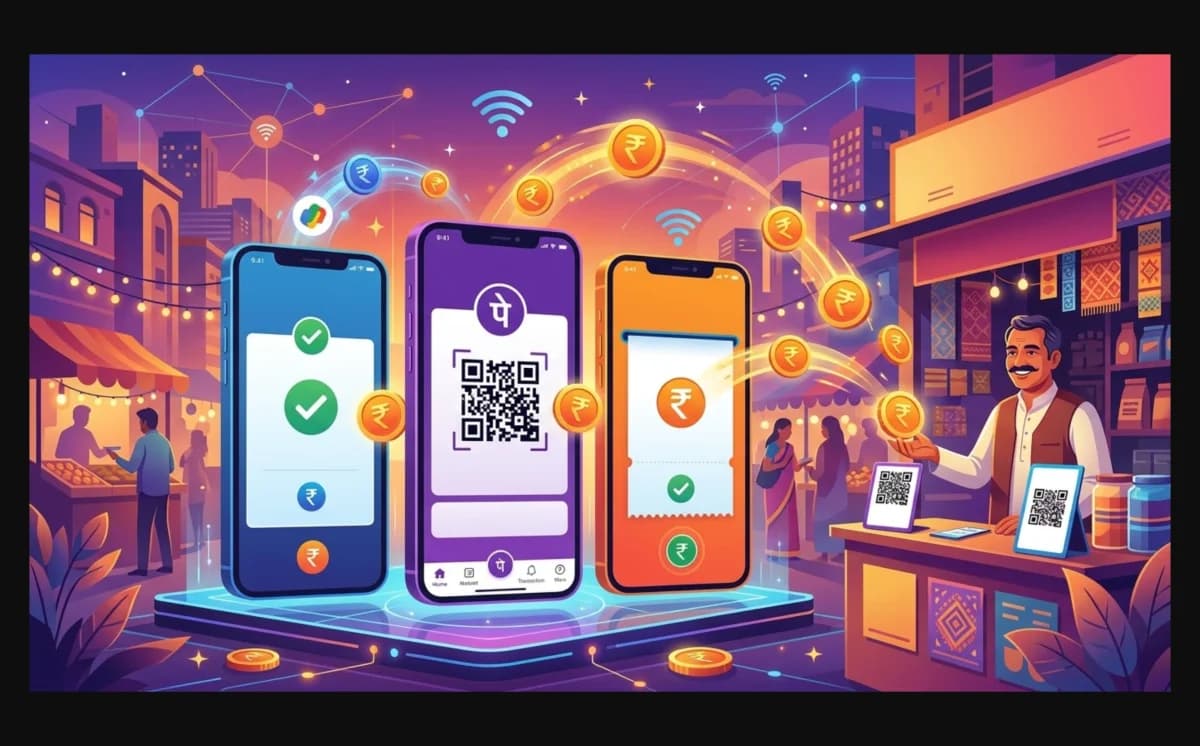
The Big Three: PhonePe vs Google Pay vs Paytm
These three apps together account for over 90% of all UPI transactions in India. Here is how they compare:
| Feature | PhonePe | Google Pay | Paytm |
|---|---|---|---|
| UPI Market Share | ~47% | ~35% | ~10% |
| Linked Banks | All major banks | All major banks | All major + Paytm Payments Bank |
| Wallet | Yes (PhonePe wallet) | No wallet | Yes (Paytm wallet) |
| Bill Payments | Electricity, gas, DTH, loan EMI | Electricity, gas, DTH | Full range including municipal taxes |
| Investments | Mutual funds, gold, insurance | Mutual funds, gold, FD | Mutual funds, gold, stocks (via Paytm Money) |
| Rewards | Cashback on transactions, scratch cards | Scratch cards, rewards points | Cashback, Paytm First loyalty program |
| Merchant QR | Largest merchant network | Strong in urban areas | Largest offline merchant base |
| Unique Feature | Insurance + loan marketplace | Clean UI, Google ecosystem integration | Widest utility payments, Fastag |
PhonePe: Best for All-Round Usage
PhonePe leads with ~47% UPI market share and the most comprehensive feature set. It handles UPI payments, mutual fund investments, insurance purchases, and bill payments — all in one app. Their merchant QR network is the largest in India, meaning you will rarely find a shop that does not accept PhonePe.
Google Pay: Best for Simplicity
If you want a clean, no-clutter payment app, Google Pay is hard to beat. It integrates seamlessly with your Google account and offers a minimalist interface. The rewards are decent though not as generous as before, and the investment options (mutual funds, gold, FDs) are expanding.
Paytm: Best for Utility Payments
Despite its troubles with RBI over the Paytm Payments Bank, Paytm remains the most versatile utility payment platform. From FASTag recharges to municipal tax payments to booking train tickets, Paytm covers more categories than any other app. It also has the widest offline merchant acceptance, especially in smaller towns.
Other UPI Apps Worth Considering
| App | Best For | Key Advantage |
|---|---|---|
| CRED | Credit card bill payments | Rewards for paying credit card bills, exclusive member deals |
| Amazon Pay | Amazon shoppers | Cashback on Amazon purchases, auto-pay for EMIs |
| WhatsApp Pay | Casual users | Pay within WhatsApp chats — no separate app needed |
| BHIM | Basic UPI users | Government-made, lightweight, no ads |
| Bank Apps | Full banking + UPI | Access to all banking services alongside UPI |
Wallet vs UPI: What Is the Difference?
This confuses many people, so let us clear it up:
Mobile Wallet
- You load money into the app from your bank account
- Money sits in the app's wallet, not in your bank
- Can be used even without a bank account
- Examples: Paytm Wallet, PhonePe Wallet, Amazon Pay Balance
- Limited to ₹10,000 (without full KYC) or ₹2 lakh (with full KYC)
UPI
- Money transfers directly between bank accounts
- No pre-loading needed — deducted from your bank in real time
- Requires a linked bank account
- Limit: ₹1 lakh per transaction (higher for specific categories)
- More secure because it uses bank-level authentication (UPI PIN)
Verdict: For most people, UPI is better. Wallets made sense when UPI did not exist — now they are mainly useful for small transactions, offers, and specific use cases like gifting.
Transaction Limits You Should Know
| Category | UPI Transaction Limit |
|---|---|
| Person to Person | ₹1 lakh per transaction |
| Person to Merchant | ₹1 lakh per transaction |
| Tax Payments | ₹5 lakh per transaction |
| Insurance Premiums | ₹5 lakh per transaction |
| Hospital/Education | ₹5 lakh per transaction |
| IPO Applications | ₹5 lakh per transaction |
| UPI Lite (offline) | ₹500 per transaction, ₹2,000 wallet limit |
Note: Daily limits may vary by bank. Check with your bank for exact caps.
Safety Features Across UPI Apps
Every UPI app offers baseline security, but some go further:
- UPI PIN: Mandatory for every transaction — set this up and never share it with anyone
- Biometric lock: PhonePe and Google Pay support fingerprint/face unlock for the app itself
- App lock: Additional PIN or pattern lock when opening the app
- Transaction alerts: Instant SMS and in-app notifications for every debit and credit
- Spam detection: PhonePe and Google Pay flag suspicious collect requests
- Trusted contacts: Some apps let you mark trusted contacts to avoid accidental payments to scammers
Critical safety reminders:
- You never need to enter your UPI PIN to receive money. If someone asks you to, it is a scam
- Never scan a QR code sent by a stranger "to receive payment"
- Decline collect requests from unknown contacts
- Do not install screen-sharing apps at anyone's request
Rewards and Cashback: Where You Actually Earn
The glory days of heavy UPI cashback are over, but there is still money to be saved:
- PhonePe: Scratch cards on UPI transactions, cashback on bill payments and recharges, occasional flash deals
- Google Pay: Rewards points convertible to cashback, referral bonuses, lucky stamps during festivals
- Paytm: Cashback on first transactions of the month, loyalty tiers via Paytm First, special merchant offers
- CRED: Coins for credit card bill payments, redeemable for brand deals and experiences
- Amazon Pay: 1-2% cashback on Amazon purchases when you pay via Amazon Pay UPI
Pro tip: Do not let cashback influence which app you use primarily. The amounts are small (₹10-50 per transaction). Choose based on features and reliability, not temporary offers.
What Is Coming Next
UPI Lite: Offline Small Payments
UPI Lite is already rolling out and enables payments under ₹500 without internet connectivity. You pre-load up to ₹2,000 into the UPI Lite wallet, and payments happen instantly without entering your UPI PIN. This is a game-changer for rural areas and quick daily transactions.
UPI for International Payments
India is aggressively expanding UPI's global reach. You can already use UPI in Singapore, UAE, France, Sri Lanka, and Mauritius. The goal is to make UPI a global payment standard — imagine paying with your PhonePe in Tokyo or London.
CBDC — The Digital Rupee
The RBI's digital rupee (e₹) is being piloted alongside UPI. Unlike UPI, which moves money between bank accounts, the digital rupee is actual currency issued by the RBI and stored in a digital wallet. It aims to combine the convenience of digital payments with the trust of cash — eventually.
Credit on UPI
NPCI and banks are working on allowing credit lines directly on UPI — meaning you could pay via UPI using a pre-approved loan amount, not just your bank balance. This could transform UPI from a payment tool into a lending platform.
Choosing the Right App for You
Here is a quick decision guide:
- Want one app that does everything? PhonePe
- Want the cleanest, simplest experience? Google Pay
- Need widest utility payments (FASTag, taxes, trains)? Paytm
- Primarily pay credit card bills? CRED
- Shop a lot on Amazon? Amazon Pay
- Want to pay within WhatsApp chats? WhatsApp Pay
There is no single best app — many people use 2-3 apps for different purposes, and that is perfectly fine. The important thing is to use digital payments smartly and safely.
And remember: the money you save through cashback and rewards is pocket change compared to what smart investing can do. Even a small monthly SIP of ₹1,000 started today can grow into lakhs over the long term. Use our SIP Calculator to see the power of compounding, and our EMI Calculator if you are considering any loan products through these apps.
Frequently Asked Questions
Which is the best UPI app in India?
Top UPI apps by user base: Google Pay, PhonePe, Paytm, Amazon Pay, BHIM. All offer near-identical core UPI functionality with marginal feature differences. Pick based on: cashback offers (PhonePe and Paytm lead), merchant acceptance (PhonePe and Google Pay are widest), and additional features like investments (Paytm Money, Groww UPI).
Are mobile wallets safe in India?
Yes — RBI regulates mobile wallets and PPIs (Prepaid Payment Instruments) under strict KYC and capital adequacy norms. Funds are held in escrow accounts at banks. Always use the official app from Play Store / App Store, enable biometric/PIN, and never share OTP. Major incidents are usually phishing, not platform breaches.
What is the difference between UPI and a mobile wallet?
UPI (Unified Payments Interface) is a payment system that connects directly to your bank account — money moves bank-to-bank instantly. A mobile wallet (Paytm Wallet, PhonePe Wallet, Amazon Pay) holds funds in a separate balance you load from a bank account. UPI is faster and avoids loading; wallets are useful for offers and small instant payments.
Are there transaction limits on UPI?
Standard UPI: ₹1 lakh per transaction, ₹1 lakh per day per app per person. UPI for capital markets, insurance premiums, hospital bills: ₹5 lakh per transaction. UPI Lite (for small offline payments): ₹2,000 per transaction, ₹4,000 per day. Limits are set by RBI and updated periodically.
How does UPI make money if it's free for users?
UPI is largely subsidized by the government and banks. Banks earn from increased customer engagement and cross-sell. Merchants pay small interchange fees on credit-card-on-UPI transactions. The Indian government has historically provided incentive payments to banks for UPI volumes, making the platform viable despite zero charges to consumers.
Can I use UPI without a bank account?
No — UPI requires a bank account. However, you can receive payments without one if someone sends to your phone number; you'd need to link a bank account before withdrawing. Some PPIs (mobile wallets) work without bank accounts but with strict KYC and limits.
What is UPI 2.0 and what's new?
UPI 2.0 added several features: overdraft account linking (use overdraft like a payment source), one-time mandates (recurring payments), invoice in inbox (verify payment before paying), and signed-intent QR codes. UPI Lite added offline payments and AutoPay added recurring debits.
Can I use UPI for international payments?
Yes — UPI is now interoperable with several countries. As of 2026, UPI works in: Singapore (PayNow), UAE (NPCI International), France (Lyra), Bhutan, Nepal, Sri Lanka, Mauritius. NRIs can also use UPI on Indian numbers from these countries. Cross-border QR payment is being expanded to more countries.
What happens if a UPI transaction fails?
Failed UPI transactions usually reverse within 24-72 hours automatically. If the amount isn't refunded: (1) raise complaint via the UPI app's "Help/Dispute" section, (2) escalate to your bank's UPI helpdesk, (3) file complaint at NPCI's grievance portal, (4) for amounts above ₹10K, file at RBI Banking Ombudsman.
Should I use multiple UPI apps?
Maintaining 1-2 apps is enough for most users. Multiple apps fragments transaction history (harder to track), may create confusion, and offers diminishing utility. The exception: power users who chase cashback offers across PhonePe, Google Pay, Paytm, and Amazon Pay during festival sales.
Official Sources & References
- Reserve Bank of India — banking and digital payment regulations
- NPCI — National Payments Corporation of India, UPI operator
- RBI Banking Ombudsman — payment grievance redressal
Disclaimer: This article is for educational purposes only and does not constitute financial advice. Market share figures, features, and reward programs mentioned are based on publicly available information as of March 2026 and may change. Please verify current terms with the respective app or service provider.
Written by
Jaspal Singh
Founder & Editor
Personal finance writer helping Indians make smarter money decisions through clear, jargon-free guides on taxes, investments, and budgeting.
Continue Reading
5 Credit Card Rules Changing From April 1 — Your Spending Will Be Watched
Spend over ₹10 lakh on credit cards? The Income Tax Department will know. From April 1, 2026, new rules change how credit cards are monitored, authenticated, and reported. Here are 5 changes every cardholder must know.

Legal Aspects of Real Estate in India: What Every Buyer Must Know
Understand the key legal checks before buying property in India — RERA, title deeds, encumbrance certificates, stamp duty, registration, and common legal traps to avoid.
Renting vs Buying a House in India: The Honest Math
Should you rent or buy a house in India? We run the numbers on an ₹80 lakh property and compare EMIs, rent, opportunity cost, and tax benefits to find the real answer.