LPG Crisis: Black Market Prices Hit ₹4,000 — What Are Your Options?
Jaspal Singh
Author
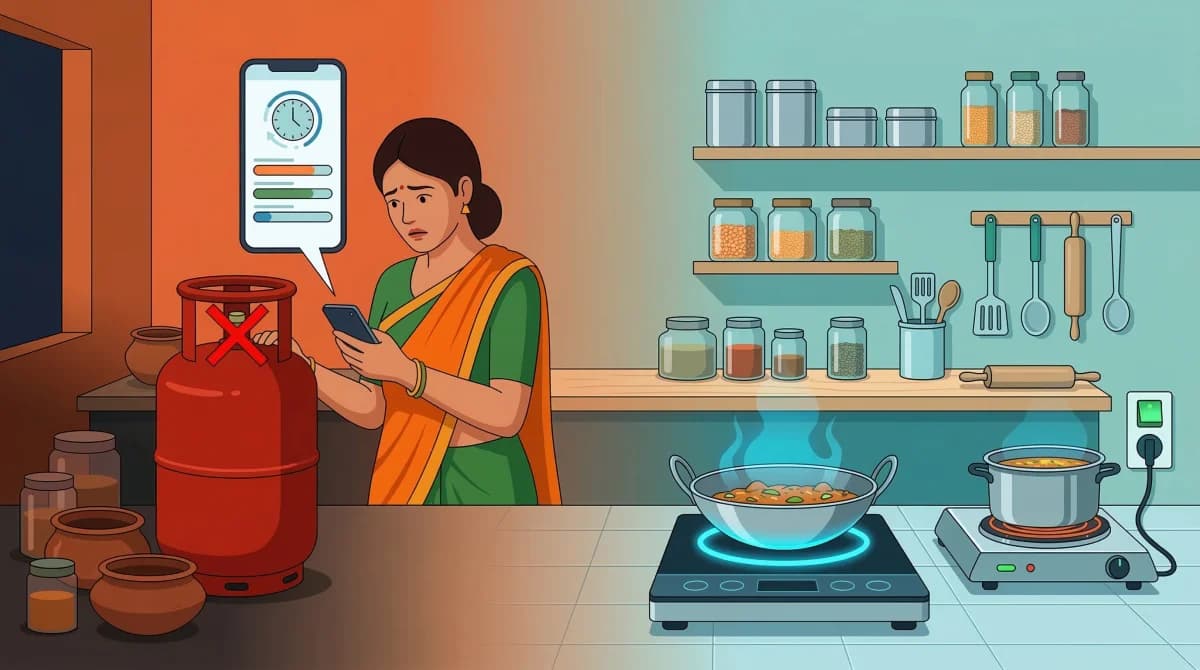
India's Cooking Gas Emergency
India is in the grip of its worst LPG shortage in decades. What started with the Iran-Israel conflict closing the Strait of Hormuz on February 28 has spiralled into a full-blown kitchen crisis affecting millions of households.
Here is how bad it has gotten:
Black market prices have hit ₹4,000-₹4,500 per domestic cylinder — more than 4x the official rate of ₹913
Rural areas face a 45-day wait for cylinder delivery, up from the normal 7-10 days
Booking gap extended to 25 days to prevent panic buying and diversion
741 cylinders seized in Chhattisgarh alone during crackdowns on hoarding
India imports 60% of its LPG, and 90% of those imports normally pass through the Strait of Hormuz
Why Is There a Shortage?
The root cause is simple geography: the Strait of Hormuz — a narrow waterway between Iran and Oman — carries roughly 90% of India's LPG imports. When the US-Israel-Iran conflict escalated and Iran effectively blocked the strait, India's cooking gas supply was immediately choked.
Unlike petrol and diesel (which India sources from diverse routes), LPG is heavily dependent on Gulf countries. India has zero strategic LPG reserves — meaning there is no buffer to absorb supply shocks.
The good news: two Indian LPG tankers — Nanda Devi and Shivalik — successfully crossed the Strait on March 14-15 with a naval escort, carrying 92,700 metric tonnes of cooking gas. They are reaching Kandla and Mundra ports this week. But this is a temporary relief — not a permanent solution.
What the Government Is Doing
Rationing: Minimum booking gap extended to 25 days between refills
Commercial LPG capped at 20%: To prevent hoarding and price gouging by commercial users
Kerosene made available through PDS and retail outlets as a backup cooking fuel
Crackdown on black marketing: Hundreds of cylinders seized across states
Diplomatic channels: India negotiated safe passage for tankers through the Hormuz strait with Iran
What Can You Do Right Now?
1. Switch to an induction cooktop (best alternative)
Induction cooktops have seen a 95% surge in sales since the crisis began. They run on electricity, cook faster than gas, and cost ₹1,500-3,000 for a good model. Running cost is roughly ₹2-3 per hour — comparable to LPG but without the supply risk.
Check out our Best Induction Cooktops in India guide for top picks.
2. Use an electric kettle and rice cooker
For boiling water, making tea/coffee, and cooking rice — electric appliances are more efficient than gas. A ₹1,000 electric kettle and ₹2,000 rice cooker can handle 50% of daily cooking needs without any gas.
3. Conserve your current LPG
Use pressure cookers — they use 70% less gas than open cooking
Soak dal and rice before cooking — reduces cooking time by 30-40%
Cover pots while cooking — traps heat and reduces gas consumption by 25%
Turn off the flame early — food continues cooking in residual heat for 5-10 minutes
4. Consider a home biogas unit (long-term)
A Pune engineer has built a biogas system that converts kitchen waste into cooking gas, saving 6 LPG cylinders per year. Read the full story: Pune Engineer Makes Cooking Gas from Kitchen Waste.
5. Do NOT buy from black market
Paying ₹4,000 for a ₹913 cylinder funds criminals and encourages hoarding. Report black marketing to your local consumer helpline (1800-11-4000) or the MyLPG app.
How Long Will the Crisis Last?
Analysts see three scenarios:
Scenario | Probability | Duration | Impact on LPG |
|---|---|---|---|
Ceasefire / Hormuz reopens | 35% | 2-4 weeks | Prices normalise within 1 month |
Extended conflict (base case) | 50% | 3-6 weeks more | Shortage continues, possible further hikes |
Prolonged war / full blockade | 15% | 6+ months | Severe rationing, pivot to alternatives |
Even in the best case, LPG prices are unlikely to return to pre-crisis levels of ₹853 anytime soon. The ₹913 rate may become the new normal — and further hikes are possible if crude oil stays above $100.
The Financial Impact on Your Budget
For a typical family using 8-10 cylinders per year, the ₹60 price hike alone adds ₹480-600 per year to your cooking costs. If the shortage forces you to buy even one cylinder at black market rates (₹4,000), that is ₹3,087 extra — enough for 4 months of a ₹750 SIP.
This is why investing in alternatives like induction cooktops is a financially smart move — a ₹2,500 induction cooktop pays for itself within months if it replaces even 2-3 cylinders per year.
Use our SIP Calculator to see how redirecting cooking fuel savings into investments can grow your wealth.
Related Reading
Disclaimer: This article is for educational purposes only. LPG prices and availability vary by location. Government policies mentioned are based on publicly available information as of March 17, 2026 and may change. For the latest LPG booking status, check the MyLPG app or your distributor.
Written by
Jaspal Singh
Founder & Editor
Personal finance writer helping Indians make smarter money decisions through clear, jargon-free guides on taxes, investments, and budgeting.
Continue Reading

Creating a Financial Plan: Step-by-Step Guide for Indians
A practical 10-step guide to creating your first financial plan — from calculating net worth and killing high-interest debt to goal-based investing and tax optimization.
Financial Planning for Families in India: A Complete Guide
A practical 7-step guide to financial planning for Indian families — emergency fund, insurance, goal-based investing, tax saving, and teaching kids about money.

How to Save Money on Transportation in India
Transportation eats up 10-15% of most Indian budgets. Here are practical ways to cut your commute costs — from metro passes to electric scooters to simply combining your errands.