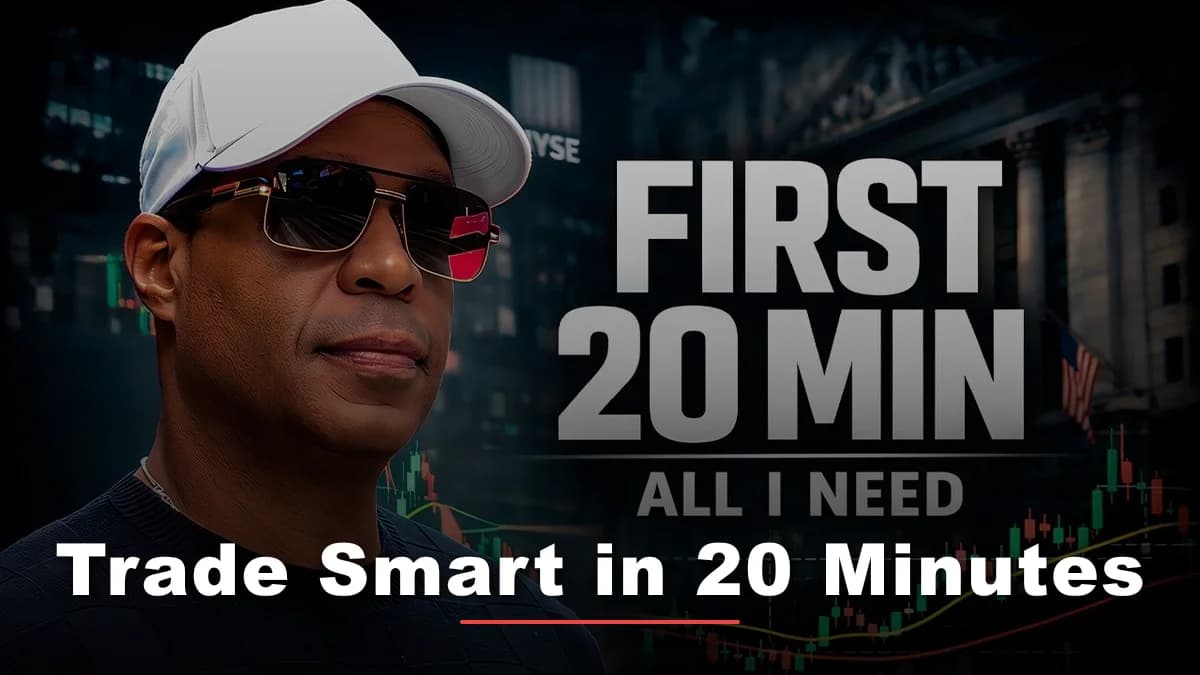
7 Brutal Trading Truths from Steven Dux: $27K to $50 Million
This article is based on a video by Words of Rizdom. Watch the original video above or on YouTube.
Watch on YouTubeKey Takeaways
- Steven Dux turned $27,000 into $50+ million in roughly 10 years, primarily by short selling small-cap stocks.
- 92 out of 100 traders fail. Only 1 in 100 makes serious money — and it requires treating trading like engineering, not gambling.
- His "First Red Day" strategy has a tracked average down move of 26.4% — he knows this to the decimal because he backtested thousands of setups.
- After every winning trade, he withdraws 50-80% of the profit and mentally books the trade as a loss to kill ego.
- After every mistake, he cuts position size by 50% on the next trade — a non-negotiable rule.
- He rates himself a "trash trader" — his actual P&L is only 25-30% of what his system should theoretically produce.
- Lucky money is borrowed money. Any profit from undisciplined trades will be returned to the market — with interest.
Steven Dux does not look like what most people imagine when they think of a $50-million trader. No flashy livestreams, no prediction calls on Twitter, no "guru" energy. He is an engineer who happens to trade stocks — and he has the verified track record to back it up: $27,000 to over $50 million, a single-day record of $6 million+, and a single-month record of $20 million.
In a nearly two-hour interview on the Words of Rizdom podcast, Dux laid out his strategy, his risk rules, and — most valuably — the psychological framework that keeps him profitable while 92% of traders blow up. Here are the seven most important lessons.
1. The Numbers Do Not Lie — and They Are Ugly
Dux does not sugarcoat the reality of trading. According to his own data and industry research, the distribution of outcomes among 100 active traders looks like this:
- 92 traders lose money and quit
- 4 traders break even (after years of effort)
- 2 traders make a small profit — barely worth their time
- 1 trader earns around $100,000/year consistently
- 1 trader makes $10 million+
Those odds are worse than almost any other professional pursuit. And the cruelest part? The people in the losing 92% often had early wins that convinced them they were special. Dux says 90% of his own students eventually become gamblers — one lucky big win rewires their brain to chase the feeling instead of following the system.
For Indian retail traders rushing into F&O after seeing someone post a green P&L screenshot on social media, this is a cold shower. SEBI's own data shows that 9 out of 10 individual traders in equity F&O lost money in FY 2021-22, with an average loss of Rs 1.1 lakh per person. The numbers are global. The lesson is universal.
2. His Edge Is Boredom, Not Brilliance
Dux's core strategy is called the "First Red Day Short." It works like this:
- A small-cap stock runs up massively — 100%, 200%, sometimes more
- It peaks, sells off hard, and the hype dies
- The stock consolidates for weeks or months while bagholders suffer in silence
- One day it gaps back up — often near the original high — on a new catalyst or just momentum
- The bagholders who held through all that pain finally see breakeven and dump their shares
- This creates a cascade of selling. Dux shorts into this exact moment
The average down move he has tracked across hundreds of these setups: negative 26.4%. He knows this because he backtested it obsessively — "to the decimal point," as he puts it.
His screening criteria: stock up 20%+, pre-market volume over 1 million shares, price above $3, market cap under $1 billion, float under 100 million shares. He trades only 7-8 times per month. The rest of the time, he waits.
This is the opposite of what trading influencers sell. There is no action every day. There is no screen full of indicators. There is a simple, repeatable pattern — and the discipline to sit on your hands until it appears.
3. Risk Management That Actually Hurts
Ask any trader about risk management and they will recite textbook rules. Dux's rules are different because they are designed to cause psychological pain — which is exactly why they work.
Position sizing: Never take a position larger than 10% of the day's volume OR 1% of the stock's float — whichever is smaller. This prevents him from becoming trapped in an illiquid position.
The 50% punishment rule: After every mistake — not every loss, every mistake (there is a difference) — he cuts his position size by 50% on the next trade. A bad trade that happened to make money is still a mistake. This rule forces brutal honesty.
No hard stop losses: Instead of setting a stop, he sizes positions so that even the worst-case scenario results in a bounded dollar loss he can absorb. This is counterintuitive but logical — hard stops on volatile small caps get triggered by noise, not signal.
Two backup accounts: He recommends beginners maintain two separate trading accounts. When one blows up (and it will), you still have capital to trade with while you rebuild discipline.
For Indian investors, the principle translates directly to position sizing in F&O. If you are trading Nifty options, can you honestly say you never risk more than 1-2% of your capital on a single trade? Use our lumpsum calculator to see what even modest, consistent returns look like over time — the math of not blowing up is more powerful than any single win.
4. The "Perfect Trader" Framework — How Dux Stays Humble with $50 Million
This is perhaps the most original idea in the entire interview. Dux built what he calls a "Perfect Trader Calculator" — a tool that computes what his P&L should have been if he had executed every trade perfectly according to his own rules.
The result? His actual performance is only 25-30% of his theoretical maximum.
Let that sink in. A man who made $20 million in a single month looks at his own data and concludes: "I am a trash trader."
"People look at me as the best trader. I look at myself as probably the worst compared to what I designed."
This is not false modesty. It is a deliberate psychological strategy. By constantly comparing himself to his own theoretical best — not to other traders, not to benchmarks — he eliminates complacency. There is always a gap to close. There is always room to improve execution.
Indian investors can apply this principle without being traders. Track your actual portfolio returns against a simple benchmark — say, a Nifty 50 index fund. If you are underperforming the index after fees and taxes, your "stock picking" is costing you money. Our SIP calculator can show you what disciplined, automatic investing produces over 10-20 years. Compare honestly.
5. Lucky Money Is Borrowed Money
Dux's most quotable line from the interview deserves its own section:
"The money you gambled and won — no matter how long — you will lose in the future, and more."
His framework: if a trade did not follow your rules but still made money, that profit is not real. It is borrowed from the market. The market will collect — with interest — because the behavior that produced the lucky win will be repeated until it produces a devastating loss.
This is why he excludes lucky wins from his performance data. He literally removes them from his tracking spreadsheet. If the win was not systematic, it does not count. Including it would corrupt his data and, worse, his psychology.
After his record $20 million month in 2021, Dux's ego ballooned. He bought two Lamborghinis. He started taking trades outside his system. The result? He lost over $800,000 on stupid, undisciplined trades. The market collected.
For anyone who made quick money in the 2020-21 bull run — crypto, small-caps, IPO listings — ask yourself: was that skill, or was that borrowed money? The answer matters, because the market always settles its debts.
6. Withdraw Like Your Life Depends on It
Most traders reinvest their profits to "compound faster." Dux does the exact opposite.
After every profitable trade, he withdraws 50-80% of the profit. He resets his day trading account to roughly $2 million at the start of each year. His reasoning:
"I made $1 million. I withdraw $800K. I tell myself it's a losing trade — I only made $200K."
This serves two purposes. First, it locks in profits permanently — money withdrawn cannot be lost on the next trade. Second, it kills the dopamine hit. By framing a $1 million win as a "$200K trade," he short-circuits the euphoria that leads to reckless behavior.
He also makes a deeper point about lifestyle: "You only eat three meals a day. Start eating 10 — doesn't change your lifestyle." Beyond a certain income, more money in a trading account does not improve your life. It just increases the amount you can lose.
The Indian parallel: if your mutual fund portfolio or stock holdings have given you strong returns, consider booking partial profits and moving them to safer instruments — an FD, a PPF, or simply paying off debt. Compounding works best when the base is protected. Use our compound interest calculator to see how even conservative withdrawn amounts grow over decades.
7. Seasonality, Patience, and the Art of Doing Nothing
Dux's best trading season runs from October to February. March through September? He describes it as "boring." Fewer setups, lower volatility in his universe, less edge.
So what does a $50 million trader do for seven months of the year? Mostly nothing. He waits. He studies. He refines his system. He does not force trades just because the market is open.
His stats back this up: his win rate on short trades is 90-95%, but on long trades it drops to 60-65% — which is precisely why he avoids longs almost entirely. He is a 98-99% short seller. He also completely blacklisted biotech stocks after 10 years of data showed a net return of barely 1%. Ten years of data. Most traders would not have the discipline to track, let alone act on, that conclusion.
The background that makes this possible: Dux has an engineering degree and spent his formative years playing Starcraft 2 competitively. Both trained the same skill — systematic thinking under pressure. He learned trading in six months of studying 10 hours a day, treating it not as an art but as a solvable system.
For Indian investors, the seasonality lesson applies broadly. Markets have cycles. Budget season, earnings season, election years, global rate cycles — each creates predictable patterns. The discipline is not in trading every day. It is in recognising when your edge is present and when it is not, and having the courage to sit still.
Watch the Full Interview
The full 1 hour 39 minute conversation between Steven Dux and Words of Rizdom covers far more than we could fit here — including his detailed screening process, how he handles short squeezes, his views on trading education, and why he thinks most trading courses are scams. It is one of the most honest, data-driven trading interviews available on YouTube.
Watch "Steven Dux - Trading $27,000 to OVER $50+ MILLION" on YouTube
Video by Words of Rizdom on YouTube.
The Bottom Line for Indian Investors
Steven Dux's world — US small-cap short selling — is far removed from the average Indian investor's reality. But his principles are universal:
- Track everything. Know your actual numbers, not your feelings about your numbers.
- Size positions so you survive the worst case, not the expected case.
- Withdraw and protect profits. Compounding only works if the base survives.
- Compare yourself to your own potential, not to others on social media.
- Lucky money is borrowed money. If you cannot explain why a trade worked, it did not "work" — you got lucky, and the bill is coming.
Whether you are trading F&O on NSE, picking stocks for the long term, or simply running a SIP in index funds, these truths apply. The math does not care about your market.
Disclaimer: This article is a summary and analysis of a publicly available YouTube interview. It is intended for educational purposes only and does not constitute financial or trading advice. Trading in equities, derivatives, and short selling involves substantial risk of loss. Past performance — including Steven Dux's results — does not guarantee future returns. Always consult a SEBI-registered financial advisor before making investment decisions.
Founder & Editor
Personal finance writer helping Indians make smarter money decisions through clear, jargon-free guides on taxes, investments, and budgeting.