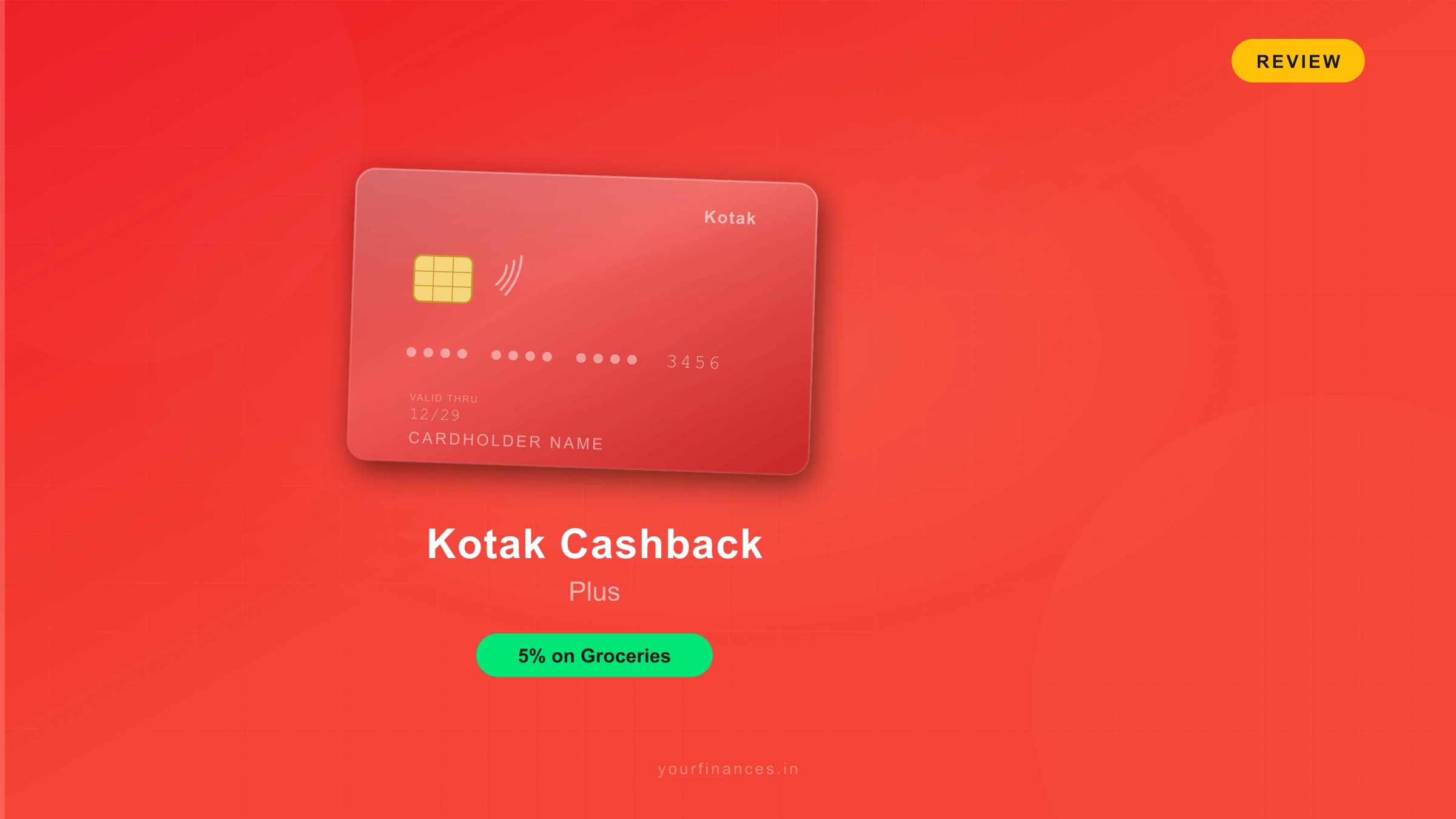
Kotak Cashback Plus Credit Card Review: Best for Groceries?
Jaspal Singh
Author
Affiliate Disclosure: Some links on this page are partner links. If you apply for a card through them, Your Finances may earn a commission at no extra cost to you. We are not affiliated with, and are not paid by, the card issuer to write favourably. Fees and features are taken from the issuer's own published terms and can change without notice — always confirm on the issuer's website before applying. Nothing here is personalised financial advice.
The Kotak Cashback+ Credit Card is sold on a simple promise: 5% back on the things urban Indians actually spend on every week — Swiggy and Zomato orders, online grocery baskets, movie tickets and OTT subscriptions. At a joining and annual fee of ₹750 plus GST, that sounds like an easy win.
It can be. But there is a single number buried in Kotak's own terms that decides whether this card earns you ₹9,000 a year or ₹2,000, and most reviews skip past it. That number is 750. This review is largely about what it does to your returns.
What the card pays, in Kotak's own words
Kotak publishes the earn structure on its fees and charges page. Here it is without the marketing gloss:
| Spend category | Rate | Notes |
|---|---|---|
| Online food delivery, online groceries, online movie tickets, OTT subscriptions | 5% | Counts towards the monthly accelerated cap |
| Fuel, at any fuel station | 3% | Also counts towards the same cap |
| Everything else eligible | 0.5% | Uncapped |
| UPI spends (RuPay variant only) | 0.5% | Uncapped |
One reward point equals ₹1, so there is no devaluation game to decode here — a welcome change from cards where "points" quietly convert at 25 paise each. Fuel also gets a 1% surcharge waiver on transactions between ₹500 and ₹4,000, capped at ₹3,500 in an anniversary year, and that waiver stacks on top of the 3% cashback rather than replacing it.
The 750-point cap is the whole story
Kotak caps cashback earned on accelerated spends at 750 points per billing cycle. That alone is unremarkable — most cashback cards cap something. What matters is the sentence that follows it in Kotak's FAQ:
"Accelerated categories will earn no reward points once the capping of 750 reward points/billing cycle is met."
Read that carefully. On many competing cards, once you exhaust the accelerated cap, further spending in that category drops down to the base rate. Here it drops to zero. A ₹4,000 Zomato order placed after you have hit the cap earns you nothing at all — not 0.5%, not 1%. Nothing.
Since 5% of ₹15,000 is exactly 750, the cap binds the moment your 5% category spending passes ₹15,000 in a billing cycle — and sooner if you are also buying fuel, because fuel shares the same ceiling.
Kotak's own illustration sits just under its own cap
This is the detail worth pausing on. Kotak publishes a value chart assuming ₹2,88,000 of annual spending. Work out the accelerated points in their example:
- 5% categories: ₹10,000 a month → 500 points
- Fuel at 3%: ₹7,000 a month → 210 points
- Total accelerated: 710 points against a 750 cap
Their headline figure of ₹10,530 a year is therefore calculated at a spending level that lands roughly ₹40 short of the ceiling. Spend a little more in exactly the categories the card advertises, and your marginal return collapses to nothing. The illustration is not dishonest — the arithmetic checks out — but it describes the best case, not a typical one.
The practical ceiling is straightforward: 750 points × 12 months = ₹9,000 a year from accelerated categories, plus whatever the uncapped 0.5% adds.
What ₹750 actually costs, and when you break even
The advertised fee is ₹750, but you pay GST on it. At 18%, the real outgo is ₹885 a year. So the card has to generate ₹885 of cashback before it has earned its keep.
That is not a high bar. At the full 5% rate you clear it with about ₹17,700 of category spending across the whole year — under ₹1,500 a month on food delivery and groceries combined. Most people who were drawn to this card in the first place will pass that comfortably.
The fee waiver is a different matter. Kotak waives the annual fee at ₹2,00,000 of annual retail spending, which works out to roughly ₹16,700 every month on this one card. There is no joining fee waiver at all — the first ₹885 is payable regardless.
If you want to model what a large recurring spend costs you across a year, our EMI calculator is a reasonable proxy for the cash-flow side of the question.
Where this card genuinely works
The Cashback+ suits a fairly specific person, and suits them well:
- You spend ₹10,000–₹15,000 a month online on food, groceries and entertainment. This is the sweet spot — high enough to make the fee trivial, low enough that the cap never bites.
- You drive, but not heavily. The 3% plus 1% surcharge waiver is a genuinely competitive fuel proposition, provided fuel is not competing with your food spending for the same 750 points.
- You want cash, not points. The 1 point = ₹1 conversion means no transfer partners to research and no expiring miles to chase.
- You want free add-on cards. Up to three, issued free, for family members aged 18 and over — though they draw on the primary card's limit rather than getting their own.
Where it falls short
- The zero-after-cap rule is unusually harsh. It is the single biggest reason to look elsewhere if your online spending is high.
- Fuel and food compete for the same ceiling. A card that caps these separately will out-earn this one for anyone with a real commute.
- Offline groceries do not qualify. The 5% is explicitly for online groceries. Your neighbourhood kirana or a supermarket till earns 0.5%.
- No joining fee waiver. You are ₹885 down before you earn anything.
- The ₹2 lakh waiver threshold is demanding for a card most people will use as a category card rather than a primary one.
How it compares within the cashback segment
The obvious comparison is the flat-rate approach. A card paying a uniform rate on everything online, with a higher or differently-structured cap, will beat the Cashback+ for anyone whose online spending is both high and spread across many merchant types — electronics, travel, fashion — because those categories earn only 0.5% here.
Conversely, if your online spending is concentrated in food, groceries and entertainment and sits under ₹15,000 a month, the 5% rate is hard to beat at this fee level. The Cashback+ is a category specialist wearing the clothes of a general-purpose card. Judge it as a specialist.
Our wider comparison of options across issuers is in the best credit cards in India guide, and if you are new to how billing cycles, minimum dues and interest-free periods interact, start with our credit cards guide.
Fees and charges
| Charge | Amount |
|---|---|
| Joining fee | ₹750 + GST |
| Annual fee | ₹750 + GST |
| Joining fee waiver | Not available |
| Annual fee waiver | Annual retail spends of ₹2,00,000 |
| Add-on cards | Free, up to 3 |
| Fuel surcharge waiver | 1% on ₹500–₹4,000; max ₹3,500 per anniversary year |
Interest rates, foreign currency markup and cash advance charges are set out in Kotak's Most Important Terms and Conditions document rather than the summary page, and they change from time to time. Check the MITC on Kotak's own website before you apply — we have deliberately not reproduced numbers here that we could not verify at source.
Our verdict
The Kotak Cashback+ is a good card held to a narrow brief. If your online food, grocery and entertainment spending lands between roughly ₹5,000 and ₹15,000 a month, it will quietly return several thousand rupees a year against an ₹885 cost, in cash, with no redemption puzzle to solve.
Push past ₹15,000 a month in those categories and the proposition changes sharply, because the marginal rupee earns nothing rather than a reduced rate. That is the trade to understand before you apply — not the 5% on the front of the brochure.
Frequently Asked Questions
What exactly counts as an "accelerated" spend on the Kotak Cashback+?
Online food delivery, online groceries, online movie tickets and OTT subscriptions at 5%, plus fuel at 3%. All of these draw on the same 750-point monthly pool.
What happens after I hit the 750-point cap?
Accelerated categories stop earning entirely for the rest of that billing cycle. They do not fall back to the 0.5% base rate. Spending in non-accelerated categories continues to earn 0.5% as normal, because that rate is uncapped.
Is the cap monthly or annual?
Per billing cycle, so effectively monthly. It resets each cycle, which means unused headroom does not carry forward.
Do fuel cashback and the fuel surcharge waiver stack?
Yes. Kotak's own value chart shows both applied to the same fuel spend — 3% cashback plus a 1% surcharge waiver on transactions between ₹500 and ₹4,000, subject to the ₹3,500 annual waiver cap.
Does buying groceries at a supermarket earn 5%?
No. The 5% rate is specified for online groceries. In-store grocery purchases fall into the 0.5% bucket.
How do I avoid the annual fee?
Spend ₹2,00,000 on retail purchases in the card anniversary year. The joining fee cannot be waived.
Is the RuPay variant worth choosing?
If you make heavy use of UPI, yes — the RuPay version earns 0.5% on UPI-on-credit-card spends, which is uncapped. That is a small rate on a potentially large base.
Part of our study: this card is one of ten examined in What Indian Credit Cards Claim vs What Their Own Numbers Show — a comparison of advertised annual value against each issuer's own published caps, point values and value charts.
Disclaimer: Fees, reward rates and caps in this review were taken from Kotak Mahindra Bank's published fees and charges page on 28 July 2026 and can change without notice. This is general information, not personalised financial advice. Confirm all terms on the issuer's website before applying, and consider your own circumstances — or speak to a qualified adviser — before taking on any credit product.