March 31 Tomorrow: 7 Financial Tasks You Must Complete Today
Jaspal Singh
Author
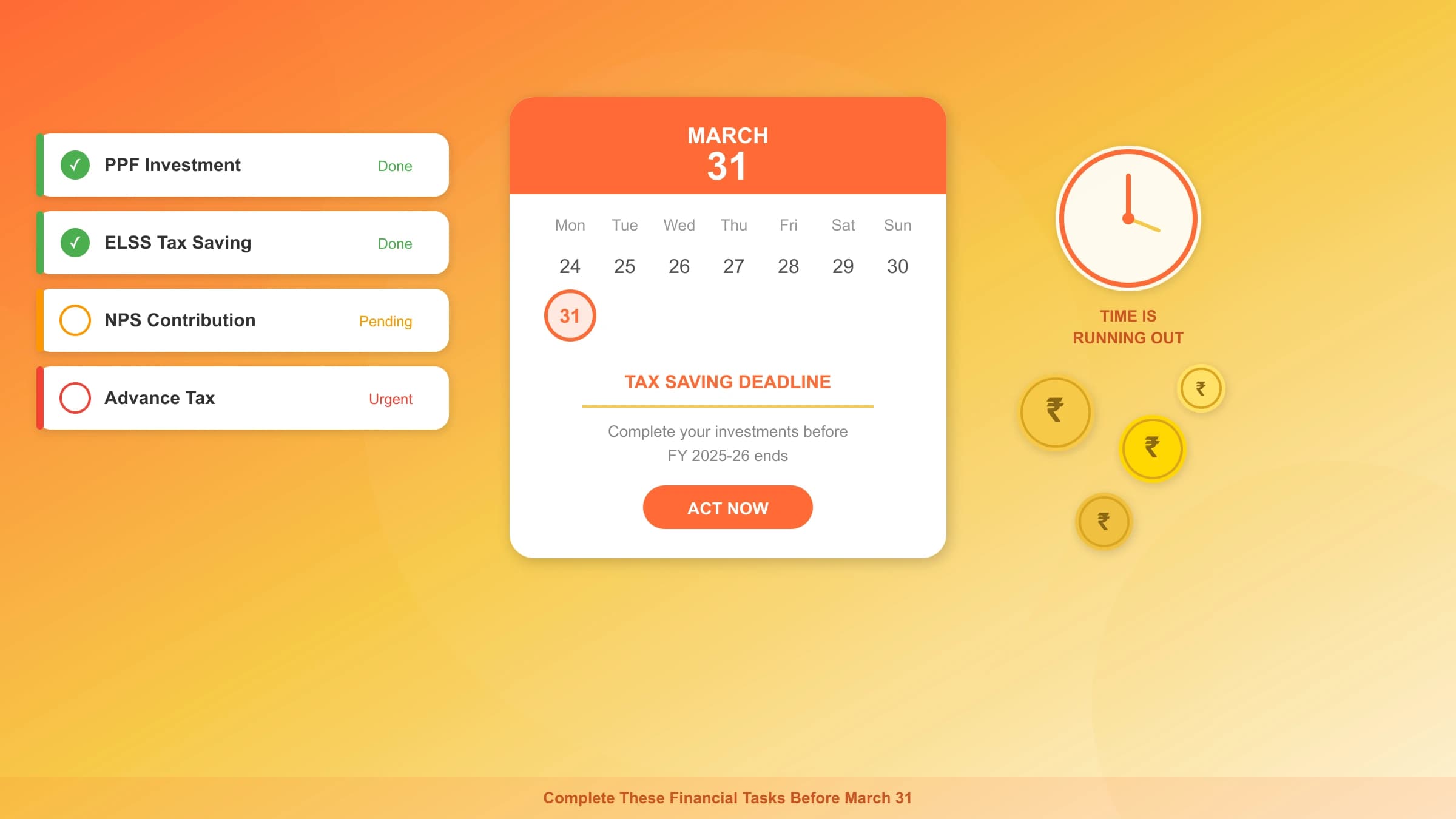
Tomorrow Is March 31 — Your Last Chance
March 31 is not just a date — it's a hard deadline. Miss it, and you'll pay more tax, lose exemptions, and face penalties that cannot be reversed. The financial year 2025-26 ends tomorrow, and whatever you haven't done by midnight will be gone forever.
Here are the 7 things you must complete today — not initiate, but complete.
1. Max Out Section 80C (₹1.5 Lakh Limit)
If you're on the old tax regime, ensure your 80C investments add up to ₹1.5 lakh. This includes:
- ELSS mutual funds — 3-year lock-in, can invest online instantly
- PPF contribution — if you have an account, top it up
- 5-year tax-saving FD — available at any bank
- Life insurance premiums — ensure payment is credited, not pending
- Tuition fees — for up to 2 children
Critical: Payment must be credited to the institution by March 31. Simply initiating a UPI transfer on the last day may not count if it settles on April 1.
2. Claim the Extra ₹50,000 NPS Deduction
Section 80CCD(1B) gives you an additional ₹50,000 deduction over and above the 80C limit — but only if you contribute to your NPS Tier-I account. This can save up to ₹15,600 in tax (30% bracket + cess).
Invest via the eNPS portal using net banking or UPI. Read our detailed guide: NPS Tax Hack: How to Claim Extra ₹50,000 Deduction
3. Pay Health Insurance Premium (Section 80D)
Deductions under 80D:
- ₹25,000 for yourself and family (₹50,000 if senior citizen)
- ₹25,000 additional for parents' health insurance (₹50,000 if parents are senior citizens)
- ₹5,000 for preventive health check-ups (no bills needed)
If your premium renewal is due in April, consider prepaying it before March 31 to claim the deduction this year.
4. Book Tax-Loss Harvesting Gains
You have a ₹1.25 lakh LTCG exemption on equity investments per financial year. If you have unrealised profits, you can:
- Sell stocks/mutual funds to book profits up to ₹1.25 lakh
- Pay zero tax on these gains
- Reinvest immediately at the same price
This resets your cost basis and ensures you use this year's exemption. After March 31, you lose it permanently for FY26.
5. Deposit Minimum ₹500 in PPF
If you have a PPF account, you must deposit at least ₹500 per financial year to keep it active. Dormant PPF accounts attract penalties and require a reactivation process. A quick ₹500 deposit today keeps your account alive.
6. Link PAN with Aadhaar
If your PAN is not linked to Aadhaar, it becomes inoperative from April 1. An inoperative PAN means:
- Higher TDS on salary, bank interest, and other income
- Cannot file income tax returns
- Cannot open new bank/demat accounts
Link it now on the Income Tax portal. A late linking fee of ₹1,000 may apply.
7. Submit Investment Proofs to Employer
If you declared investments at the start of the year but haven't submitted proof, your March salary may have excess TDS deducted. Submit rent receipts, insurance premiums, 80C investment receipts, and home loan certificates to HR immediately.
Quick Action Checklist
| Task | Section | Max Benefit | Do It On |
|---|---|---|---|
| 80C investments | 80C | ₹1.5 lakh deduction | Any investment platform |
| NPS contribution | 80CCD(1B) | ₹50,000 extra | eNPS portal |
| Health insurance | 80D | ₹25,000-₹1 lakh | Insurer website |
| Tax harvesting | LTCG exemption | ₹1.25 lakh tax-free | Zerodha/Groww |
| PPF minimum deposit | — | Keep account active | Bank/post office |
| PAN-Aadhaar link | — | Avoid inoperative PAN | incometax.gov.in |
| Investment proofs | — | Correct TDS | Email to HR |
Use our Income Tax Calculator to check your exact savings, and the NPS Calculator to project your retirement corpus.
Disclaimer: This article is for educational purposes only and does not constitute financial advice. Tax deductions mentioned apply to the old tax regime. The new regime is the default from April 1 — most 80C/80D deductions won't apply unless you opt out. Consult a chartered accountant for advice specific to your situation.
Written by
Jaspal Singh
Founder & Editor
Personal finance writer helping Indians make smarter money decisions through clear, jargon-free guides on taxes, investments, and budgeting.
Continue Reading

Belated & Revised ITR: Deadlines & Penalties
Missed the ITR deadline or made a mistake? Here's how belated, revised and updated returns work for AY 2026-27 — the dates, the ₹1,000–₹5,000 late fee, and the other penalties.

ELSS Funds: Save Tax + Grow Wealth
ELSS funds give you an 80C tax deduction, a 3-year lock-in and equity-linked returns. Here's how they're taxed, ELSS vs PPF, and whether they still make sense in the new tax regime.

How to Save Tax Beyond Section 80C
Maxed out your ₹1.5 lakh under Section 80C? Save more with 80D, the extra ₹50,000 NPS deduction, home loan interest and more — and see what still works in the new tax regime.