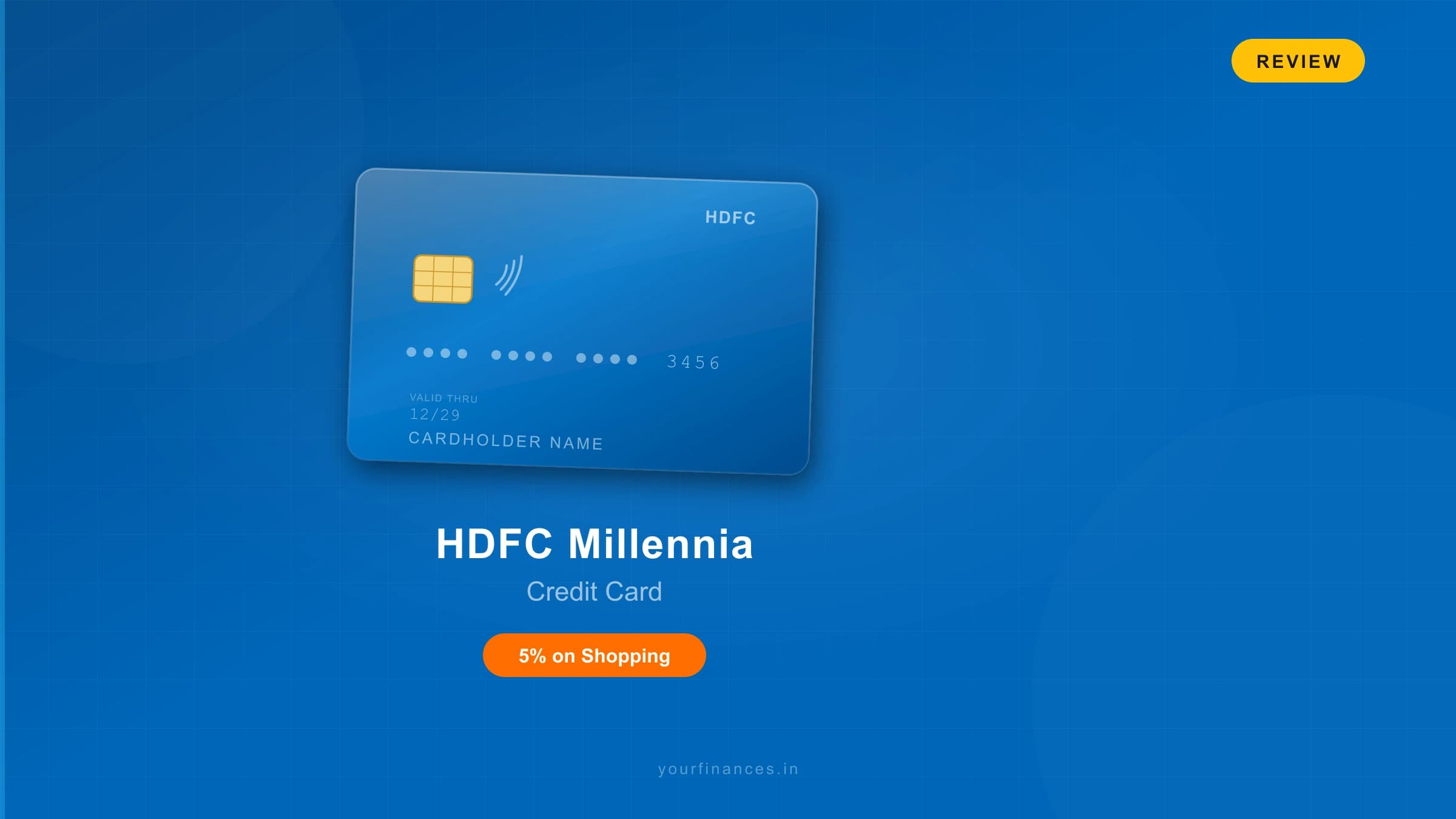
HDFC Millennia Credit Card Review: The Best All-Rounder?
Jaspal Singh
Author
Affiliate Disclosure: Some links on this page are partner links. If you apply for a card through them, Your Finances may earn a commission at no extra cost to you. We are not affiliated with, and are not paid by, the card issuer to write favourably. Fees and features are taken from the issuer's own published terms and can change without notice — always confirm on the issuer's website before applying. Nothing here is personalised financial advice.
The HDFC Bank Millennia is sold on a single number: 5% CashBack at Amazon, Flipkart, Swiggy, Zomato, Myntra and six other names most urban Indians use every week. HDFC calls it "The Best CashBack Credit Card" and tells you on the same page that you can save up to ₹20,000 annually.
Both statements are defensible. Neither survives contact with the number that actually governs this card, which is 1,000 — the maximum CashPoints the 5% rate can pay you in a calendar month. That ceiling binds at exactly ₹20,000 of eligible spending, and the sentence in HDFC's terms describing what happens beyond it is unusually blunt. This review is mostly about that ceiling and what HDFC's own tools reveal when you push them.
We drove HDFC's own savings calculator, and it tells on itself
HDFC publishes a Millennia savings calculator with six spending sliders. As it loads, each sits at ₹6,500 a month — ₹39,000 a month in total, ₹4,68,000 across a year. Press Calculate and it returns:
"You can save up to ₹19,660 Annually"
Against an advertised headline of "up to ₹20,000", the default assumption lands ₹340 short. That is a 1.7% gap. The sliders have not been set to a typical customer; they have been set to a customer who very nearly validates the marketing.
The itemised break-up HDFC shows underneath is worth reproducing, because it is the clearest statement of value the bank publishes anywhere:
| Category | Assumed monthly spend | Annual value per HDFC |
|---|---|---|
| Shopping | ₹6,500 | ₹3,900 |
| Entertainment & travel | ₹6,500 | ₹3,900 |
| Groceries | ₹6,500 | ₹3,900 |
| Dining | ₹6,500 | ₹2,400 |
| Fuel | ₹6,500 | ₹780 |
| Other spends | ₹6,500 | ₹780 |
| Itemised total | ₹39,000 | ₹15,660 |
| Headline shown | — | ₹19,660 |
The ₹4,000 difference between the itemised lines and the headline is the four quarterly milestone vouchers, at ₹1,000 each. HDFC does not label it, but the arithmetic is unambiguous.
Two of those lines are not cashback. The ₹780 against fuel is the fuel surcharge waiver — a refund of a surcharge the fuel station's acquiring bank levies, not money the card pays you. Fuel earns no CashPoints at all under HDFC's terms. And the ₹4,000 of vouchers is not cash either, as we will come to. Strip both out and the CashPoints HDFC's own default actually generates are ₹14,880 a year on ₹4,68,000 of spending — 3.18%, not 5%.
The cap binds at ₹20,000 a month, and HDFC's default sits at ₹19,500
HDFC's terms, published 20 July 2026, set out the structure plainly:
| Spends on | Rate | Maximum CashPoints per cycle |
|---|---|---|
| Amazon, BookMyShow, Cult.fit, Flipkart, Myntra, Sony LIV, Swiggy, Tata CLiQ, Uber, Zomato | 5% | 1,000 |
| Other spends (excluding fuel, EMI, wallet, rent, government) | 1% | 1,000 |
Five per cent of ₹20,000 is exactly 1,000. So the accelerated rate stops paying the moment your combined spending across those ten merchants passes ₹20,000 in a calendar month.
Now look again at the calculator's default. Shopping, entertainment and groceries are the three lines HDFC credits at the full 5% — ₹3,900 a year each is precisely 5% of ₹6,500, twelve times over. Together they assume ₹19,500 a month of accelerated spending, producing 975 CashPoints against a ceiling of 1,000.
HDFC's default customer is set ₹500 a month below the point where their headline rate switches off. We verified this by driving the calculator directly, holding the same three categories and moving only the amount:
| Monthly spend in 5% categories | CashPoints earned | Annual value returned | Effective rate |
|---|---|---|---|
| ₹19,500 (HDFC's default) | 975 | ₹11,700 | 5.00% |
| ₹20,000 | 1,000 (at cap) | ₹12,000 | 5.00% |
| ₹24,000 | 1,000 | ₹12,000 | 4.17% |
| ₹40,000 | 1,000 | ₹12,000 | 2.50% |
| ₹50,000 | 1,000 | ₹12,000 | 2.00% |
Read the third row against the second. An extra ₹4,000 a month — ₹48,000 across a year — spent at exactly the merchants this card advertises returns nothing at all.
One point in HDFC's favour, and it matters: the calculator applies this cap correctly. We tested ₹50,000 of monthly category spend split three different ways and it returned ₹16,000 every time, capping once across the whole bucket rather than once per slider. Several competing issuers publish static value charts that quietly ignore their own ceilings. HDFC's tool does not, and it deserves credit for that.
Past the cap the rate is not lower — it is zero
This is the sentence to understand before applying. HDFC's terms state it twice, once for each bucket:
"Spends beyond the capping of 1,000 shall not be considered for CashPoints posting."
On many cards, exhausting an accelerated cap drops you to the base rate. Here there is no fallback. A ₹6,000 Flipkart order placed after you have hit 1,000 points earns zero — not 1%, nothing. The 1% bucket has its own separate 1,000-point ceiling, which binds at ₹1,00,000 of other monthly spending, and behaves the same way.
That gives the card a hard theoretical ceiling: 2,000 CashPoints a month, ₹24,000 a year, plus ₹4,000 of milestone vouchers. Reaching it demands ₹20,000 a month at the ten merchants and ₹1,00,000 a month everywhere else — ₹14.4 lakh of annual spending on a card whose stated minimum is a net monthly income of ₹35,000. At that spend the card returns 1.94%.
What a CashPoint is worth depends entirely on how you spend it
Against your statement, one CashPoint is ₹1, which is clean. Everywhere else it is not:
| Redemption route | Value per CashPoint |
|---|---|
| CashBack against statement balance | ₹1.00 |
| SmartBuy flight and hotel bookings | ₹0.30 |
| Airmiles | ₹0.30 |
| Rewards catalogue | up to ₹0.30 |
Choosing the wrong route costs you 70% of the value. There are further limits: a minimum of 500 points before you can redeem against your statement, redemption capped at 3,000 points per calendar month, flight and hotel bookings settled at most 50% in points, vouchers at most 70% — and unredeemed points lapse after two years. Redeem against the statement, monthly, and ignore the rest.
The quarterly milestone is an either/or, and you have to go and claim it
Spend ₹1,00,000 net in a calendar quarter and you become eligible for a benefit — but only one. HDFC's milestone document is explicit that you cannot take both the lounge access and the voucher:
"Upon achieving quarterly spends milestone, users can either opt for HOI airport lounge access voucher (Or) Rs.1000 voucher from available list of Brands."
It is also not automatic. You receive an SMS and email, and must then claim the voucher through a separate rewards portal within 120 days or forfeit it. Anyone counting ₹4,000 a year of milestone value should treat it as ₹4,000 conditional on four separate acts of admin.
Note too that the Millennia has carried no complimentary lounge access since 1 December 2023. Lounge visits exist only inside this either/or, at ₹1 lakh of quarterly spending each.
Verified fees and charges
| Charge | Amount |
|---|---|
| Joining fee | ₹1,000 + GST (₹1,180 at 18%) |
| Annual / renewal fee | ₹1,000 + GST |
| Joining fee waiver | None published |
| Renewal fee waiver | Spend over ₹1,00,000 in the year before renewal |
| Welcome benefit | CashPoints equal to the fee amount, credited on paying it |
| Fuel surcharge waiver | 1% on transactions of ₹400–₹5,000; maximum ₹250 per statement cycle |
| Interest-free period | Up to 50 days |
| Eligibility (salaried) | Age 21–40; net monthly income above ₹35,000 |
| Eligibility (self-employed) | ITR above ₹6,00,000 a year |
The welcome benefit is genuinely good and rarely mentioned: pay the ₹1,000 fee and HDFC credits 1,000 CashPoints, worth ₹1,000 against your statement. The fee is effectively refunded in year one. The ₹180 of GST is not.
Two things we could not verify and will not invent. HDFC publishes no foreign currency markup for the Millennia on either the card page or its dedicated fees-and-charges page, and the corresponding column in the bank's Most Important Terms and Conditions is blank for this card, though 3.5% is the figure shown for most comparable HDFC variants. The salaried age ceiling of 40 is stated on the product page; no equivalent ceiling is published for self-employed applicants. Confirm both with HDFC before applying.
Worked example: the ₹39,000-a-month cardholder
Take HDFC's own default customer and settle up honestly over a year.
- Accelerated spending of ₹19,500 a month at the ten merchants: 975 CashPoints monthly, ₹11,700 a year.
- Other eligible spending of ₹13,000 a month at 1%, less the ₹6,500 of fuel that earns nothing: 65 CashPoints monthly, ₹780 a year.
- Dining, which HDFC credits at an effective 3.08% — consistent with assuming roughly half goes to Swiggy or Zomato at 5% and half elsewhere at 1%, though the bank does not show this working: ₹2,400 a year.
- Fuel surcharge waiver, not cashback: ₹780 a year.
- Four quarterly vouchers at ₹1 lakh each, claimed within 120 days: ₹4,000 a year.
- Less the fee: −₹1,180, offset in year one by the ₹1,000 welcome credit.
Total in year one, everything claimed: about ₹19,480 on ₹4,68,000 of spending, or 4.16%. Of that, ₹14,880 is cash against your statement; the rest is a surcharge refund and four vouchers you have to chase. From year two the fee is a real ₹1,180 unless you clear the ₹1 lakh waiver, which this customer does comfortably.
That is a good result. It is also the best case HDFC could construct, and it is built on spending ₹39,000 a month — more than the ₹35,000 minimum monthly income the card requires you to earn. If you want to sanity-check what a large recurring commitment costs you across a year, our EMI calculator handles the cash-flow side.
Who the Millennia genuinely suits
- You spend ₹15,000–₹20,000 a month across those ten merchants and no more. This is the sweet spot, and it is a narrow one. Inside it you earn a true 5% and the cap never bites.
- You want cash, not a puzzle. Redeemed against your statement, a CashPoint is a rupee. No transfer partners, no award charts.
- You are under 40 and salaried above ₹35,000 a month. The entry bar is low for a card paying this rate.
- Year one is close to free. The welcome credit returns the fee in points.
Who should look elsewhere
- Heavy online spenders. Above ₹20,000 a month at those merchants your marginal return is zero. At ₹40,000 a month you are earning 2.5% and falling.
- Anyone who drives much. Fuel earns no CashPoints whatsoever, and the surcharge waiver caps at ₹250 a statement cycle.
- Anyone over 40 applying as salaried. The published ceiling is 40.
- Anyone who wanted lounge access. It has not been complimentary since December 2023, and now costs ₹1 lakh of quarterly spending — and the voucher instead.
- Anyone who will not do the admin. Points lapse at two years, redemption needs 500 points minimum, and milestone vouchers expire 120 days after you are told you have won one.
Millennia or Pixel Play?
HDFC sells both as cashback cards and they behave very differently. The Millennia's accelerated cap is 1,000 points a month against Pixel Play's 500 per bucket — twice as much headroom — but Pixel Play drops to 1% after its cap where the Millennia drops to zero. The crossover sits around ₹60,000 a month of accelerated spending; below that the Millennia's larger cap wins, above it Pixel Play's fallback does. Millennia pays into your statement; Pixel Play pays into a PayZapp wallet. Our HDFC Pixel Play review works through that card's own numbers.
Outside HDFC, the closest comparison is the Kotak Cashback+, which has the same zero-after-cap rule at a lower fee and a lower ceiling, and the CASHBACK SBI Card, which pays a flat 5% online across almost all merchants rather than a named list. For a shortlist by use case see our guide to the best credit cards in India, and if this is your first card, start with how credit cards work.
The verdict: work out which side of ₹20,000 you live on
The Millennia is a good card wearing a misleading headline. At ₹15,000–₹20,000 a month across Amazon, Swiggy, Flipkart and the rest it returns a genuine 5% in real cash, for a fee that is refunded in points in year one. Very few cards at ₹1,000 do better.
But it is a category card with a hard ceiling, not the general-purpose earner "The Best CashBack Credit Card" implies. Spend more than ₹20,000 a month where it advertises 5% and the extra earns you nothing at all. HDFC's own calculator, left at its defaults, assumes ₹19,500 — ₹500 below that line. Work out which side of ₹20,000 a month you live on. That answer, not the 5%, tells you whether this card is worth carrying.
Frequently Asked Questions
What is the maximum cashback the HDFC Millennia can pay in a month?
2,000 CashPoints — 1,000 from the 5% merchants and 1,000 from the 1% bucket, each capped separately. That is ₹2,000 a month, or ₹24,000 a year, plus up to ₹4,000 of quarterly milestone vouchers. Reaching it requires roughly ₹1.2 lakh of spending every month.
Which merchants qualify for 5% on the Millennia?
Ten, and only ten: Amazon, BookMyShow, Cult.fit, Flipkart, Myntra, Sony LIV, Swiggy, Tata CLiQ, Uber and Zomato. Uber qualifies only for travel and commute transactions under merchant category codes 4121 and 7512. EMI transactions at these merchants earn nothing.
What happens once I hit the 1,000 CashPoint cap?
Further spending in that bucket earns zero for the rest of the calendar month. HDFC's terms say such spends "shall not be considered for CashPoints posting" — there is no fallback to a lower rate. The cap resets on the 1st and unused headroom does not carry forward.
Does the Millennia Credit Card still offer airport lounge access?
Not as a standing benefit. Complimentary domestic lounge access was withdrawn on 1 December 2023. Lounge access now exists only as an alternative to the ₹1,000 quarterly milestone voucher, after ₹1 lakh of spending in a calendar quarter — you may take one or the other, not both.
How much is one Millennia CashPoint worth?
₹1 when redeemed against your statement balance, subject to a 500-point minimum and a 3,000-point monthly ceiling. Just 30 paise on SmartBuy flight and hotel bookings, airmiles or the rewards catalogue. Points expire two years after they are earned.
How do I get the Millennia annual fee waived?
Spend more than ₹1,00,000 in the year before your renewal date — about ₹8,350 a month. There is no waiver on the joining fee, but HDFC credits CashPoints equal to the fee amount when you pay it, which returns the ₹1,000 though not the GST.
Does fuel spending earn cashback on the Millennia?
No. Fuel is excluded from both the 5% and 1% buckets. You get a 1% surcharge waiver on fuel transactions between ₹400 and ₹5,000, capped at ₹250 per statement cycle, which refunds a charge rather than paying you a reward.
Is there an age limit on the Millennia Credit Card?
For salaried applicants HDFC publishes a range of 21 to 40 years, alongside a net monthly income requirement above ₹35,000. Self-employed applicants need annual ITR above ₹6,00,000; no age ceiling is published for them on the product page.
Part of our study: this card is one of ten examined in What Indian Credit Cards Claim vs What Their Own Numbers Show — a comparison of advertised annual value against each issuer's own published caps, point values and value charts.
Disclaimer: Fees, reward rates and caps in this review were taken from HDFC Bank's own product page, fees-and-charges page, Millennia terms and conditions published 20 July 2026, Quarterly Spends Milestone document, Most Important Terms and Conditions version 4.4 dated July 2026, and the bank's Millennia savings calculator, all captured on 5 August 2026 and can change without notice. Figures attributed to HDFC's calculator were produced by operating that calculator directly; derived percentages are labelled and the arithmetic is shown. HDFC does not publish a foreign currency markup for this card and we have not reproduced one. This is general information, not personalised financial advice. Confirm all terms on the issuer's website before applying, and consider your own circumstances — or speak to a qualified adviser — before taking on any credit product.