Best Stock Market Books for Beginners in India (2026)
Jaspal Singh
Author
Affiliate Disclosure: This page contains links to products on Amazon.in. As an Amazon Associate, Your Finances earns from qualifying purchases. This does not affect our editorial recommendations or the price you pay.
Thinking of investing in the stock market but don't know where to start? You're not alone. India has over 10 crore demat accounts today, and most new investors jump in without understanding the basics — only to lose money and blame "the market." The right books can change that. They teach you how to think about stocks, not just which stocks to buy.
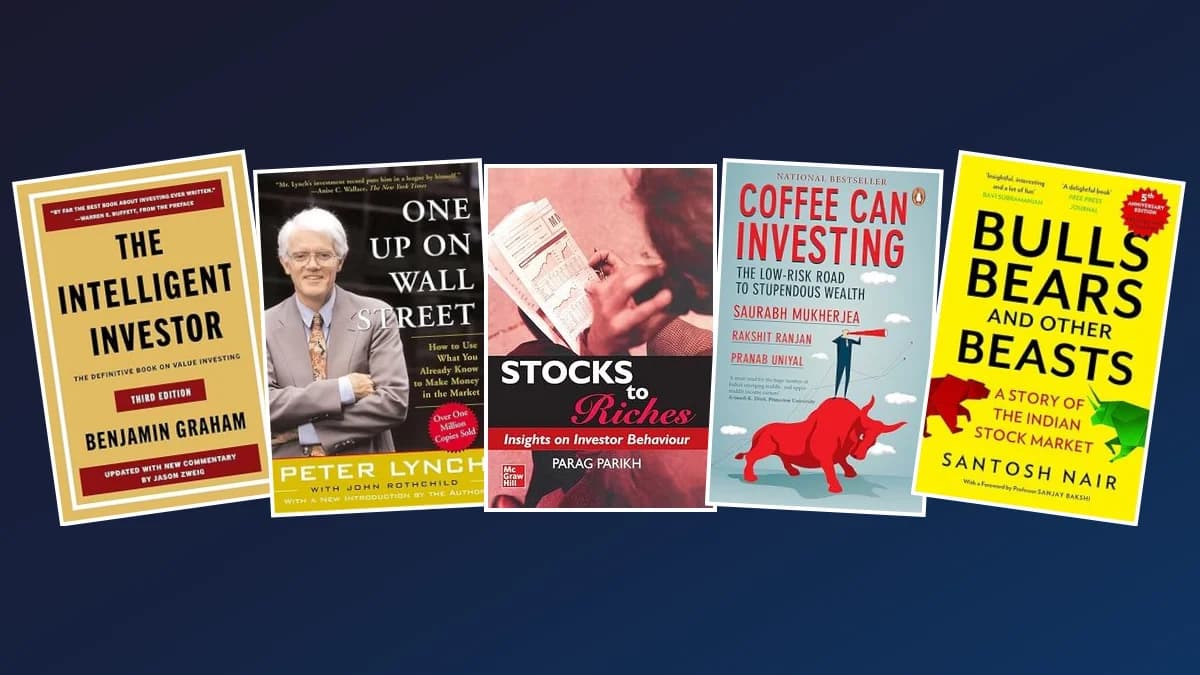
We've curated 8 books that every Indian stock market beginner should read — a mix of global investing classics and India-specific guides that understand our markets, regulations, and investor psychology. Whether you're a salaried professional starting a SIP or someone considering direct equity, these books will give you the foundation to invest with confidence.
Quick Comparison
| Book | Author | Best For | Price |
|---|---|---|---|
| The Intelligent Investor | Benjamin Graham | Value investing fundamentals | ~₹500 |
| One Up on Wall Street | Peter Lynch | Finding stocks in everyday life | ₹363 |
| Learn to Earn | Peter Lynch | Absolute beginners | ₹361 |
| Stocks to Riches | Parag Parikh | Indian investor psychology | ₹519 |
| How to Avoid Loss and Earn Consistently | Prasenjit Paul | Practical Indian stock picking | ₹399 |
| Coffee Can Investing | Saurabh Mukherjea | Long-term buy-and-hold strategy | ₹331 |
| The Unusual Billionaires | Saurabh Mukherjea | Analysing great Indian companies | ₹274 |
| Bulls, Bears and Other Beasts | Santosh Nair | Indian market history & stories | ₹395 |
Why Reading Before Investing Matters
SEBI data shows that over 90% of individual traders lose money in the derivatives segment. The pattern is clear — most people enter the market driven by tips, social media hype, or FOMO, without understanding the fundamentals. Books give you a framework: how to evaluate a company, when to buy, when to sell, and most importantly, how to manage your emotions when markets crash.
Think of it as an investment in yourself. A ₹400 book that teaches you to avoid one bad trade could save you lakhs over your investing lifetime. Here are the 8 books we recommend for every Indian beginner.
Our Top 8 Picks
Prices are indicative and were verified in July 2026 — online prices change often, so tap the "Check Price" button for the live amount.

The Intelligent Investor — Benjamin Graham
~₹480
- The original value investing bible, first published in 1949
- Teaches the concept of "margin of safety" — buying stocks below their intrinsic value
- Warren Buffett calls it "the best book on investing ever written"
- Updated commentary by Jason Zweig makes it relevant for modern markets
Key takeaway: The stock market is a voting machine in the short run, but a weighing machine in the long run. Focus on a company's intrinsic value, not its share price.
Who it's for: Anyone who wants to understand value investing — the philosophy behind India's most successful long-term investors.
Check Price on Amazon
One Up on Wall Street — Peter Lynch
~₹370
- Peter Lynch managed Fidelity's Magellan Fund to 29.2% annual returns for 13 years
- Teaches you to find great stocks in everyday life — the brands you use, the shops you visit
- Classifies stocks into 6 types: slow growers, stalwarts, fast growers, cyclicals, turnarounds, and asset plays
- Written in a conversational, humorous style that makes investing fun
Key takeaway: You already know more than you think. The best stock ideas come from your daily observations — the restaurant that's always packed, the product everyone is buying.
Who it's for: Beginners who find financial jargon intimidating. Lynch makes stock picking feel accessible and logical.
Check Price on Amazon
Learn to Earn — Peter Lynch
~₹364
- Written specifically for young and first-time investors
- Covers the history of capitalism, how companies work, and why stocks exist
- Explains the basics: what is a stock, how the stock market works, what drives prices
- Much simpler than "One Up on Wall Street" — a true beginner's starting point
Key takeaway: Before you invest in stocks, understand what a stock actually represents — a share of ownership in a real business.
Who it's for: Complete beginners, college students, and young professionals who are opening their first demat account.
Check Price on Amazon
Stocks to Riches — Parag Parikh
~₹549
- Written by the late Parag Parikh, founder of PPFAS Mutual Fund (now one of India's most respected AMCs)
- Focuses on investor behaviour — why we make irrational decisions with money
- Uses real Indian market examples: Harshad Mehta scam, tech bubble, IPO mania
- Blends behavioural finance with practical Indian investing wisdom
Key takeaway: Your biggest enemy in the stock market isn't volatility — it's your own psychology. Understanding behavioural biases is more important than reading balance sheets.
Who it's for: Indian investors who want to understand why they make bad investment decisions, not just what to invest in.
Check Price on Amazon
How to Avoid Loss and Earn Consistently in the Stock Market — Prasenjit Paul
~₹399
- One of the best-selling stock market books on Amazon India
- Teaches a simple, rules-based approach to picking stocks using financial ratios
- Covers PE ratio, debt-to-equity, ROE, and dividend yield with real Indian company examples
- Short (under 200 pages), practical, and written for the Indian retail investor
Key takeaway: You don't need to be a CA or MBA to analyse stocks. A few key financial ratios can help you separate good companies from bad ones.
Who it's for: Beginners who want a step-by-step, practical approach to picking Indian stocks — no theory overload, just actionable methods.
Check Price on Amazon
Coffee Can Investing — Saurabh Mukherjea
~₹410
- Introduces the "coffee can" strategy: buy great companies and hold them for 10+ years
- Backed by extensive research on Indian stock market data going back decades
- Shows how a portfolio of quality stocks, left untouched, beats most active fund managers
- Covers real estate, mutual funds, and insurance myths alongside equity investing
Key takeaway: The best returns come from doing nothing — buy fundamentally strong companies and resist the urge to sell. Time in the market beats timing the market.
Who it's for: Busy professionals who want a low-maintenance, high-return investing strategy. Pairs perfectly with a SIP calculator for systematic investing.
Check Price on Amazon
The Unusual Billionaires — Saurabh Mukherjea
~₹319
- Deep-dives into 7 Indian companies that delivered 10x+ returns: Asian Paints, HDFC Bank, Marico, Page Industries, Axis Bank, Berger Paints, Astral Poly
- Explains what makes these companies extraordinary — moats, management quality, capital allocation
- Teaches you to identify "greatness" in a company before the market recognises it
- Uses the ROCE (Return on Capital Employed) framework to filter stocks
Key takeaway: Extraordinary returns come from ordinary-looking businesses that do simple things extraordinarily well — consistent revenue growth, high ROCE, and clean governance.
Who it's for: Investors who've understood the basics and now want to learn how to analyse Indian companies like a professional fund manager.
Check Price on Amazon
Bulls, Bears and Other Beasts — Santosh Nair
~₹370
- A narrative history of the Indian stock market told through the eyes of a fictional broker
- Covers every major event: the Harshad Mehta scam, the Ketan Parekh saga, the 2008 crash, demonetisation
- Reads like a novel — entertaining yet deeply educational
- 5th Anniversary Edition includes recent events and updated commentary
Key takeaway: Markets are cyclical. Understanding the history of Indian market crashes and booms helps you stay calm during the next downturn — and recognise opportunities.
Who it's for: Anyone who wants to understand how the Indian stock market actually works — the politics, the operators, the regulators, and the retail investor's role in it all.
Check Price on AmazonHow We Chose These Books
We evaluated over 30 stock market books available on Amazon India using these criteria:
- Beginner-friendly: No prerequisites. You shouldn't need a finance degree to understand the book.
- Proven track record: Authors with real investing experience or market expertise, not social media influencers.
- India-relevant: At least half the list focuses on Indian markets, regulations, and companies — because investing in India is different from investing in the US.
- Actionable: Each book should change how you think about or approach investing, not just add theoretical knowledge.
- Available on Amazon.in: All books are readily available in paperback with good ratings (4+ stars).
Suggested Reading Order
If you're a complete beginner, we recommend this sequence:
- Learn to Earn → Understand what stocks and markets actually are
- The Intelligent Investor → Build a value investing mindset
- One Up on Wall Street → Learn to spot opportunities around you
- Stocks to Riches → Understand Indian investor psychology
- How to Avoid Loss → Get a practical stock-picking framework
- Coffee Can Investing → Develop a long-term strategy
- The Unusual Billionaires → Learn to analyse great Indian companies
- Bulls, Bears and Other Beasts → Understand market cycles and history
Frequently Asked Questions
Which is the best stock market book for complete beginners?
Learn to Earn by Peter Lynch is the best starting point. It explains the fundamentals of capitalism, stocks, and markets in simple language without assuming any prior knowledge. Follow it up with One Up on Wall Street for stock-picking strategies.
Should I read Indian or international stock market books?
Both. International classics like The Intelligent Investor teach timeless principles — value investing, margin of safety, emotional discipline. Indian books like Stocks to Riches and Coffee Can Investing apply these principles to Indian markets, regulations (SEBI, taxation), and companies (Nifty 50, BSE). Our list includes 4 Indian and 4 international books for this reason.
Can books really help me make money in the stock market?
Books won't give you hot stock tips. What they give you is a framework for thinking. Understanding concepts like PE ratio, ROCE, margin of safety, and compounding helps you make better decisions and avoid costly mistakes. Use our compound interest calculator to see how even small improvements in returns add up over decades.
How much should I invest in books before starting to invest?
The total cost of all 8 books on this list is under ₹3,500. That's less than one month's SIP for most beginners. Read at least 2-3 books before putting real money in the market. Start with a SIP in index funds (use our SIP calculator) while you're still reading — that way you learn and invest simultaneously.
Are these books relevant in 2026 with AI and algo trading?
More relevant than ever. AI and algorithms trade on short-term patterns — retail investors compete by having a long-term horizon and behavioural discipline, exactly what these books teach. The fundamentals of value investing, compounding, and business analysis haven't changed in 75 years.
Start Your Investing Journey
The stock market rewards patience, discipline, and knowledge. These 8 books will give you the foundation to invest with confidence — whether you choose SIPs in mutual funds, direct equity, or a mix of both. Start reading today and complement your learning with our lumpsum calculator and compound interest calculator to see the power of long-term investing.
Disclaimer: This article contains affiliate links to Amazon.in. If you purchase through these links, we earn a small commission at no extra cost to you. All recommendations are based on our independent editorial judgement. Prices may vary — check Amazon for the latest pricing.
Related Guides
- Best Personal Finance Books for Beginners — build the money mindset first.
- How to Start Investing in Stocks — open a demat account and place your first trade.
- Mutual Funds for Beginners — the simpler route into equity for most people.
Written by
Jaspal Singh
Founder & Editor
Personal finance writer helping Indians make smarter money decisions through clear, jargon-free guides on taxes, investments, and budgeting.
More Best Picks

Best Credit Cards in India: Top 10 Cards Ranked
We compared 24 credit cards across cashback rates, annual fees, rewards, and perks. Here are the 10 best credit cards in India for every spending style — from cashback kings to lifetime-free gems.

Best Pressure Cookers in India (2026)
Compare the top 8 pressure cookers from Prestige, Hawkins, and Pigeon — stainless steel, hard anodised, and triply options with prices, features, and honest recommendations.

Best Washing Machines in India (2026)
Compare the top 8 fully-automatic 5-star washing machines from Samsung, LG, IFB, Haier, Whirlpool, and Panasonic — with prices, features, and honest recommendations.