Axis Flipkart Credit Card Review: Best for Flipkart Shoppers?
Jaspal Singh
Author
Affiliate Disclosure: Some links on this page are partner links. If you apply for a card through them, Your Finances may earn a commission at no extra cost to you. We are not affiliated with, and are not paid by, the card issuer to write favourably. Fees and features are taken from the issuer's own published terms and can change without notice — always confirm on the issuer's website before applying. Nothing here is personalised financial advice.
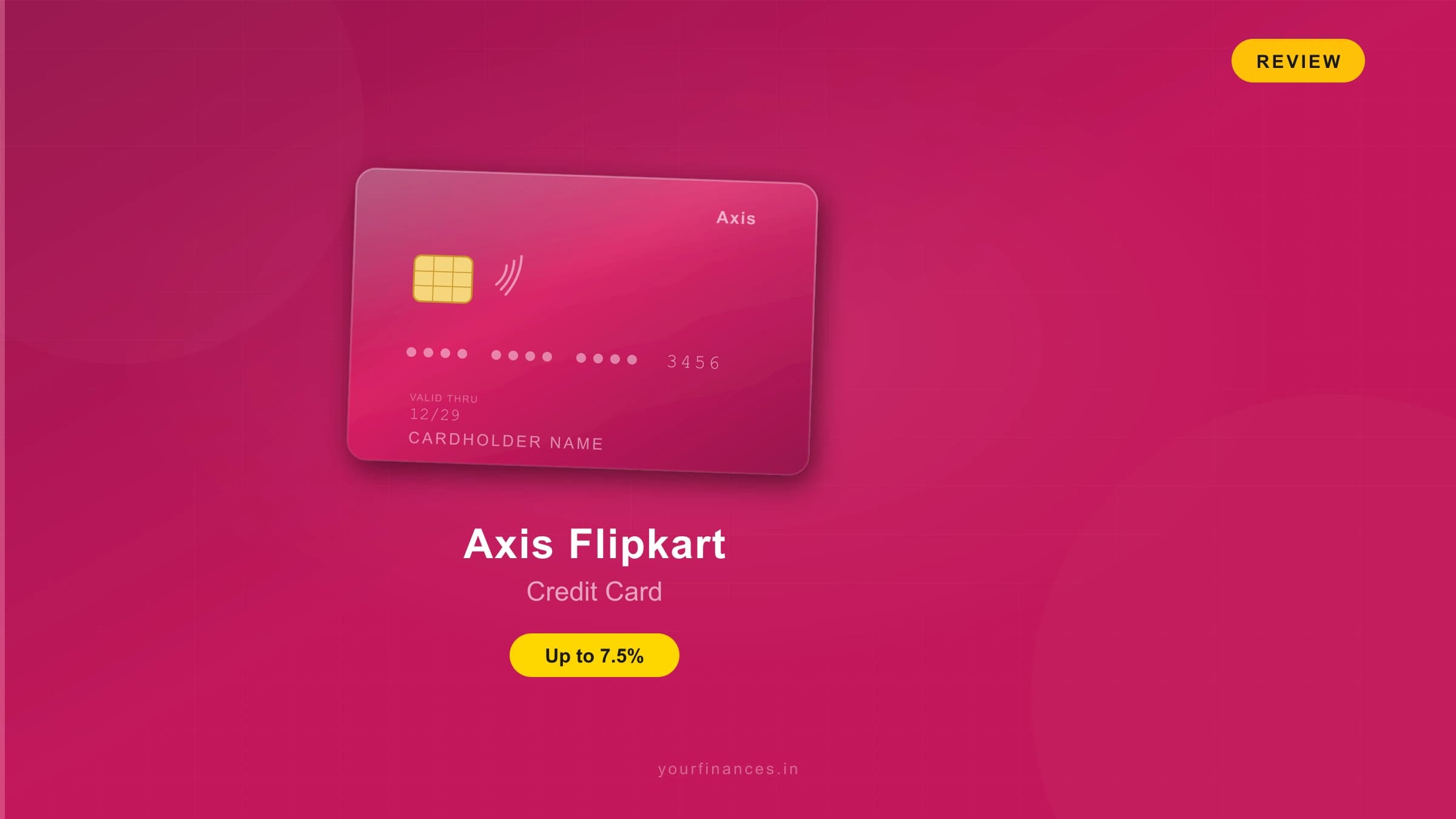
The Flipkart Axis Bank Credit Card is usually described as a Flipkart card. That undersells it and, oddly, misdescribes it. Axis's own footnote calls it "a multi-cobranding partner arrangement comprising of Flipkart, Myntra and Cleartrip" — and the highest cashback rate on the card is not on Flipkart at all. It is 7.5% on Myntra.
Whether that makes it a good card for you depends almost entirely on how much of your shopping happens on Myntra, and whether you understand two limits that Axis discloses but does not advertise.
The actual earn structure
From Axis Bank's published value chart for this card:
| Where you spend | Cashback rate |
|---|---|
| Myntra | 7.5% (capped at ₹4,000 per statement quarter) |
| Flipkart and Cleartrip | 5% |
| Preferred merchants | 4% |
| Everything else | 1% |
| Fuel | 1% surcharge waiver |
The joining fee is currently nil as a limited period offer. The annual fee is ₹500 from the second year, waived if you spend more than ₹3,50,000 in the year. Welcome benefits are stated as ₹350 of activation value.
Two limits worth knowing before you apply
1. The Myntra cap is ₹4,000 a quarter
The headline 7.5% is real, but capped at ₹4,000 of cashback per statement quarter. Work backwards: ₹4,000 ÷ 7.5% means the cap binds once your Myntra spending passes roughly ₹53,000 in a quarter. Below that, you get the full rate. Above it, additional Myntra spending stops paying the accelerated rate.
For most people this is a generous ceiling — ₹16,000 a year of cashback from one merchant is a lot. It matters only if you are a very heavy Myntra shopper, in which case plan your large purchases across quarters rather than bunching them.
2. Rent and wallet loads do not count towards the fee waiver
This is the one that catches people. The ₹500 annual fee is waived at ₹3,50,000 of annual spending — but Axis explicitly excludes rent transactions (MCC 6513) and wallet load transactions (MCC 6540) from the spend counted towards that waiver.
Paying rent on a credit card to hit a spending threshold is a common tactic. It does not work here. Worse, rent transactions also attract a 1% fee per transaction in their own right, so you would be paying to accumulate spending that does not count.
What Axis's "6% return" assumes
Axis publishes a total annual benefit of ₹21,730 on ₹3,63,000 of spending, which it summarises as 6%. The arithmetic is correct. The assumptions are worth reading:
| Category | Assumed annual spend | Return |
|---|---|---|
| Myntra | ₹1,00,000 | ₹7,500 cashback |
| Flipkart and Cleartrip | ₹90,000 | ₹4,500 cashback |
| Preferred merchants | ₹35,000 | ₹1,400 cashback |
| Other spends | ₹80,000 | ₹800 cashback |
| Dining | ₹40,000 | ₹500 cashback + ₹6,000 in discounts |
| Fuel | ₹18,000 | ₹180 surcharge waiver |
| Welcome benefits | — | ₹350 |
| Annual fee waiver | — | ₹500 |
| Total | ₹3,63,000 | ₹21,730 |
Two things stand out. First, the model puts ₹1,00,000 a year on Myntra — over a quarter of all spending, on clothes. If your wardrobe budget is smaller, your return drops sharply, because everything outside the partner merchants earns just 1%.
Second, ₹6,000 of the ₹21,730 — more than a quarter of the total — is a dining discount, not cashback. You only collect it by eating at participating restaurants through the card's dining programme. It is real, but it is not money in your account.
Third, and this is a pattern worth recognising across issuers: total assumed spending of ₹3,63,000 sits just above the ₹3,50,000 fee-waiver threshold. The illustration is constructed to clear its own bar by ₹13,000.
Strip out the dining discount and the welcome benefit, and the cash return on ₹3,63,000 of spending is ₹14,700 — a genuinely good 4.05%, but only for someone whose spending really is half Flipkart, Myntra and Cleartrip.
The fee table
| Charge | Amount |
|---|---|
| Joining fee | Nil (limited period offer) |
| Annual fee | ₹500 from the second year |
| Annual fee waiver | Annual spends above ₹3,50,000, excluding rent and wallet loads |
| Add-on card fees | Nil |
| Card replacement | Nil |
| Finance charges | 3.75% per month (55.55% per annum) |
| Cash withdrawal | 2.5%, minimum ₹500 |
| Cash payment fee | ₹175 |
| Foreign currency transaction fee | 3.5% |
| Dynamic currency conversion markup | 1.5% |
| Rent transaction fee | 1% per transaction |
| Education transaction fee | 1% per transaction |
| Over limit penalty | 2.5% of the over-limit amount, minimum ₹500 |
Late payment charges are tiered: nil under ₹500 due, ₹500 up to ₹5,000, ₹750 up to ₹10,000 and ₹1,200 above that, with an extra ₹100 per cycle if you miss the minimum amount due twice in a row.
Cleartrip is on the card, but this is not a travel card
The 5% on Cleartrip is useful for domestic bookings. The 3.5% foreign currency fee means that as soon as you are spending in another currency, this card costs you more than most alternatives return. Book your flights with it; do not carry it abroad.
Who should carry this card
It is close to ideal for a specific and fairly common Indian shopper: someone who buys clothes on Myntra, electronics and household goods on Flipkart, books domestic travel on Cleartrip, and would like the annual fee to disappear. At nil joining fee, the first year is genuinely free, so the trial costs nothing.
It is a poor fit if your online shopping is mostly on other platforms, if you were counting on rent payments to hit the fee waiver, or if you spend materially abroad.
For alternatives across issuers see our best credit cards in India guide. If you are weighing a big Flipkart purchase on EMI, the EMI calculator will show you the true cost, and our credit cards guide covers how the interest-free period actually works.
Verdict
A strong category card wearing co-brand clothing, and better than its reputation — the Myntra rate is the best thing on it and the one most reviews bury. Take it while the joining fee is nil, use it for the three partner brands, and put everything else on a card that pays more than 1%.
Frequently Asked Questions
What is the highest cashback rate on the Flipkart Axis Bank card?
7.5% on Myntra, capped at ₹4,000 per statement quarter. Flipkart and Cleartrip earn 5%, preferred merchants 4%, and all other spending 1%.
Is there a joining fee?
Not currently — Axis lists it as nil under a limited period offer. The annual fee of ₹500 applies from the second year.
How do I get the annual fee waived?
Spend more than ₹3,50,000 in the year. Rent transactions (MCC 6513) and wallet loads (MCC 6540) are excluded from that calculation.
Does paying rent with this card help me reach the waiver?
No. Rent is excluded from the qualifying spend and additionally attracts a 1% transaction fee, so it costs you money without moving you towards the waiver.
Can I really earn 6% back?
That figure is Axis's own, calculated on ₹3,63,000 of annual spending that includes ₹1,00,000 on Myntra and a ₹6,000 dining discount. The pure cashback component is ₹14,700, or about 4.05%, and only if your spending matches their category mix.
Is it good for international spending?
No. The foreign currency transaction fee is 3.5%, with a further 1.5% markup on dynamic currency conversion.
When does the Myntra cap reset?
Every statement quarter. The ₹4,000 ceiling binds at roughly ₹53,000 of Myntra spending in a quarter, so spreading large purchases across quarters preserves the full 7.5%.
Part of our study: this card is one of ten examined in What Indian Credit Cards Claim vs What Their Own Numbers Show — a comparison of advertised annual value against each issuer's own published caps, point values and value charts.
Disclaimer: Fees, cashback rates and caps in this review were taken from Axis Bank's published Flipkart Axis Bank Credit Card page on 28 July 2026 and can change without notice. Figures described as Axis's own are the bank's stated values under its own spending assumptions. This is general information, not personalised financial advice. Confirm all terms with the issuer before applying.