Oil Shock: Which Indian Sectors Are Hit the Hardest?
Jaspal Singh
Author
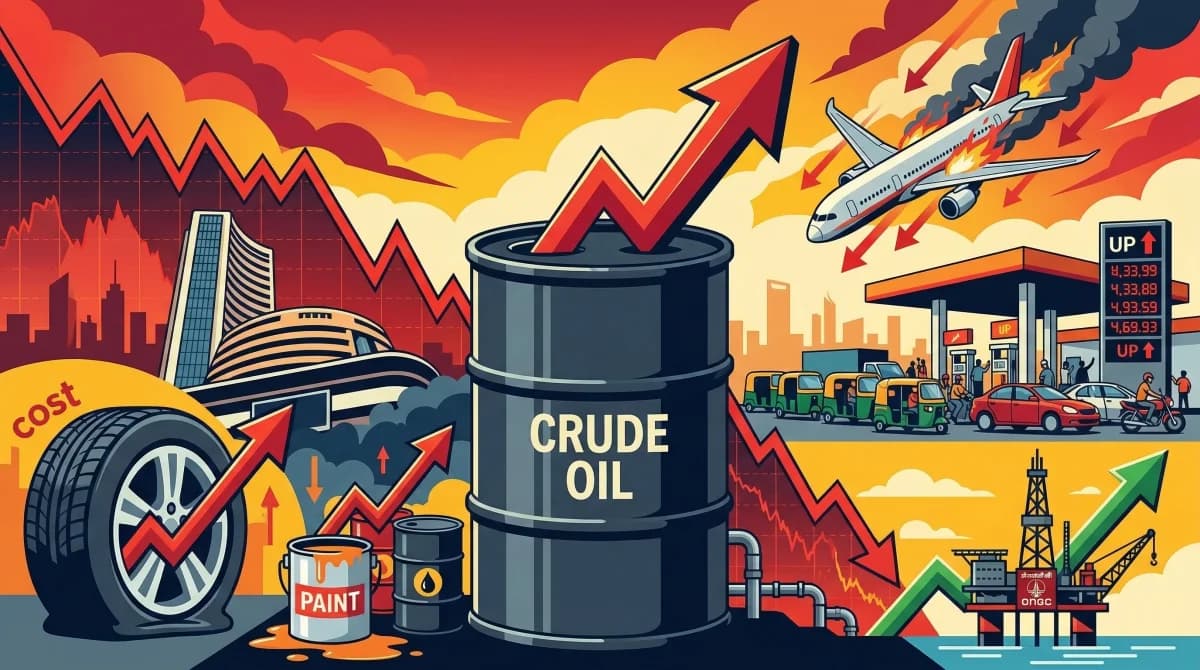
Imagine you run a lemonade stand. You buy lemons, sugar, and cups every day. One morning, the price of lemons suddenly doubles because a big storm destroyed half the lemon farms. Your costs shoot up, but your customers still expect lemonade at the same price. That's roughly what's happening to many Indian companies right now — except instead of lemons, the problem is crude oil.
In the first week of March 2026, Brent crude oil surged past $116 per barrel — up a staggering 78% from its February close of $67. The trigger? A full-blown military conflict between the US, Israel, and Iran that has effectively shut down the Strait of Hormuz, the narrow waterway through which roughly 31% of all seaborne crude oil flows globally.
For India, this is a big deal. We import over 85% of our crude oil, and about half of those imports come through the Strait of Hormuz. Every $1 increase in crude oil prices adds roughly $2 billion to India's annual oil import bill. So when oil jumps by $50 in a matter of days, the impact on Indian businesses — and their stock prices — is enormous.
Let's break down, sector by sector, who's getting hurt the most and who's quietly celebrating.
1. Oil Marketing Companies (OMCs) — The Biggest Losers
Think of oil marketing companies like shopkeepers who buy petrol and diesel at international prices and sell them to you at the petrol pump. When crude oil prices spike, their buying cost goes up instantly. But they can't raise petrol and diesel prices freely because the government often asks them to hold prices steady to control inflation.
The result? They sell fuel at a loss on every litre.
Here's how the big three OMC stocks performed on March 9, 2026:
CompanyStock Price (9 Mar)FallHPCL₹370.10-8.67%BPCL₹326.25-7.49%Indian Oil (IOC)₹156.30-7.29%
Global brokerage UBS downgraded all three — cutting IOC and BPCL to 'Neutral' and HPCL to 'Sell'. Target prices were slashed: IOC from ₹190 to ₹175, BPCL from ₹425 to ₹365, and HPCL from ₹540 to just ₹340.
The reasoning is straightforward: with limited scope for retail fuel price hikes and the rupee also weakening, integrated refining-plus-marketing margins are getting squeezed from both sides.
2. Aviation Stocks — Turbulence Ahead
If you've ever wondered why flight tickets get expensive sometimes, here's a clue: jet fuel (called ATF) makes up about 40% of an airline's operating costs. When crude oil doubles, jet fuel prices follow, and airlines either raise ticket prices (losing passengers) or absorb the cost (losing profits). Either way, investors don't like it.
On March 9, 2026, aviation stocks hit 52-week lows:
IndiGo (InterGlobe Aviation) — crashed 8% in a single day
SpiceJet — fell nearly 9% over the week
Air India — faces an estimated 40% revenue hit from West Asia flight suspensions
HSBC estimates that every $1/barrel increase in jet fuel raises IndiGo's annual fuel bill by about ₹300 crore and SpiceJet's by ₹27.5 crore. With crude up by over $50 in a matter of days, you can do the maths — we're talking thousands of crores in additional costs.
Adding to the pain, Indian airlines have cancelled nearly 179 flights due to airspace disruptions over the Middle East, including 86 Air India flights and 72 IndiGo flights.
3. Paint Stocks — The Surprising Victim
Most people don't connect a can of paint to an oil barrel, but here's the thing: key paint ingredients like solvents, resins, and titanium dioxide are all derived from crude oil. When crude prices spike, paint companies' raw material costs shoot up.
On March 9, 2026:
Asian Paints — fell 5.12%
Indigo Paints — dropped 4.83%
Berger Paints — lost 4.80%
Kansai Nerolac — declined 4.72%
Over the past month, the damage has been even worse: Kansai Nerolac is down 11%, Shalimar Paints has nosedived over 14%, and Berger Paints has lost about 7%.
HSBC lowered its target price on Asian Paints from ₹2,900 to ₹2,600, maintaining a cautious 'Hold' rating. The problem is that paint companies are already dealing with weak demand and intense competition — making it harder to pass on higher costs to consumers.
4. Tyre Stocks — Double Whammy
Tyre companies face a unique problem: about 90% of their raw materials are commodities. Roughly 45% of input costs come from crude oil derivatives (synthetic rubber and chemicals), and another 45% from natural rubber. When both crude and rubber prices rise together, it's a double whammy.
Here's how tyre stocks were battered on March 9:
CompanyFallJK Tyre-8.25%CEAT-5.07%Apollo Tyres-4.30%Balkrishna Industries-4.00%MRF-3.00%
CLSA estimates a 15-20% increase in raw material costs across the tyre industry. While companies will try gradual price hikes, margins will take a significant hit in the near term.
5. Chemical Stocks — Supply Chain Fears
India's chemical sector is heavily dependent on crude oil and natural gas as feedstock. Many petrochemical products are literally made from crude derivatives. Higher input costs directly eat into profitability.
On March 9, chemical stocks like UPL, Deepak Fertilisers, and SRF fell up to 6%. Emkay Global warned that the Iran war could disrupt chemical supply chains significantly.
The concern goes beyond just cost. India sources about 50-55% of its LNG from the Middle East, and LNG prices have already surged by 150%. Companies like Aarti Industries, which derives 23% of revenue from the Middle East, face both higher input costs and potential demand disruption.
6. Who Benefits? — Upstream Oil Producers
Not every oil-related stock is suffering. Companies that produce crude oil — rather than buying it — are having a great time. Higher oil prices mean they earn more for every barrel they pump out of the ground.
ONGC — rose 4.73%; every $1/barrel rise in crude boosts ONGC's earnings by about 1.5-2%
Oil India — gained 4.43%
Reliance Industries — jumped 3%; benefits from higher diesel crack spreads and improved petrochemical margins
Analysts note that RIL's correction has been overdone — the company won't be negatively impacted like OMCs because its refining business actually earns more when margins are volatile, and its petrochemical arm benefits from rising product prices.
The Bigger Picture for India
India currently holds an estimated 100 million barrels in strategic oil reserves — enough for about 40-45 days of consumption. But with the Strait of Hormuz seeing a 70-90% drop in tanker traffic, these reserves could deplete faster than expected.
According to ICICI Securities, if Brent crude sustains above $100, the Nifty50 could see another 10% correction from current levels. The Sensex has already slid to 10-month lows, closing at 77,566 on March 9.
For the Indian economy, higher oil prices mean:
Higher inflation — everything from transport to food gets costlier
Wider current account deficit — we pay more foreign currency for oil imports
Weaker rupee — more dollars going out puts pressure on the rupee
Tighter RBI policy — rate cuts get delayed, hurting growth
What Should Investors Do?
Panic selling during a crisis is rarely a good idea. Here's a more thoughtful approach:
Don't stop your SIPs. In fact, market dips are when SIPs work their magic — you buy more units at lower prices. Use our SIP Calculator to see how staying consistent through volatility actually boosts long-term returns.
Consider upstream oil stocks like ONGC or Oil India if you want short-term crude-price exposure.
Avoid catching falling knives in OMCs and aviation — wait for clarity on oil price direction before buying dips.
If you have lump sum cash, deploy it gradually rather than all at once. A staggered approach reduces risk during uncertain times. Check our Lumpsum Calculator to plan your investments.
Diversify. IT and pharma sectors have limited crude oil exposure and may offer relative safety.
Key Takeaway
Oil above $100 is painful for India. From the paint on your walls to the tyres on your car, from your flight tickets to the petrol in your tank — crude oil touches everything. The current crisis driven by the US-Iran-Israel conflict and the Strait of Hormuz disruption is a sharp reminder of how dependent India's economy is on imported oil.
But every crisis also creates opportunities. Stay informed, stay invested, and let time work in your favour.
Disclaimer: This article is for educational and informational purposes only. It does not constitute financial advice, stock recommendations, or an endorsement to buy or sell any securities. Stock markets are subject to risks. Past performance is not indicative of future results. Please consult a SEBI-registered financial advisor before making any investment decisions.
Written by
Jaspal Singh
Helping Indians make better financial decisions through simple, actionable advice.
Continue Reading

Bandhan Bank Stock Rallies 10%: Should You Buy Now?
Bandhan Bank shares surged 10% in 5 sessions on strong Q3 results and microfinance recovery. Here's what drove the rally, key fundamentals, and whether you should invest now.
Defence Stocks Surge in India Amid Iran War Tensions
Defence stocks like HAL, BEL, and Bharat Dynamics are surging as the Iran war escalates. Here's why defence companies benefit from geopolitical tensions and whether you should invest now.

Bandhan Bank Share Rally: 10% Gains in 5 Sessions
Bandhan Bank shares have surged 10% over five consecutive sessions in March 2026, reaching Rs 190.20 despite broader market weakness. Here's what's driving the rally and whether you should consider buying.