New Tax Regime Default from April 2026: What Changes
Jaspal Singh
Author
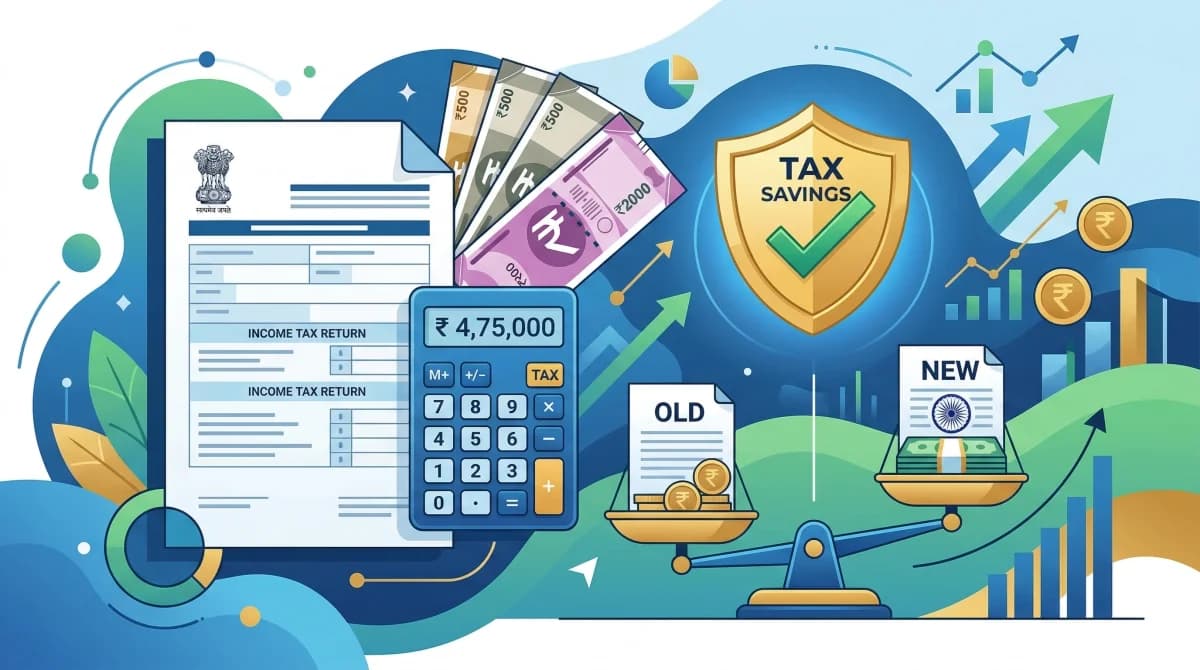
Big news for every taxpayer in India. Starting April 1, 2026, the New Tax Regime becomes the default income tax system. This means unless you specifically choose the Old Tax Regime, you will automatically be placed under the New Tax Regime.
But what does this actually mean for your salary, your investments, and your tax bill? Let's break it down in plain, simple language — no jargon, no confusion.
What Changed in Budget 2025?
Finance Minister Nirmala Sitharaman announced major income tax relief in the Union Budget 2025-26. Here are the key changes that take effect from FY 2025-26 (Assessment Year 2026-27):
Zero tax on income up to Rs 12,00,000 under the New Tax Regime (thanks to a Rs 60,000 rebate under Section 87A)
Standard Deduction increased to Rs 75,000 for salaried employees and pensioners
Salaried individuals earning up to Rs 12,75,000 effectively pay zero tax
New, lower tax slabs with rates starting from just 5%
The New Tax Regime is now the default option — you don't need to do anything to opt in
Think of it like this: imagine your school changed the lunch menu. The new menu is now the default. If you still want the old menu, you have to raise your hand and ask for it. That's exactly how the New Tax Regime works now.
New Tax Regime Slabs for FY 2025-26
Here are the updated income tax slabs under the New Tax Regime. These are simpler, with more slabs but lower rates:
Income Slab (Per Year)Tax Rate
Up to Rs 4,00,000Nil (0%)
Rs 4,00,001 – Rs 8,00,0005%
Rs 8,00,001 – Rs 12,00,00010%
Rs 12,00,001 – Rs 16,00,00015%
Rs 16,00,001 – Rs 20,00,00020%
Rs 20,00,001 – Rs 24,00,00025%
Above Rs 24,00,00030%
Important: If your total income is up to Rs 12,00,000, you get a full rebate under Section 87A of Rs 60,000. This means your tax bill becomes zero. Add the Rs 75,000 standard deduction for salaried people, and you can earn up to Rs 12,75,000 without paying a single rupee in tax.
You can calculate your exact tax liability using our Income Tax Calculator.
Old Tax Regime Slabs (Still Available)
The Old Tax Regime hasn't changed. It still has fewer slabs but higher rates. However, it allows deductions like Section 80C, HRA, home loan interest, and more.
Income Slab (Per Year)Tax Rate
Up to Rs 2,50,000Nil (0%)
Rs 2,50,001 – Rs 5,00,0005%
Rs 5,00,001 – Rs 10,00,00020%
Above Rs 10,00,00030%
Note for senior citizens (60-79 years): The basic exemption is Rs 3,00,000. For super senior citizens (80+ years), it is Rs 5,00,000.
Old Regime vs New Regime: Side-by-Side Comparison
Here's a simple comparison to help you decide which regime works better for you:
FeatureNew Tax Regime (Default)Old Tax Regime
Basic ExemptionRs 4,00,000Rs 2,50,000
Standard DeductionRs 75,000Rs 50,000
Section 87A RebateRs 60,000 (income up to Rs 12L)Rs 12,500 (income up to Rs 5L)
Zero Tax Income (Salaried)Up to Rs 12,75,000Up to Rs 5,00,000
Section 80C (PPF, ELSS, LIC)Not allowedUp to Rs 1,50,000
Section 80D (Health Insurance)Not allowedUp to Rs 25,000 (+ Rs 50,000 for senior parents)
HRA ExemptionNot allowedAllowed
Home Loan Interest (Sec 24b)Not allowedUp to Rs 2,00,000
NPS (Sec 80CCD(1B))Not allowedAdditional Rs 50,000
NPS Employer Contribution (Sec 80CCD(2))Allowed (up to 14% of salary)Allowed (up to 10% of salary)
Tax RatesLower (5% to 30%)Higher (5% to 30%)
Opt-in Required?No (default)Yes (must opt in)
Who Benefits Most from the New Tax Regime?
The New Tax Regime is a clear winner for most Indians. Here's who benefits the most:
1. Salaried Employees Earning Up to Rs 12.75 Lakh
If your gross salary is Rs 12,75,000 or less, you pay absolutely zero tax under the New Regime. No need to invest in tax-saving instruments, no need to submit rent receipts, no paperwork. Simple.
2. People Who Don't Have Many Investments
If you don't invest heavily in PPF, ELSS, NPS, or don't have a home loan, the New Regime gives you lower tax rates without needing any deductions.
3. Young Professionals and Freelancers
If you're early in your career and haven't built an investment portfolio yet, the New Regime's lower rates will save you more money.
4. Anyone Earning Above Rs 24 Lakh
Even for high-income earners, the New Regime can be beneficial because the rates are spread across more slabs, keeping the effective tax rate lower.
When Should You Stick with the Old Regime?
The Old Tax Regime is still available — you just need to opt in. It might be better for you if:
Your total deductions and exemptions exceed Rs 4,25,000 per year
You have a home loan with interest exceeding Rs 2 lakh
You pay significant HRA (rent in metro cities)
You invest heavily in PPF (PPF Calculator), ELSS, NPS (NPS Calculator), and health insurance
You are a senior citizen with higher exemption limits
Rule of thumb: If your total investments and deductions add up to more than Rs 4.25 lakh per year, compare both regimes using our Tax Calculator before deciding.
A Simple Example: Rs 15 Lakh Salary
Let's say Priya earns Rs 15,00,000 per year. Here's how her tax compares:
Under New Tax Regime
Gross Salary: Rs 15,00,000
Less: Standard Deduction: Rs 75,000
Taxable Income: Rs 14,25,000
Tax on Rs 4L: Nil
Tax on Rs 4L–8L: Rs 20,000 (5%)
Tax on Rs 8L–12L: Rs 40,000 (10%)
Tax on Rs 12L–14.25L: Rs 33,750 (15%)
Total Tax: Rs 93,750 (+ 4% cess = Rs 97,500)
Under Old Tax Regime (with deductions)
Gross Salary: Rs 15,00,000
Less: Standard Deduction: Rs 50,000
Less: Section 80C (PPF, ELSS): Rs 1,50,000
Less: Section 80D (Health Insurance): Rs 25,000
Less: NPS 80CCD(1B): Rs 50,000
Taxable Income: Rs 12,25,000
Tax on Rs 2.5L: Nil
Tax on Rs 2.5L–5L: Rs 12,500 (5%)
Tax on Rs 5L–10L: Rs 1,00,000 (20%)
Tax on Rs 10L–12.25L: Rs 67,500 (30%)
Total Tax: Rs 1,80,000 (+ 4% cess = Rs 1,87,200)
In this example, Priya saves Rs 89,700 by choosing the New Tax Regime — even though she maxes out her 80C, 80D, and NPS deductions under the Old Regime!
What You Should Do Before April 1, 2026
Here's your action plan:
Step 1: Calculate Your Tax Under Both Regimes
Use our Income Tax Calculator to compare your tax liability under both the New and Old regimes. Plug in your salary, deductions, and investments.
Step 2: Inform Your Employer (If Choosing Old Regime)
If you want the Old Tax Regime, you must tell your employer at the start of the financial year. Otherwise, they will deduct TDS based on the New Regime by default.
Step 3: Review Your Investments
If the New Regime saves you more tax, you don't need to invest in tax-saving instruments just for deductions. But that doesn't mean you should stop investing! Consider these for wealth creation:
PPF — still one of the safest investments with tax-free returns (PPF Calculator)
NPS — excellent for retirement planning, and employer contributions are still deductible under the New Regime (NPS Calculator)
ELSS Mutual Funds — short 3-year lock-in, potential for 12-15% returns
Health Insurance — essential financial protection regardless of tax benefits
Step 4: File on Time
Salaried employees can switch between regimes every year. Self-employed and business owners can switch only once. Make sure you file your return on time to avoid penalties.
Other Tax Changes You Should Know
Budget 2025-26 also brought these changes:
TCS on foreign education and medical expenses reduced from 5% to 2%
Form 15G/15H simplified — submit once through NSDL/CDSL, and it auto-applies across all institutions
Share buyback taxation — now taxed at a concessional rate of 12.5% for individuals
Sovereign Gold Bonds (SGBs) — secondary market purchases now subject to capital gains tax
New Income Tax Act effective from April 1, 2026, replacing the 1961 Act with simplified language
For the full details, you can visit the official Income Tax India website.
The Bottom Line
The New Tax Regime is designed to be simpler, with lower rates and zero tax for income up to Rs 12 lakh. For most salaried Indians earning up to Rs 12.75 lakh, it's a straightforward win — no tax, no hassle.
For higher earners, it depends on how many deductions you claim. But even then, many people will find the New Regime more beneficial.
The smartest thing you can do right now? Run the numbers. Use our Tax Calculator to compare both regimes with your actual salary and investments. Don't guess — calculate.
Remember: invest for wealth creation, not just for tax saving. Your future self will thank you.
Disclaimer: This article is for informational purposes only and does not constitute financial or tax advice. Tax laws and regulations are subject to change. Please consult a qualified tax professional or chartered accountant before making any financial decisions. For official information, visit incometaxindia.gov.in.
Written by
Jaspal Singh
Helping Indians make better financial decisions through simple, actionable advice.
Continue Reading

Navigating the Future of Taxes: A Deep Dive into India's New Income Tax Bill, 2025
Big changes are on the horizon for India's taxpayers. In a landmark move, the Indian Parliament has passed the Income Tax (No. 2) Bill, 2025, a comprehensive piece of legislation designed to replace t...
Tax Loss Harvesting: A Kid-Friendly Guide to Saving Money on Stock Market Profits
Have you ever heard grown-ups talking about the stock market and taxes? It might sound complicated, but today we're going to learn about something called tax loss harvesting in a way that's easy to un...

How to File Income Tax Returns Online in India: A Step-by-Step Guide
Filing income tax returns is a crucial financial responsibility for every Indian taxpayer. With the digital transformation of government services in India, the Income Tax Department has made significa...