Gold Price Crash in India March 2026: What Happened?
Jaspal Singh
Author
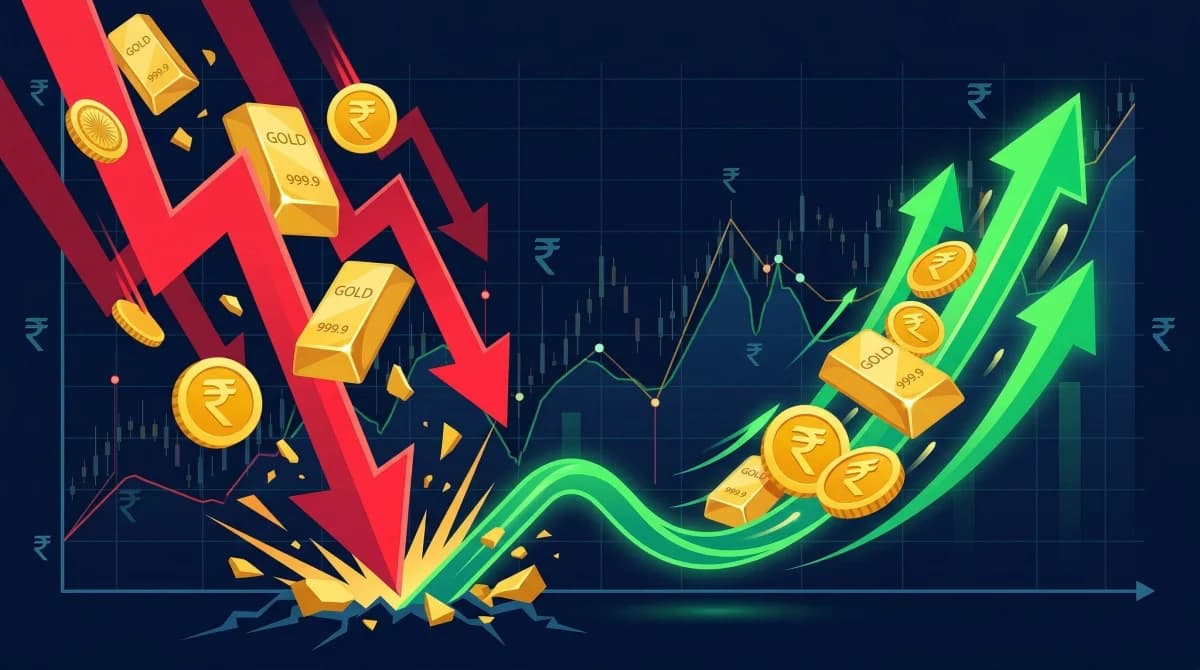
If you have been watching gold prices this week, you probably felt like you were on a roller coaster. In just five trading days, 24 karat gold in India crashed by over Rs 1.1 lakh per 100 grams. That is a massive fall. And then, almost out of nowhere, gold bounced back over 2% in a single day.
So what is going on? Why did gold fall so hard, and why did it jump right back up? Let us break it all down in simple language.
The 5-Day Gold Crash: What the Numbers Say
Between March 2 and March 6, 2026, gold prices in India fell for five consecutive trading sessions. Here is how the decline played out day by day for 24K gold per 100 grams:
March 4: Dropped Rs 31,100 — the sharpest single-day fall
March 5: Fell another Rs 16,300
March 6: Slipped Rs 7,700 more
By the end of March 6, 24 karat gold had lost approximately Rs 1,09,800 to Rs 1,19,600 per 100 grams from its recent highs. To put that in everyday terms, if you owned 100 grams of gold, you would have seen over one lakh rupees vanish from its value in less than a week.
For 10 grams of 24K gold — the standard unit most Indians track — prices settled around Rs 1,61,130 to Rs 1,63,200 depending on the city. That is roughly a 6.9% decline from where gold stood on March 1.
Why Did Gold Prices Crash?
Three big reasons came together to push gold down:
1. Profit-Taking After Record Highs
Gold had been on an incredible run. In January 2026, international gold hit a record of $5,608.35 per ounce. That is a price level nobody expected even a year ago. When something goes up that fast, many investors — especially big institutional players — start selling to lock in their profits. Think of it like this: if you bought a toy for Rs 100 and it suddenly became worth Rs 500, you might want to sell it before the price drops. That is exactly what happened.
2. The US-Iran Conflict Factor
This is where it gets interesting. On February 28, 2026, the United States and Israel launched coordinated military strikes on Iranian targets. You would think that war and crisis would make gold prices go up, right? And initially, they did — gold surged past $5,300 per ounce in panic buying after the strikes.
But here is the tricky part. Once the initial shock passed, investors realized they had pushed prices too high too fast. The US dollar also strengthened because America is seen as a safe economy even during wars. A stronger dollar makes gold more expensive for buyers using other currencies (like the rupee), so demand dipped.
3. Reduced Safe-Haven Demand (Temporarily)
Once markets digested the news of the conflict, the panic subsided. Traders shifted from "buy everything safe" mode to a more calculated approach. Gold, which had been bought in a frenzy, was sold off as some investors moved their money elsewhere.
The Sudden Rebound: Gold Bounces Back 2%
Just when it looked like gold might keep falling, March 7 brought a sharp reversal. International gold prices rebounded over 2% to approximately $5,181 per ounce, bouncing from a support level of $5,071.
What caused the bounce? The Middle East crisis escalated further. As tensions between the US, Israel, and Iran showed no signs of cooling down, investors rushed back to gold as a safe haven. This is the classic pattern: when the world feels uncertain, people buy gold.
In India, domestic gold prices on March 7 held steady around:
24K Gold: Rs 1,61,130 to Rs 1,63,200 per 10 grams
22K Gold: Rs 1,47,700 to Rs 1,48,738 per 10 grams
18K Gold: Rs 1,20,850 per 10 grams
City-Wise Gold Prices on March 7, 2026
Gold prices vary slightly from city to city due to local taxes, transportation costs, and dealer margins. Here are the 24K gold rates per 10 grams in major Indian cities:
Delhi: Rs 1,61,280
Mumbai: Rs 1,61,130
Chennai: Rs 1,63,200 (usually the highest due to premium demand)
Bangalore: Rs 1,61,130
Kolkata: Rs 1,61,130
Hyderabad: Rs 1,61,130
Pune: Rs 1,61,130
Chennai consistently commands a premium because of Tamil Nadu's strong cultural tradition of gold buying, especially during wedding and festival seasons.
What Does This Mean for You as an Investor?
If you are someone who owns gold — whether physical gold, Sovereign Gold Bonds (SGBs), gold ETFs, or digital gold — this week's wild swings probably made you nervous. Here is how to think about it:
If You Already Own Gold
Do not panic. Gold has been one of the best-performing assets over the last two years. Even after this 5-day crash, gold is trading at levels that were considered impossibly high just a year ago. A correction after a massive rally is normal and healthy.
If You Are Thinking of Buying Gold
Dips like this can be good entry points — but do not try to time the bottom. Nobody can predict exactly when gold will stop falling or start rising. A better strategy is to invest through a Systematic Investment Plan (SIP) in gold ETFs or gold mutual funds. You can use our SIP Calculator to see how regular monthly investments grow over time.
How Much Gold Should You Own?
Financial advisors typically recommend that gold should make up 5% to 15% of your total investment portfolio. Gold is not meant to be your primary wealth builder — it is your safety net. Think of gold like an umbrella. You do not use it every day, but when it rains, you are glad you have it.
For long-term wealth creation, a diversified approach works best. Use our Lumpsum Calculator to compare how a one-time investment in equity mutual funds might grow versus gold, or try the Compound Interest Calculator to understand how your money multiplies over different time periods.
Why Gold Remains Important for Indian Families
India is the second-largest consumer of gold in the world. For Indian families, gold is not just an investment — it is tradition, security, and sometimes even a form of savings passed down through generations.
The Reserve Bank of India (RBI) itself holds significant gold reserves as part of India's foreign exchange reserves. As of recent data, the RBI holds over 800 tonnes of gold, reflecting how even the central bank views gold as a critical safety asset.
If you prefer government-backed gold investments, Sovereign Gold Bonds (SGBs) issued by the RBI offer a unique advantage — you earn 2.5% annual interest on top of any gold price appreciation, and there is no capital gains tax if you hold them until maturity.
Where to Buy Gold in India Today
Physical gold: Jewellers like Tanishq, Kalyan Jewellers, and Malabar Gold
Digital gold: Through Google Pay, PhonePe, or Paytm (backed by MMTC-PAMP or Augmont)
Gold ETFs: Through stockbrokers like Zerodha, Groww, or Upstox
Gold mutual funds: Through any mutual fund platform (no demat account needed)
Sovereign Gold Bonds: Through banks, post offices, or stockbrokers when issued by the RBI
Key Takeaway
This week's gold volatility — a Rs 1.1 lakh crash followed by a 2% rebound — is a powerful reminder that no investment moves in a straight line. Gold is a fantastic long-term hedge against uncertainty, but in the short term, it can swing wildly.
The smart approach? Do not react to daily prices. Instead, have a clear plan for how much gold you want in your portfolio, invest regularly through SIPs or SGBs, and let time do the heavy lifting.
Disclaimer: This article is for informational purposes only and does not constitute financial advice. Gold prices are subject to market risks and can fluctuate significantly. Past performance is not indicative of future results. Please consult a qualified financial advisor before making any investment decisions.
Written by
Jaspal Singh
Helping Indians make better financial decisions through simple, actionable advice.
Continue Reading

Bandhan Bank Share Rally: 10% Gains in 5 Sessions
Bandhan Bank shares have surged 10% over five consecutive sessions in March 2026, reaching Rs 190.20 despite broader market weakness. Here's what's driving the rally and whether you should consider buying.

Mutual Fund Outflows in India: What It Means for You
India's mutual funds saw their first net monthly outflow since 2023, rattling headlines. But behind the noise, direct plan investors grew their assets by 43%. Here's what's really going on and what you should do.
Best FD Interest Rates in India – March 2026
Looking for the best fixed deposit rates in March 2026? We compare FD rates across SBI, HDFC, ICICI, and small finance banks — including senior citizen rates, tax rules, and how to pick the right FD for your money.